
Editorial Disclosure: TopDatingFinder is reader-supported. When you join a dating platform through our links, we may earn an affiliate commission at no extra cost to you. Our comparisons, pricing audits, and editorial rankings follow an independent, research-driven testing methodology. Read our full Review Methodology.
If you are choosing between EliteSingles (often searched as “Elite Singles“) and eHarmony in 2026, the decision hinges on matchmaking philosophy and contractual commitment. eHarmony operates a larger, nationwide member pool driven by an intensive psychological questionnaire and proven marital track record, but requires multi-month contracts ranging from $104 to $230 upfront. EliteSingles, relaunched in 2026 under SuccessfulMatch, caters specifically to degree-holding professionals with granular career filters and a flexible 1-month plan, though its active member pool is actively rebuilding. For most marriage-minded singles, eHarmony offers superior liquidity; for urban professionals wanting career-filtered dates without long contract lock-in, EliteSingles is a compelling alternative.
Quick Verdict: EliteSingles or eHarmony?
Both EliteSingles and eHarmony occupy the premium tier of serious relationship platforms, deliberately distancing themselves from casual swipe applications like Tinder or Bumble. However, our side-by-side audits reveal fundamentally distinct architectures designed for different dating personas:
- Choose eHarmony if: You are pursuing a marriage-focused life partner, value psychological compatibility over resume attributes, and live either in a major city or a secondary metropolitan area where high liquidity is crucial. You must also be prepared to commit to a minimum 3, 6, or 12-month upfront contract ($104.22 to $229.68), as eHarmony offers zero month-to-month plans.
- Choose EliteSingles if: You are a college-educated professional aged 30 to 50 who considers career ambition, educational parity, and intellectual compatibility non-negotiable. It is especially suitable if you reside in a Tier-1 urban center and prefer testing the waters with a 1-month paid subscription ($64.99) rather than locking into a long-term commitment.
At a Glance: Side-by-Side Comparison
The following benchmark matrix compares core operational, demographic, and financial metrics audited across both platforms in 2026:
| Metric & Feature | EliteSingles (2026 Audited) | eHarmony (2026 Audited) | Editorial Edge |
|---|---|---|---|
| Primary Target Dater | Educated professionals (85%+ university degrees), executives, and white-collar singles aged 30–50. | Committed singles of all professional backgrounds committed to marriage; core demographic aged 28–55+. | Audience Specific |
| Corporate Ownership | SuccessfulMatch.com, Inc. (acquired & relaunched in 2026; operates independently). | ParshipMeet Group (ProSiebenSat.1 Media; long-standing operating corporate entity). | eHarmony (Stability) |
| Matching Mechanism | Big Five Personality Test (5–10 mins) + granular career/education filters + open Gallery browsing. | Compatibility Assessment (80/39 questions) + proprietary 32 DIMENSIONS® model; zero open browsing. | eHarmony (Depth) |
| Browsing Autonomy | Hybrid: Daily curated picks (3–7 profiles) + “Have You Met” roulette + manual filter browsing. | Strictly Curated: Delivers a daily batch based on algorithmic score; no open keyword/zip search. | EliteSingles (Autonomy) |
| Free Tier Utility | Profile creation, 5-minute personality quiz, view unblurred profile photos, send smiles. Messaging locked. | Profile creation, full questionnaire, view match list with compatibility scores. Photos frosted/blurred; messaging locked. | EliteSingles (Visibility) |
| Cheapest Entry Cost | $64.99 (1-month single plan) or $104.97 (3-month plan, $34.99/mo). | $104.22 total upfront (3-month Light with 40% promo, $34.74/mo) or $200.88 total (12-month Light, $16.74/mo). | EliteSingles (Flexibility) |
| Shortest Commitment | 1 Month (single billing cycle, no multi-month contract required). | 3 Months (legally binding multi-month contract; no 1-month tier). | EliteSingles (1-Month Tier) |
| Active Pool Liquidity | Rebuilding phase in 2026; strong in major metros (NYC, LA, SF, Chicago), thinner in secondary markets. | Extensive, highly established nationwide user base across urban, suburban, and regional markets. | eHarmony (Scale) |
| Profile Verification | Mandatory profile photo review & manual identity friction gate during registration. | SMS/Email verification, automated behavior monitoring & photo moderation screening. | Tie (Baseline Checks) |
| Mobile & Web Apps | Responsive Web, iOS App, Android App. | Responsive Web, iOS App, Android App. | Tie |
Who Should Choose EliteSingles
EliteSingles is engineered for daters who view socioeconomic and intellectual parity as prerequisites for romantic chemistry. If you feel alienated by mainstream apps where career ambitions and educational background are afterthoughts, EliteSingles filters out the noise immediately.
- Singles with Advanced Degrees: Over 85% of members on EliteSingles hold a bachelor’s, master’s, doctorate, or professional certification. Conversations routinely align around career demands, professional development, and shared intellectual interests.
- High-Earning Professionals with Demanding Schedules: Doctors, attorneys, tech professionals, finance executives, and entrepreneurs who work 60+ hours per week frequently struggle with traditional open-market dating. EliteSingles delivers a manageable batch of 3 to 7 curated introductions daily, eliminating the time drain of continuous swiping.
- Daters Prioritizing 1-Month Billing Freedom: Unlike eHarmony, which locks users into multi-month legally binding contracts, EliteSingles offers an honest 1-month paid subscription ($64.99). This makes it significantly less risky for daters who want to evaluate local member quality for 30 days before committing several hundred dollars.
- Singles in Dense Urban Hubs: Because EliteSingles is currently rebuilding its member density under SuccessfulMatch management, it performs exceptionally well in Tier-1 metropolitan areas such as New York, Washington D.C., Boston, Chicago, San Francisco, and London.
Who Should Choose eHarmony
eHarmony remains the undisputed institutional heavyweight for singles whose sole, uncompromising objective is a lasting marriage or lifelong partnership. It is intentionally designed with high psychological and financial friction to repel casual daters entirely.
- Marriage-First Daters: eHarmony does not cater to casual dates, casual hookups, or “seeing where things go.” The entire user onboarding process filters for individuals willing to invest time and money into finding a permanent spouse.
- Daters Who Trust Compatibility Science: If you prefer an algorithm that analyzes emotional temperament, conflict-resolution style, relational values, and family goals over superficial photo browsing, eHarmony’s 32 DIMENSIONS® model provides a deeply structured matchmaking framework.
- Singles in Suburban and Secondary Markets: If you live outside a major metropolitan hub (cities with populations between 100,000 and 500,000, or suburban corridors), eHarmony’s massive historical brand equity ensures far higher local candidate liquidity than specialized niche apps like EliteSingles.
- Daters Across All Age Brackets: While EliteSingles concentrates heavily in the 30–50 age range, eHarmony has balanced representation spanning singles in their late 20s up through active 50+ mature daters (for senior-focused comparisons, see our guide on OurTime vs SeniorMatch).
Are EliteSingles and eHarmony the Same Company?
A frequent misconception among consumers researching premium dating sites is that EliteSingles and eHarmony share parent ownership. They are entirely separate, independent corporate entities with zero shared infrastructure, algorithms, or member databases.
Understanding their distinct corporate histories clarifies how each service operates in 2026:
- eHarmony: Founded in 2000 by clinical psychologist Dr. Neil Clark Warren, eHarmony is currently operated by the ParshipMeet Group, an international dating enterprise headquartered in Europe and majority-owned by German mass media conglomerate ProSiebenSat.1 Media. eHarmony maintains a centralized, proprietary database and custom algorithm maintained independently in the United States and Europe.
- EliteSingles: Originally developed in Germany under Affinitas GmbH and later operated by Spark Networks SE, EliteSingles underwent a major corporate transition. In 2026, the platform was acquired and relaunched under SuccessfulMatch.com, Inc., a veteran digital relationship company founded in 2001 that also manages platforms like SilverSingles. Under SuccessfulMatch, EliteSingles was transitioned to a modernized infrastructure that resolved historic member complaints, including restoring clear, unblurred photos during free registration and introducing flexible 1-month plans.
Because they are operated by competing companies, a membership on one site provides no access to the other. Daters considering both must evaluate each platform on its independent operational merits.
Matching Systems: Profile Filters vs. Compatibility Quiz
The most profound operational difference between EliteSingles and eHarmony lies in how they introduce prospective matches. One relies on psychological personality screening paired with customizable lifestyle filters; the other relies on a closed, clinical compatibility assessment.
EliteSingles: Career Filters, Big Five Scoring & Discovery Browsing
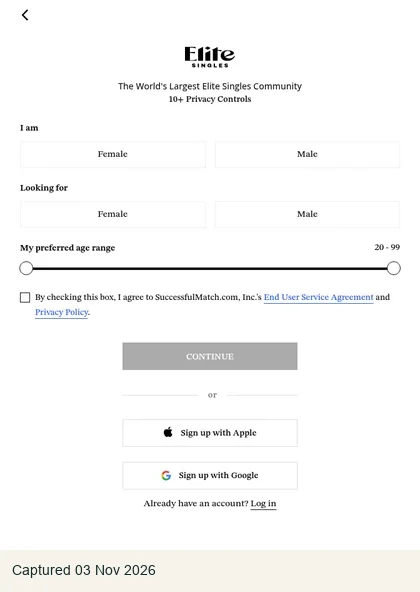
When onboarding onto EliteSingles, users complete a personality assessment based on the clinically validated Big Five Personality Model (measuring Openness, Conscientiousness, Extraversion, Agreeableness, and Neuroticism). The questionnaire takes approximately 5 to 10 minutes to complete.
Once registered, EliteSingles pairs your Big Five psychological profile with strict socioeconomic filters. Members can calibrate precise preferences for:
- Minimum education level (e.g., Bachelor’s Degree, Master’s, Doctorate)
- Professional industry and income expectations
- Geographic distance radius and willingness to relocate
- Desire for children, smoking habits, and religious alignment
Unlike eHarmony’s walled garden, EliteSingles gives users meaningful autonomy. Every day, the algorithm delivers 3 to 7 curated partner suggestions directly into your dashboard. However, you are also free to explore additional profiles via the “Have You Met” roulette feature (a rapid visual browsing tool) and review profile galleries based on customized filter parameters.
eHarmony: The Compatibility Questionnaire & 32 Dimensions® Model
eHarmony takes an entirely guided, paternalistic approach to matchmaking. The onboarding process begins with its comprehensive Compatibility Quiz. Official eHarmony documentation alternately references an 80-question test (with a streamlined 39-question format noted on specific mobile flows), which evaluates core character traits across four psychological tiers:
- Emotional Temperament: Adaptability, optimism, impulse control, and emotional maturity.
- Social Style: Extroversion, social energy rhythm, sociability, and communication under stress.
- Cognitive Orientation: Intellectual curiosity, decision-making style, and problem-solving patterns.
- Relationship Values: Altruism, marital intent, family structure, and personal autonomy.
These responses feed into eHarmony’s proprietary 32 DIMENSIONS® matching model. In daily use, eHarmony completely disables open search: you cannot search by keyword, employer, or open zip code. Instead, eHarmony calculates a numeric Compatibility Score (typically ranging from 60 to 140) for every introduction delivered to your feed. Scores of 100 or above represent strong mutual alignment across fundamental lifestyle and psychological markers.

What You Can Do for Free on Each Platform
Both platforms market themselves with “free registration,” but neither operates as a genuinely free dating service. Free accounts are essentially test drives designed to demonstrate member availability and encourage paid conversion. The table below delineates the exact operational capabilities of unpaid accounts on each site:
| Feature / Action | EliteSingles Free Tier | eHarmony Free Tier |
|---|---|---|
| Registration & Profile Setup | Full Access (Bio, preferences, photos) | Full Access (Bio, basic traits, photos) |
| Personality Test | Included (Big Five summary score) | Included (Personality Profile overview) |
| Profile Photo Visibility | Clear Photos (Photos unblurred in 2026 relaunch) | Frosted / Blurred (Photos unreadable until paid) |
| Daily Match Recommendations | Yes (3–7 daily curated introductions) | Yes (Curated match list with score) |
| Open Two-Way Messaging | Locked (Custom messages require subscription) | Locked (Cannot send/read member messages) |
| Icebreaker Interactions | Yes (Can send standard smiles and likes) | Yes (Can send pre-written smiles/questions) |
| See Who Visited Your Profile | Locked | Locked |
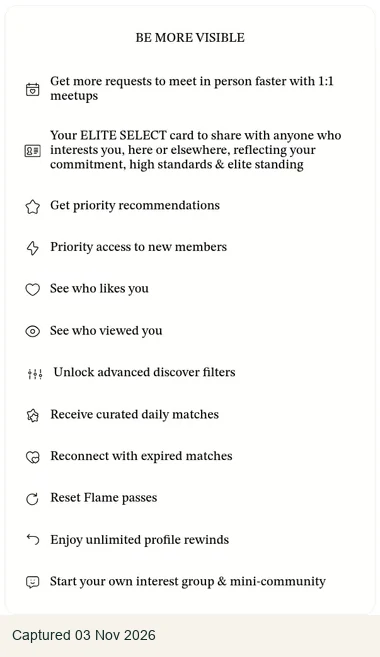
Key Takeaway on Free Tiers: EliteSingles holds a decisive edge in free-tier transparency. Following its 2026 platform update, EliteSingles allows unpaid users to view clear, unblurred member photos while browsing match suggestions. On eHarmony, free accounts face a heavily frosted photo barrier: you can see a user’s compatibility score and written bio, but their face remains completely obscured until you purchase a paid membership. To see whether unlocking messaging and photos justifies the cost, read our breakdown on is eHarmony worth paying for.
Pricing and Contract Terms in 2026
Understanding how much online dating actually costs requires piercing the industry’s widespread “per-month” marketing illusion. Both EliteSingles and eHarmony advertise amortized monthly figures that conceal substantial upfront contract commitments.
| Platform & Membership Plan | Advertised Monthly Rate | Contract Duration | True Upfront Billed Total |
|---|---|---|---|
| EliteSingles — 1-Month Plan | $64.99 / mo | 1 Month | $64.99 (Billed monthly) |
| EliteSingles — 3-Month Plan | $34.99 / mo | 3 Months | $104.97 (Billed upfront lump-sum) |
| EliteSingles — Elite Select (Concierge) | $499.00 / mo | 1 Month | $499.00 (Executive matchmaking tier) |
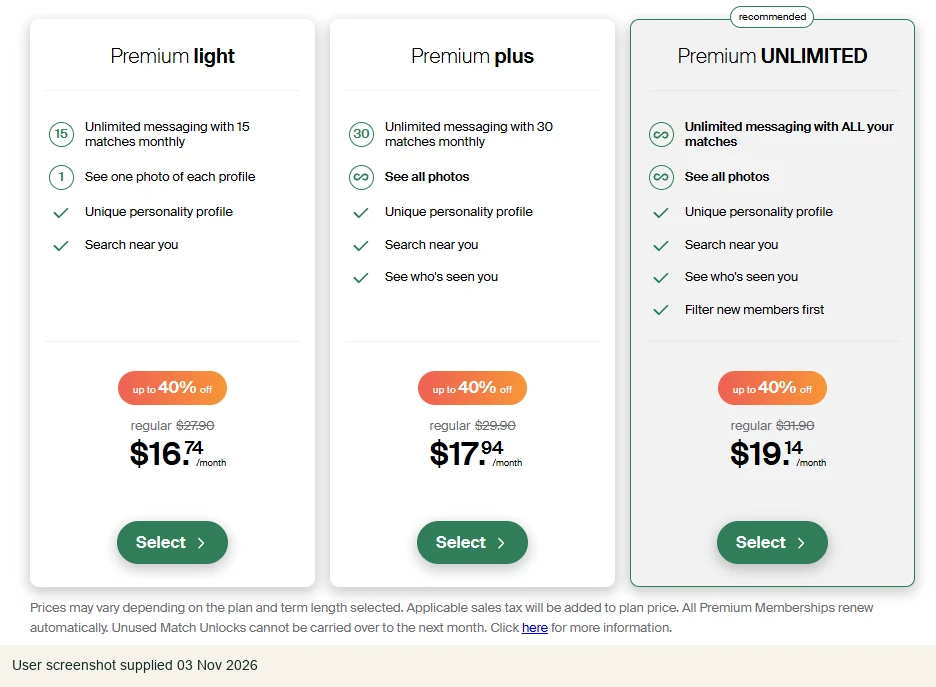
| eHarmony — Premium Light (Promo Rate) | $16.74 / mo (Nov 2026 promo) | 12 Months | $200.88 (Regular rack rate: $334.80) |
| eHarmony — Premium Light (3 Months) | $34.74 / mo (Nov 2026 promo) | 3 Months | $104.22 (Regular rack rate: $173.70) |
| eHarmony — Premium Plus (6 Months) | $27.14 / mo (Nov 2026 promo) | 6 Months | $162.84 (Regular rack rate: $271.40) |
| eHarmony — Premium Unlimited (12 Mos) | $19.14 / mo (Nov 2026 promo) | 12 Months | $229.68 (Regular rack rate: $382.80) |
Note: Pricing audited in November 2026. Rates vary across individual accounts, geographic regions, and seasonal promotional campaigns. For an exhaustive, itemized breakdown of eHarmony’s contractual fine print, see our guide on How Much Does eHarmony Cost in 2026?.
Daters must realize that eHarmony does not offer a cancellable 1-month subscription. Every subscription tier sold in the United States is a legally binding contract spanning 3, 6, or 12 months. If you select eHarmony’s 3-part installment plan (“Pay in 3”), this is not a monthly subscription—halting payment constitutes a contractual breach. Unless you exercise your narrow 3-day statutory right of rescission under state consumer protection statutes (e.g., California Civil Code § 1694.1), eHarmony strictly denies refund requests. By contrast, EliteSingles offers an honest 1-month plan for $64.99, allowing daters to walk away after 30 days without lingering debt.
Member Pool, Demographics & Geographic Liquidity
A matchmaking algorithm is only as effective as the active member pool feeding it. In evaluating EliteSingles against eHarmony, geographic location is frequently the single most decisive factor.
eHarmony: Established Scale & Broad Demographic Reach
Operating for over two decades with extensive national television and digital marketing campaigns, eHarmony maintains an expansive, active membership base across North America. Its users span from young professionals in their late 20s to retirees over 65. Most importantly, eHarmony maintains healthy liquidity in mid-tier cities, suburban communities, and regional centers. If you live in an area with a population under 300,000, eHarmony will almost certainly provide more local candidate introductions than EliteSingles.
EliteSingles: Niche Focus & The 2026 Rebuilding Phase
EliteSingles’ demographic is sharply defined: approximately 90% of members are 30 or older, and the vast majority hold university degrees. However, prospective members must understand that following its 2026 transition to SuccessfulMatch, the platform is actively rebuilding its active member pool. While major urban hubs (such as New York, Los Angeles, Chicago, London, and Toronto) boast strong member activity, secondary and rural markets can experience liquidity drop-offs. Singles in suburban or rural zip codes will likely need to expand their search radius to 50 miles or more to maintain steady match volume.
Verification, Safety, and Privacy Protocols
When paying premium subscription prices, users rightfully expect stringent safety protocols. Both platforms deploy safeguards to deter fraudulent accounts, though neither can replace basic personal vigilance.
- EliteSingles Protocols: During registration, EliteSingles enforces a manual photo approval process and automated profile friction checks. Under SuccessfulMatch, accounts exhibiting suspicious IP origins or inconsistent profile data are flagged for administrative review. However, readers must note: profile verification confirms account continuity, not legal background clearance. EliteSingles does not conduct criminal record checks.
- eHarmony Protocols: eHarmony employs automated algorithmic screening that flags suspicious communication patterns, sudden geographical IP shifts, and unverified payment attempts. It also offers basic SMS phone verification. Like EliteSingles, eHarmony does not conduct routine criminal background checks on members.
- Consumer Safety Principle: Regardless of which platform you select, never transfer funds, share personal home addresses, or transition off-platform to unencrypted messaging apps until mutual trust is established through verified video dates or public in-person meetings.
Pros and Cons: EliteSingles vs eHarmony
The following breakdown outlines the comparative strengths and operational drawbacks of each service:
| Platform | Core Advantages (Pros) | Operational Drawbacks (Cons) |
|---|---|---|
| EliteSingles |
|
|
| eHarmony |
|
|
The Final Decision: Which Platform Should You Join?
When deciding between EliteSingles and eHarmony in 2026, let your geographic location and relationship criteria guide your choice:
Choose eHarmony if your ultimate priority is marriage and you want maximum candidate liquidity. If you live outside a major metropolitan core, value psychological compatibility scoring, and are willing to commit to an audited 3, 6, or 12-month contract ($104 to $230), eHarmony’s scale and established marital track record make it the superior long-term investment. Read our exhaustive field evaluation in our standalone eHarmony Review.
Choose EliteSingles if you are an urban, career-oriented professional aged 30 to 50 who considers educational attainment, career focus, and intellectual compatibility non-negotiable. It is especially compelling if you reside in a major metropolitan market and want the freedom of a 1-month plan ($64.99) without locking yourself into a multi-month contract. Explore our full platform audit in our EliteSingles Review.
If you prefer open directory search over structured questionnaire matching, explore our head-to-head comparison in eHarmony vs Match.

eHarmony — Best for Long-Term Relationship Intent
Driven by its 32 Dimensions compatibility model and an active member base focused on marriage, eHarmony eliminates casual swiping for relationship-focused singles.
- 32 Dimensions Assessment
- High Marital Intent
- Curated Daily Matches
- Promos from $16.74/mo

EliteSingles — Best for Career-Driven Singles
Tailored for degree-holding professionals aged 30–50, EliteSingles combines Big Five personality scoring with granular career filters and flexible 1-month billing.
- 85%+ Degree Holders
- Granular Career Filters
- Flexible 1-Month Plan
- Unblurred Free Photos
Frequently Asked Questions
Is EliteSingles better than eHarmony?
Neither platform is universally superior; each serves distinct dating priorities. EliteSingles is better for educated professionals (aged 30–50) living in major metropolitan markets who want to filter dates by career and education and prefer a flexible 1-month plan. eHarmony is better for singles anywhere in the country whose primary, uncompromising goal is marriage, offering far greater user liquidity in suburban and regional areas.
Which is cheaper: EliteSingles or eHarmony?
If you want the lowest upfront financial commitment, EliteSingles is cheaper because it offers a 1-month plan for $64.99. eHarmony does not offer 1-month plans; its shortest commitment is a 3-month contract ($104.22 upfront with promotional discounts). However, on longer 12-month commitments, eHarmony’s amortized promotional monthly rate (from $16.74/mo) is lower than EliteSingles’ extended tiers.
Can I use EliteSingles or eHarmony for free?
Both platforms offer free registration and basic profile setup, but neither functions as a practical free dating service because two-way messaging is locked behind paid subscriptions. EliteSingles is significantly more generous on its free tier: following its 2026 relaunch, it displays clear, unblurred photos of match recommendations. eHarmony keeps all profile photos frosted and blurred until you purchase a subscription.
Which dating site is better for working professionals?
EliteSingles is specifically architected for working professionals, with over 85% of its user base holding university degrees and advanced credentials. It includes dedicated search filters for education level, profession, and career ambition. eHarmony includes career professionals, but its demographic spans a much broader mix of educational and occupational backgrounds.
Are EliteSingles and eHarmony owned by the same company?
No. They are operated by completely independent companies. eHarmony is owned by the ParshipMeet Group (ProSiebenSat.1 Media). EliteSingles was acquired and relaunched in 2026 under SuccessfulMatch.com, Inc. They share no algorithms, user databases, or corporate infrastructure.
Can I cancel either subscription and get a refund?
Both platforms enforce strict cancellation and refund policies. Subscriptions automatically renew unless disabled prior to the renewal date. General refunds are strictly denied once a subscription has been activated. In the United States, refunds are only legally mandated if requested within 3 business days of initial registration under state statutory rescission laws (such as California Civil Code § 1694.1).