Dating app verification can be useful. It can also be easy to overread.
A verified badge usually means that an account completed a check chosen by the dating platform. The check might confirm access to an email address or phone number, compare a live selfie with profile photos, or connect a selfie to a government-issued ID. Those processes answer different questions.
What they do not create is a blanket promise about the person behind the profile. A badge does not automatically confirm someone’s job, relationship status, intentions, background, honesty, or future behavior.
Key takeaway: The badge is only as informative as the check behind it. Before giving it weight, find out whether the platform checked a contact method, a face, an ID, or some combination of them.
This guide is based on dating-platform help pages reviewed in July 2026 and account-flow evidence documented by TopDatingFinder. Platform requirements can vary by region, device, account status, and later product changes. We did not independently test verification accuracy or measure whether any process reduces scams or fake profiles.
Table of Contents
The One-Minute Answer: Verified Is a Narrow Signal
The word “verified” has no useful meaning without the next question: verified how?
| Verification type | What it can show | What it does not show | What to check next |
|---|---|---|---|
| The person completing the step could access that email address at that time | Full identity, background, safety, or long-term control of the account | Whether the profile and conversation remain consistent | |
| Phone or SMS | The person could access the number or device used in the code flow | The legal identity of the person using the number | Whether the number is only one account step or part of a broader check |
| Photo, selfie, or liveness | A live selfie or video was compared with the face in profile photos on the reviewed platforms | The truth of every profile field, someone’s intentions, or their safety | What the platform says the badge covers and what it explicitly excludes |
| Government ID plus photo | The reviewed flow connected an ID photo and age or date-of-birth information to a live selfie or profile photos | A complete background check, good character, honest intentions, or safe behavior | Which ID fields were checked, how the data is stored, and where the feature is available |
This is not a ranking from “weak” to “perfect.” An ID-linked check covers more identity attributes than an email code, but it still cannot predict how someone will behave after the check.
Start With the Check, Not the Badge Color
A blue checkmark looks decisive because it compresses a complicated process into one small icon. That is convenient for the interface. It is less useful for readers who want to know what was actually checked.
Use four questions before treating any badge as meaningful:
- Was this a contact check, a photo match, or an ID-linked check?
- Was the process optional, required, or triggered only for some accounts?
- Does the badge confirm completion of the process, or specific profile fields?
- What does the platform say it cannot guarantee?
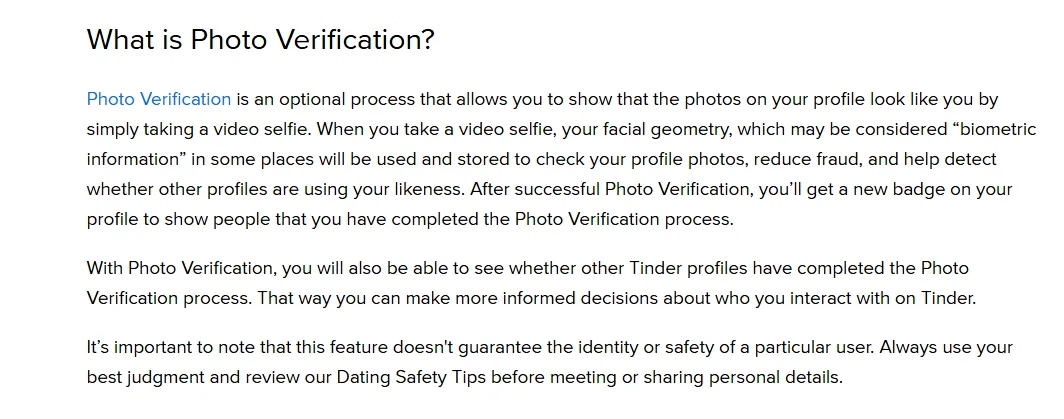
That last question matters. Tinder and Hinge both warn in their help materials that photo or selfie verification does not guarantee a user’s identity or safety. Tinder also says its Photo Verification does not confirm that all other information on a profile is authentic.
So yes, notice the badge. Just do not treat it like a promise the platform did not make.
What Each Type of Dating App Verification Can Tell You
Email Verification: Access to an Inbox
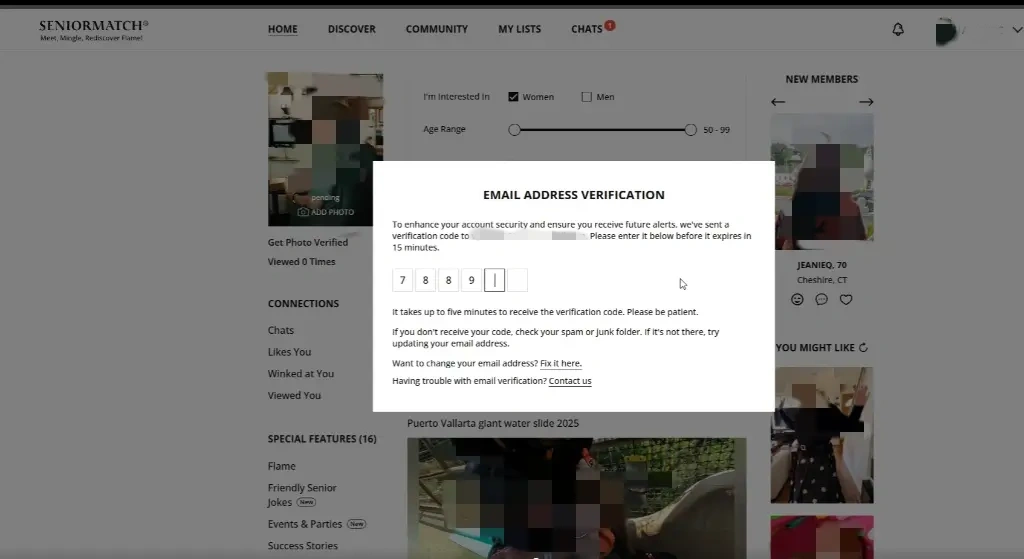
An email verification flow normally sends a code or link to an email address. Completing the step can show that the person had access to that inbox at that moment.
That is useful for account setup and access control. It is not the same as proving a legal identity. An email address can be newly created, shared, abandoned, or later compromised. The code also does not confirm a person’s age, relationship status, background, or intentions.
SeniorMatch provides a useful example of why labels need context. Its reviewed public sign-in flow offered a text or email code, while its separate main-photo verification FAQ described a short selfie video compared with profile photos. Both may be described as verification, but they are different checks.
Phone or SMS Verification: Access to a Number or Device
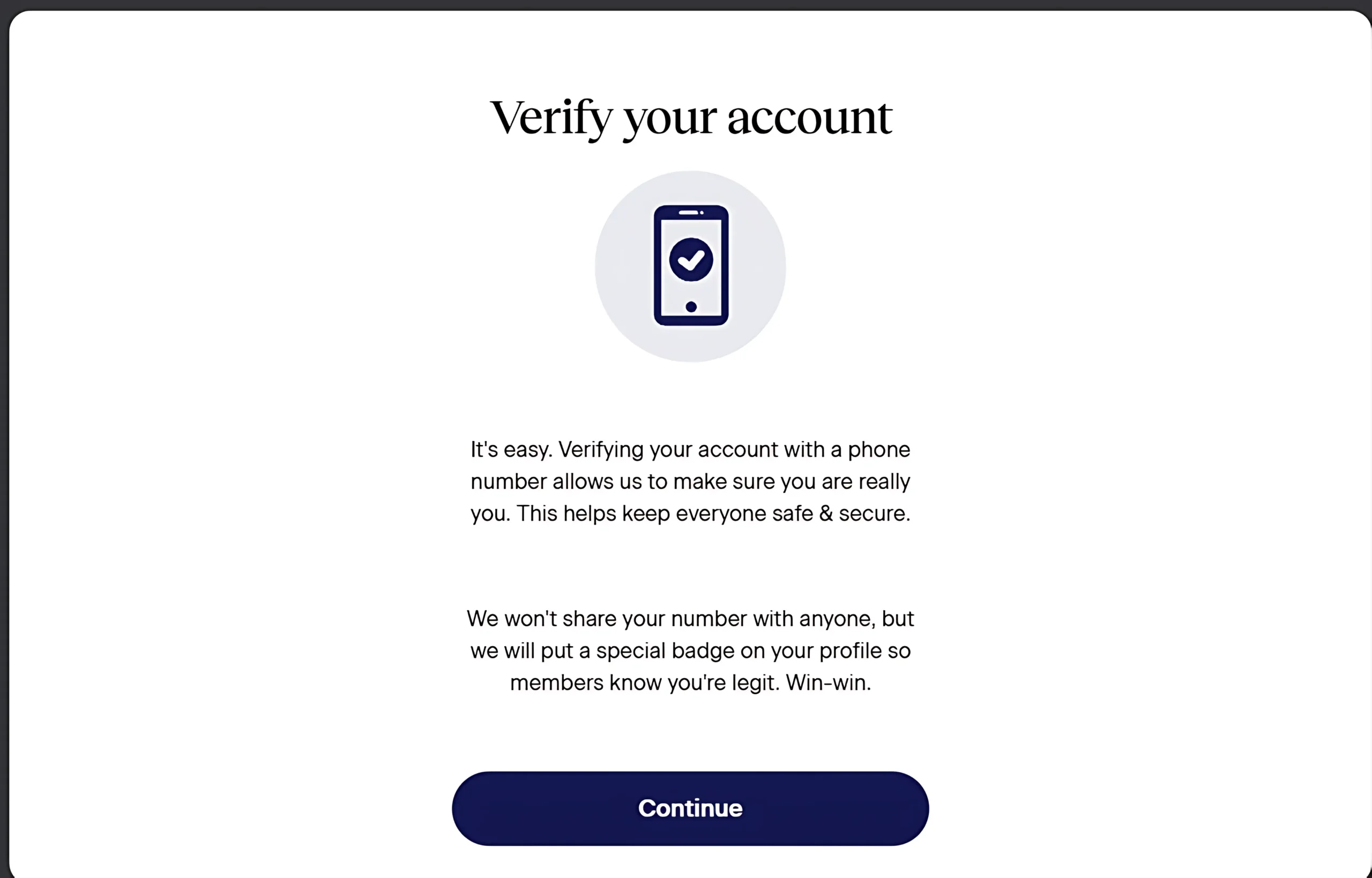
Phone verification usually asks for a code sent by text or supplied through a call. The narrow conclusion is similar to email verification: the person completing the flow could access the number or device used at that time.
That adds a step to account creation. It does not reveal the full identity behind the number. A phone badge should not be translated into “this person is safe,” “this account cannot be fake,” or “the platform ran a background check.”
In the account and help flows reviewed for this guide, Match and OurTime used phone or SMS steps. OurTime’s help page described a four-digit SMS code and noted that landline and VoIP numbers were not accepted in that flow. Those are platform-specific details, not a universal rule for dating apps.
For a closer look at how those account flows fit into broader platform decisions, see Match vs OurTime and OurTime vs SeniorMatch.
Photo, Selfie, and Liveness Verification: Does the Face Match?
Photo verification usually gets closer to the question readers care about: does the person completing the check resemble the person shown in the profile photos?
On the Tinder, Bumble, Hinge, and SeniorMatch pages reviewed for this guide, the process involved a live selfie or short video compared with profile photos. Tinder and Hinge also described liveness checks intended to assess whether the video came from a live person rather than a pre-recorded or altered clip.
That does not mean the process is impossible to bypass. We do not have reliable, platform-specific accuracy or false-positive data, so this guide does not assign a success rate.
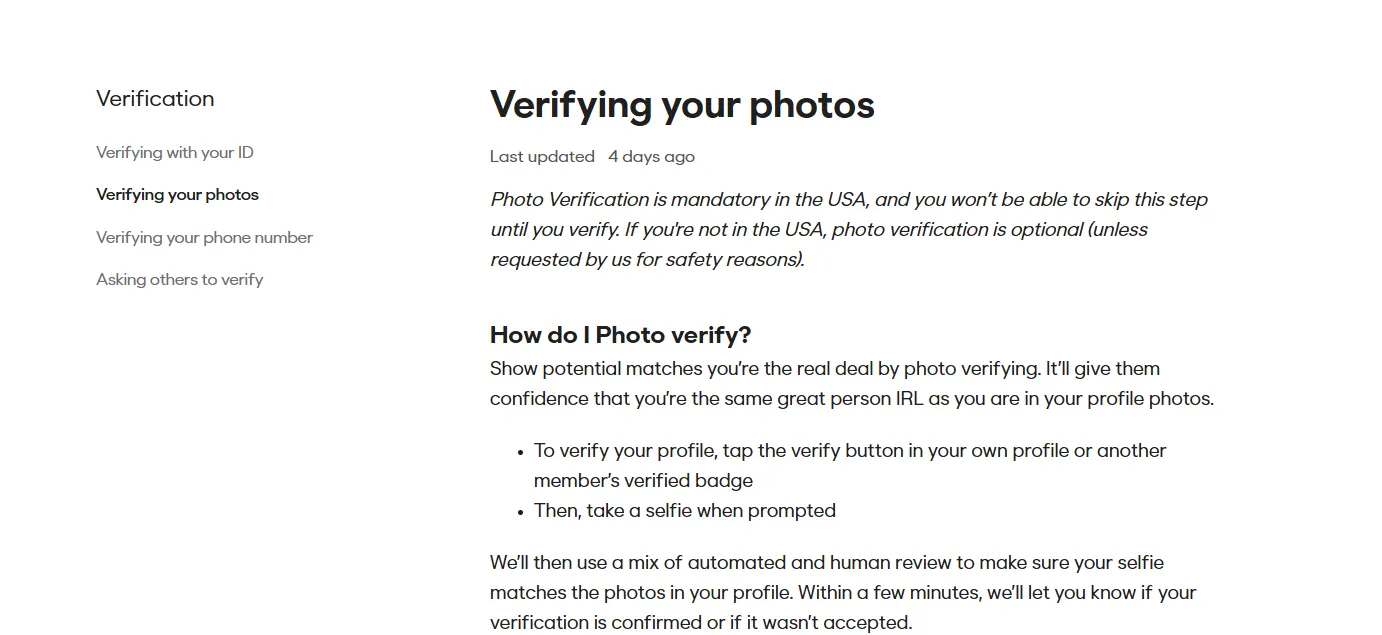
Bumble’s U.S. help page, updated July 17, 2026, described Photo Verification as mandatory in the United States and said the submitted selfie is compared with profile photos through automated and human review. That is a dated example of Bumble’s stated U.S. process, not proof that every account in every market sees the same flow.
The useful conclusion is narrow: a photo badge may give you more reason to believe the person completed a face-comparison process. It does not confirm their name, job, relationship status, intentions, or every claim in the bio.
Government-ID Verification: A Wider Check, Not a Safety Guarantee
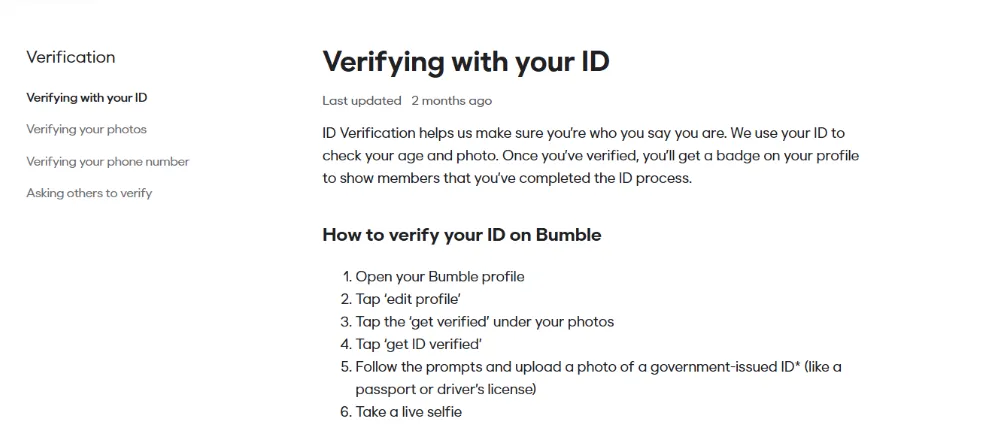
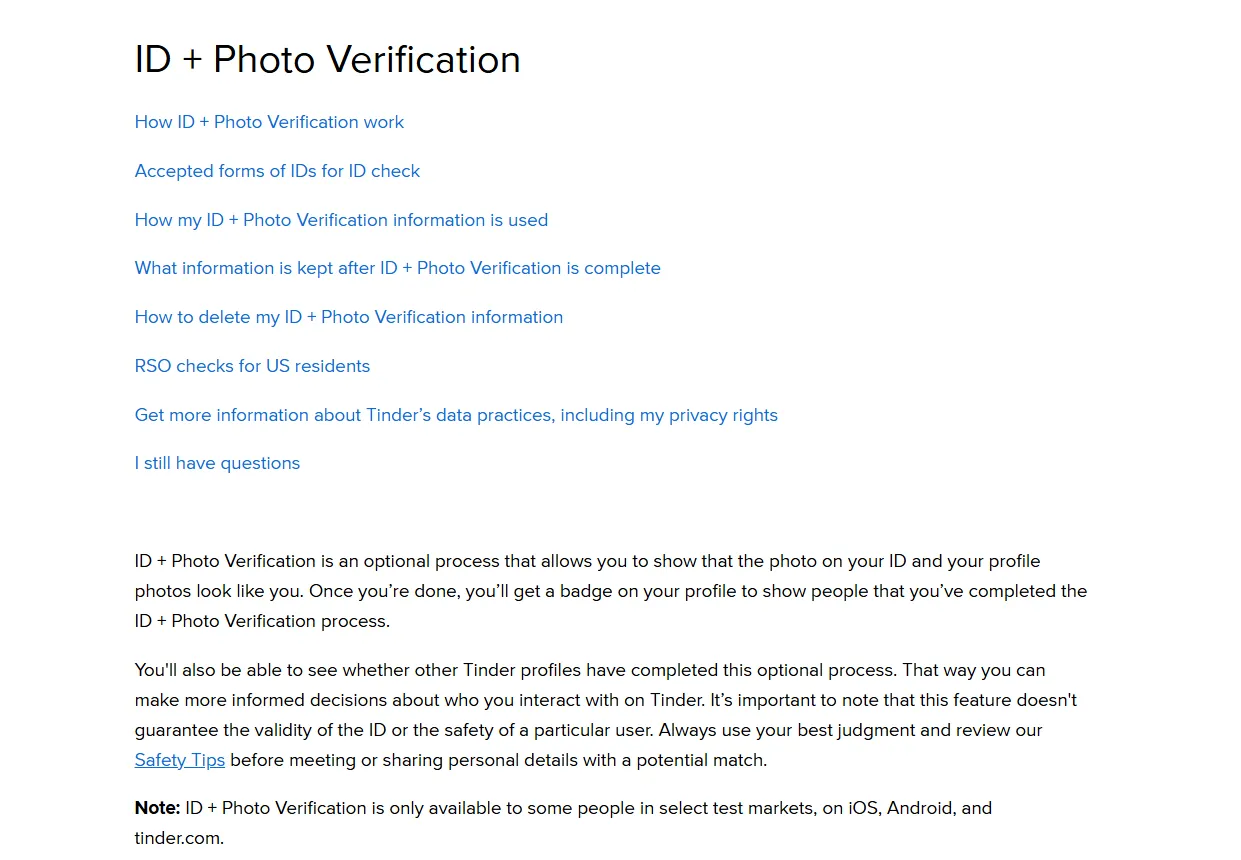
An ID-linked process can check more than a selfie-only flow. In the Bumble and Tinder help pages reviewed here, the process combined a government-issued ID with a live selfie or photo comparison. The pages also described checks involving the ID photo and age or date-of-birth information.
That is meaningfully different from confirming an email address. It can connect more identity attributes to the person completing the flow.
But here is where the boundary still matters. Tinder says its ID + Photo Verification is optional, available only to some users in select test markets, and does not guarantee the validity of the ID or the safety of the user. Bumble describes checking age and photo, but that statement is not an independent audit of every submitted document.
An ID badge does not automatically establish criminal history, relationship status, employment, character, or future behavior. Unless a platform says it checked a field, do not assume the badge covers it.
The Same Verification Label Can Describe Different Processes
Dating platforms do not use one standard verification system. Even within one platform, separate badges or prompts may represent separate checks.
| Reviewed example | What the reviewed page or flow described | The limit to remember |
|---|---|---|
| Match and OurTime | Phone or SMS code steps | Access to a number is not full identity proofing |
| SeniorMatch | Text/email code for account access and a separate selfie-video main-photo check | The contact check and photo check should not be treated as one process |
| Bumble | Photo verification and a separate government-ID flow | The U.S. requirement and feature availability can change |
| Tinder | Photo Verification plus an optional ID + Photo feature in select test markets | Neither badge is a safety guarantee |
| Hinge | Voluntary Selfie Verification and region-specific Face Check descriptions | Requirements and data practices depend on the feature and region |
Availability can vary by platform, region, device, account state, or a risk trigger. A list claiming that every user on a particular app receives the same check would age quickly. Check the current help page and the prompt shown to your own account.
Six Things Verification Does Not Automatically Prove
1. It Is Not a Universal Background Check
Email, phone, photo, and ID verification are not synonyms for criminal-background screening.
OurTime makes this distinction directly on a Colorado safety policy page. The company says it does not conduct criminal-background or identity checks on every user and warns that no online verification or screening process can guarantee safety. The page has a state-specific context, but the practical lesson is broader: look for a separate, clearly described screening process before assuming one occurred.
2. It Does Not Confirm Every Profile Field
A selfie match does not verify a job title. A phone code does not confirm relationship status. An ID age check does not prove that every sentence in a bio is accurate.
The badge covers the fields and comparisons included in the stated process. Nothing more.
3. It Does Not Prove Honest Intentions
Verification looks backward at submitted information or a completed step. It cannot tell you why someone joined, whether they want the same relationship you do, or how they will treat you.
4. It Does Not Guarantee Safe Behavior
A person can complete a legitimate verification process and still behave badly later. The check cannot predict pressure, manipulation, money requests, boundary violations, or what happens after a conversation moves off the app.
5. It Does Not Prove Activity or Compatibility
A badge does not show when someone last used the account, whether they will reply, or whether the two of you are compatible. Those are separate questions.
6. It Is Not the Same as Paying
Payment shows access to paid features. Verification shows completion of a stated check. Neither is a safety guarantee.
If you are deciding whether a subscription is worth buying, use our guide to what you can do on dating sites before paying. Do not use a Premium label or a verification badge as a substitute for that decision.
Check the Privacy Tradeoff Before Submitting a Selfie or ID
Verification is not only about receiving a badge. It can involve sensitive data.
Depending on the platform and type of check, the submitted or generated information may include:
- A selfie or video selfie.
- Screenshots or audit images taken from that video.
- Facial-geometry or biometric templates.
- A photo of a government-issued ID.
- A name, ID photo, age, or date of birth.
- The result of the verification process.
The reviewed Tinder Photo Verification page, for example, describes FaceMap and FaceVector data, audit images, and separate retention or deletion rules. Hinge’s public materials describe different handling for voluntary Selfie Verification and region-specific Face Check. One platform’s policy should not be copied onto another.
Before submitting verification data, check the current help and privacy pages for five things:
- Is the check optional, mandatory, or triggered only in certain cases?
- What information is collected or generated?
- How long is each type of information kept?
- Can you request deletion without closing the account?
- What happens to the data after account deletion?
You may decide that the added signal is worth the data exchange. You may also decide to pause and read more. The important part is making that decision from the current policy, not from the badge alone.
Use Verification as One Signal, Not the Final Decision
A verified profile deserves neither blind trust nor automatic suspicion. Give the badge exactly the weight the underlying check supports.
Use this five-step approach:
- Identify the verification type. Was it email, phone, photo, ID, or a combination?
- Keep the conclusion narrow. Accept only what the process actually checked.
- Look for consistency. Do the profile details, photos, location, and conversation fit together over time?
- Keep normal safety boundaries. Be careful with personal information, money, off-platform pressure, and meeting plans.
- Respond to behavior, not the icon. If the story changes or the requests feel wrong, a badge is not a reason to ignore that concern.
For practical profile checks beyond the badge, read How to Tell If a Dating Profile Is Fake. Before you share personal information, pay, move off-platform, or meet, use our Online Dating Safety Checklist.
Final Verdict: Ask “What Was Verified?” Before “How Much Should I Trust It?”
Dating profile verification can reduce one specific uncertainty. An email or phone code can confirm access to a contact method. A selfie check can compare a live face with profile photos. An ID-linked process can connect additional attributes, such as an ID photo and age information, to the check.
None of those steps removes every other uncertainty.
The best way to read a verified badge is to translate it into a plain sentence: this account completed this particular check. Then stop the conclusion there.
Check the platform’s current verification and privacy pages, keep watching for consistency, and make decisions based on the person’s behavior as well as the signal on the profile.
Frequently Asked Questions
What does verified mean on a dating app?
It usually means the account completed a verification process specified by the platform. The meaning depends on whether that process checked an email address, phone number, live selfie, government ID, or some combination of them.
Does photo verification confirm someone’s identity?
It can support a narrower conclusion: on the reviewed platforms, a live selfie or video was compared with profile photos. It does not automatically confirm a person’s full identity or the truth of every profile field.
Is dating-app verification a background check?
No. Contact, photo, and ID verification are separate from criminal-background screening. Only describe a background check when the platform clearly states that a separate screening process occurred and explains its scope.
What is the difference between photo verification and ID verification?
Photo verification generally compares a live selfie or video with profile photos. The reviewed ID flows also used a government-issued ID and checked information such as the ID photo and age or date of birth. An ID-linked check is broader, but it is still not a safety or behavior guarantee.
Can a verified profile still contain misleading information?
Yes. A badge does not cover profile fields the verification process did not check. It also cannot predict a person’s intentions or future behavior.
Do dating apps store verification selfies or biometric data?
Some do. The reviewed platform pages describe data that may include selfies, audit images, facial-geometry templates, or ID information. Retention and deletion rules vary by platform, feature, region, and account status, so check the current help and privacy pages before submitting.
Is verification mandatory on dating apps?
It depends. Requirements can vary by platform, region, device, account status, and risk trigger. As of July 17, 2026, Bumble’s U.S. help page described Photo Verification as mandatory in the United States, while Tinder described ID + Photo Verification as optional and limited to some users in select test markets. Recheck current platform guidance before relying on those examples.

Related Reviews & Guides
Explore our independent audits, pricing breakdowns, and relationship guides: