
You probably know that hollow feeling when you’ve been swiping for twenty minutes and every profile begins to blur together. A gym selfie, a vacation snapshot, and a bio that just says “Must love dogs, tacos, and travel.” You make a snap judgment in under two seconds. After fifty swipes, nobody feels like a real person anymore—they just look like items in a catalog.
That hollow routine is why more daters are turning to dating apps based on personality. The premise sounds refreshing: flip the script by prioritizing emotional wiring, communication habits, and core life values before physical appearance. But here is the thing: every platform defines “personality” differently. Whether you want a fun MBTI dating app to meet fellow intuitives or are comparing dating apps with personality tests grounded in clinical psychometrics, matching depth varies wildly. We spent three months field-testing the leading contenders to see which of the best personality dating apps actually deliver real dates in 2026, and which ones just sell psychological horoscopes.
The Quick Verdict for 2026:
- Best for MBTI & Community Dialogue: Boo — Combines 16 Myers-Briggs archetypes with interactive “Universes” interest forums for community-first dating.
- Best for Clinical Trait Matching & Marriage: eharmony — A serious, 20-minute psychometric test backed by a steep paywall that filters out low-intent swipers.
- Best for Academic Big Five Science: EliteSingles — Uses the empirical Five-Factor Model (OCEAN) to match career-focused professionals (85%+ hold college degrees).
- Best for Pure Typology & Introverts: Ur My Type — Dedicated 16-type matching with audio bios and free, low-pressure messaging for quiet singles.
- Best for Value-Weighted Questionnaires: OkCupid — Crowdsourced matching percentages based on hundreds of user-weighted lifestyle, ethics, and political questions.
- Best for Behavioral Chemistry & Banter: Hinge — Skips formal quizzes entirely, using Voice Prompts and specific conversation starters to show authentic wit.
Navigational note: If you are dating strictly for marriage, explore our guide to the best dating sites for marriage. If you want quiet, low-pressure conversations, consult our breakdown of the best dating apps for introverts. Midlife daters should also check our ranking of the best dating sites for over 40.
Table of Contents
Quick Decision Guide: Which Personality Dating App Fits You?
Not every personality dating app approaches compatibility from the same angle. Some want to analyze your subconscious psychology, while others just want to know if you can hold a decent conversation. The comparison table below lays out how our top picks differ in matching style, cost, and real-world strengths.
| Platform | Best For | Matching Framework | Cost Structure | Standout Feature |
|---|---|---|---|---|
| Boo | MBTI & Community | 16 Personalities + Big 5 | Freemium ($19.99/mo) | “Universes” interest forums & trait radars |
| eharmony | Marriage & Stability | 32 Compatibility Dimensions | $35.90–$65.90/mo | Clinical questionnaire & verified intent |
| EliteSingles | Professionals & Academics | Five-Factor Model (OCEAN) | $31.95–$59.95/mo | Academic trait curves & 85% degree holders |
| Ur My Type | Introverts & Typology | Pure Myers-Briggs Matrix | Free w/ ads / $9.99/mo | Archetype tags, audio bios & free messaging |
| OkCupid | Value Alignment | Weighted Q&A (0–99%) | Freemium ($24.99–$44.99/mo) | Custom importance weighting & high liquidity |
| Hinge | Behavioral Chemistry | Gale-Shapley & Prompts | Freemium ($14.99–$34.99/mo) | Voice Prompts & “Most Compatible” pairing |
The 3-Tier Framework: How Personality Dating Apps Work
Before you commit half an hour to an onboarding quiz, it helps to understand what “personality matching” actually means in software code. Across modern dating apps based on personality, the technology splits into three distinct models:
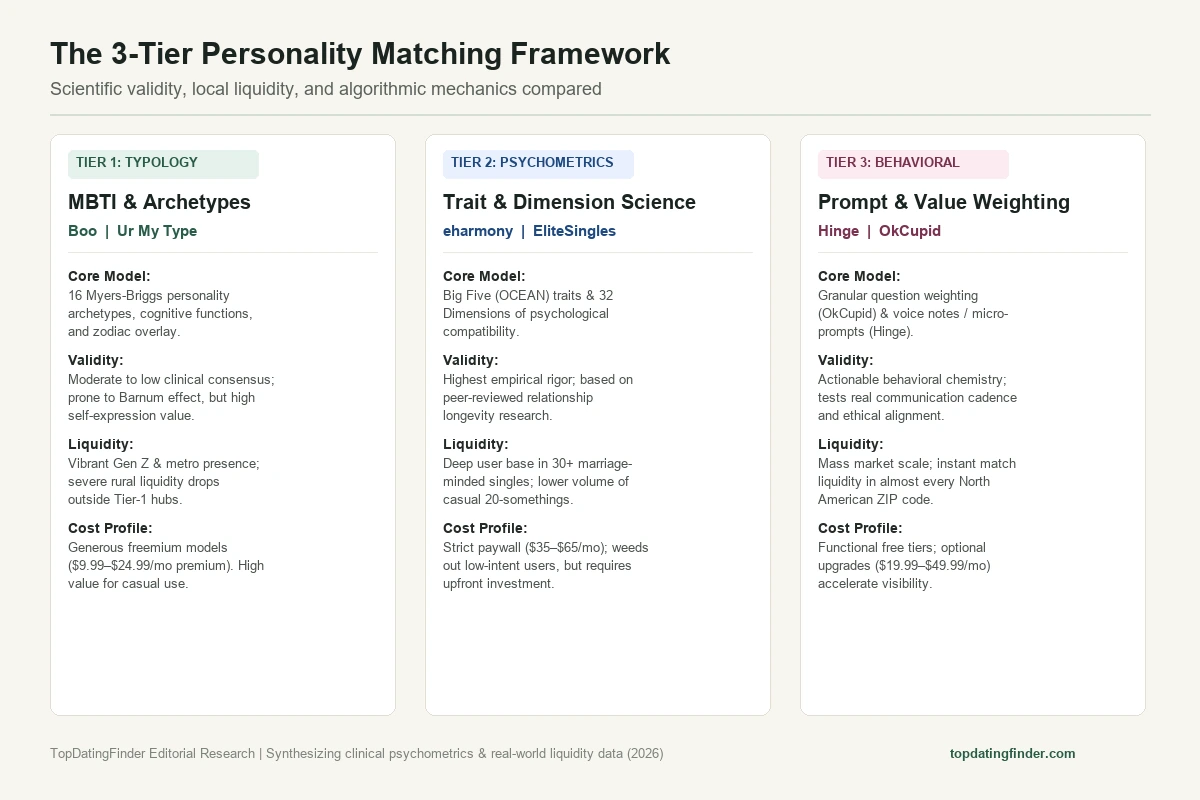
Tier 1: Cognitive Typology Apps (MBTI & Archetypes)
Platforms like Boo and Ur My Type sort you into sixteen Myers-Briggs archetypes (like INFP or ENTJ). The algorithm pairs you based on cognitive function balance—the idea that intuitive types pair naturally with complementary thinkers. It gives you an instant conversational shorthand, but user density drops off sharply once you leave major metropolitan areas.
Tier 2: Clinical Psychometrics (Trait Science)
Legacy platforms like eharmony and EliteSingles use the empirical Five-Factor Model (OCEAN): Openness, Conscientiousness, Extraversion, Agreeableness, and Emotional Stability. Unlike pop quizzes, trait psychology has decades of published relationship research behind it. The tradeoff? An exhaustive 20-minute signup questionnaire and premium subscriptions running $35 to $65 a month.
Tier 3: Behavioral & Value-Weighted Matching
Instead of trying to analyze your inner psyche, OkCupid and Hinge look at your concrete opinions and daily habits. OkCupid lets you assign mathematical importance weights to real-world questions, while Hinge watches how people react to your voice notes and written humor. You get massive local liquidity in almost every zip code without taking a single psychology quiz.
What Relationship Science Says About Compatibility Algorithms
Let’s be honest for a second: dating app marketing loves to make compatibility sound like rocket science. But what do independent relationship psychologists actually say? In a landmark review published in Psychological Science in the Public Interest, Dr. Eli Finkel (Northwestern University) and his research team evaluated decades of matchmaking algorithm data. Their conclusion was blunt:
“Individual personality traits and compatibility metrics measured before two people ever meet account for less than 5% of the variance in long-term relationship success.”
— Dr. Eli Finkel et al., Psychological Science in the Public Interest
Why can’t an algorithm predict romantic destiny? Because chemistry isn’t a static math problem—it’s an interactive dance. No questionnaire in the world can measure the things that actually make or break a relationship:
- Subconscious Chemistry: Voice tone, physical posture, laughter cadence, and biological smell.
- Conflict Habits: How someone reacts when tired or misunderstood—with warmth or passive-aggressive silence.
- Stress Attunement: How two partners co-regulate when work falls apart or finances get tight.
The Real Value of Personality Matching: Do not treat a high compatibility score as a cosmic promise. Its real superpower is simply upgrading your first conversation. By filtering out incompatible communication styles and moral dealbreakers upfront, you save weeks of dead-end dates.
In-Depth Reviews of the 6 Best Personality Dating Apps
Let’s get into the actual apps. After walking through the onboarding quizzes, checking subscriber paywalls, and testing where the matches actually come from, here is how the top 6 options stack up in 2026.
1. Boo — Best for MBTI Enthusiasts & Community Dialogue
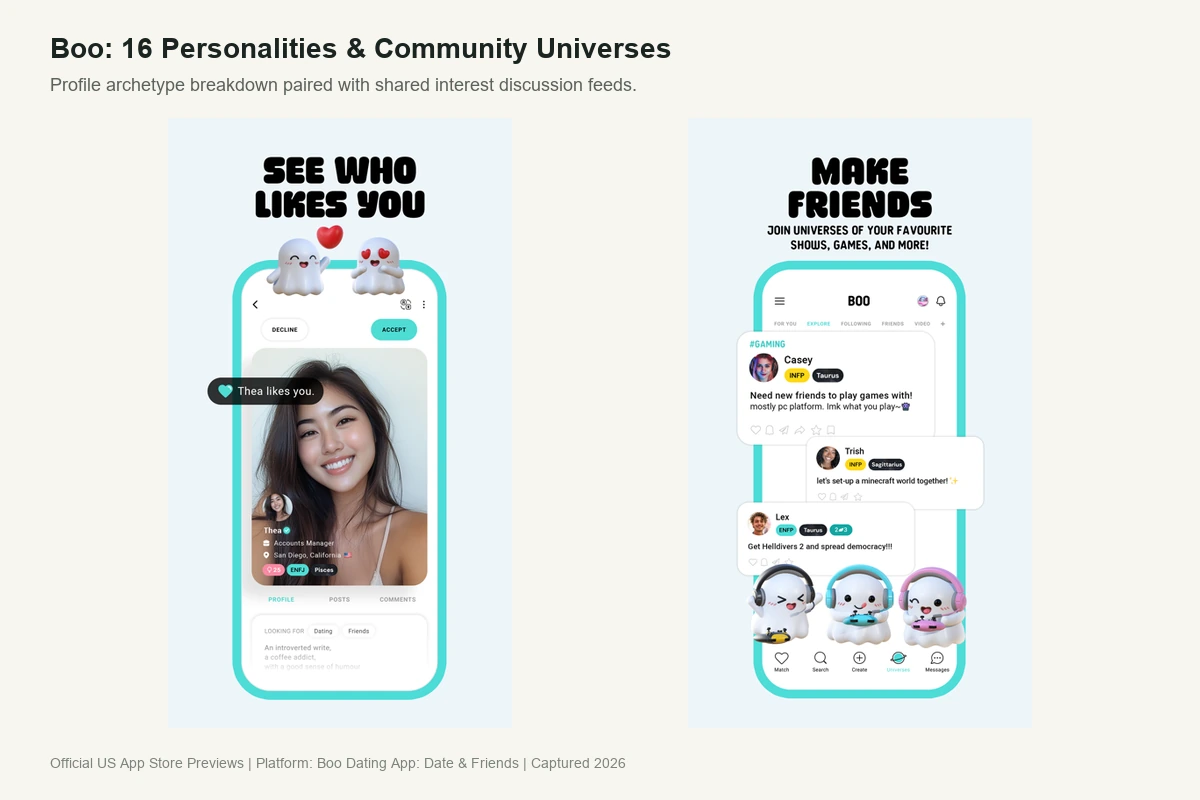
If you spend any time on Reddit or TikTok looking at MBTI memes, you have probably run into Boo. It serves as a lively MBTI dating app that builds a playful, community-first ecosystem around the 16 Myers-Briggs archetypes. You can take their quick 4-letter test or just plug in your verified type if you already know it.
What makes Boo interesting is that it doesn’t treat dating like a silent photo gallery. Profiles show trait radars and cognitive function compatibility badges, while the “Universes” tab acts like a public forum where people debate anime, philosophy, gaming, and psychology. You can jump into discussions and connect with people over shared niche interests before sliding into private chats.
Best For
Gamers, creative thinkers, and MBTI enthusiasts who want community conversation alongside dating.
Main Tradeoff
Outside major metro hubs, local liquidity dries up quickly, serving international profiles. Direct messaging non-matches requires coins or paid Infinity.
Transparent Pricing (2026): The free tier covers basic swiping, testing, and reading Universes. Boo Infinity costs $19.99 for one month ($39.99 for 3 months) to unlock unlimited swipes, visitor reveals, and free monthly direct messages.
2. eharmony — Best for Clinical Trait Matching & Marriage
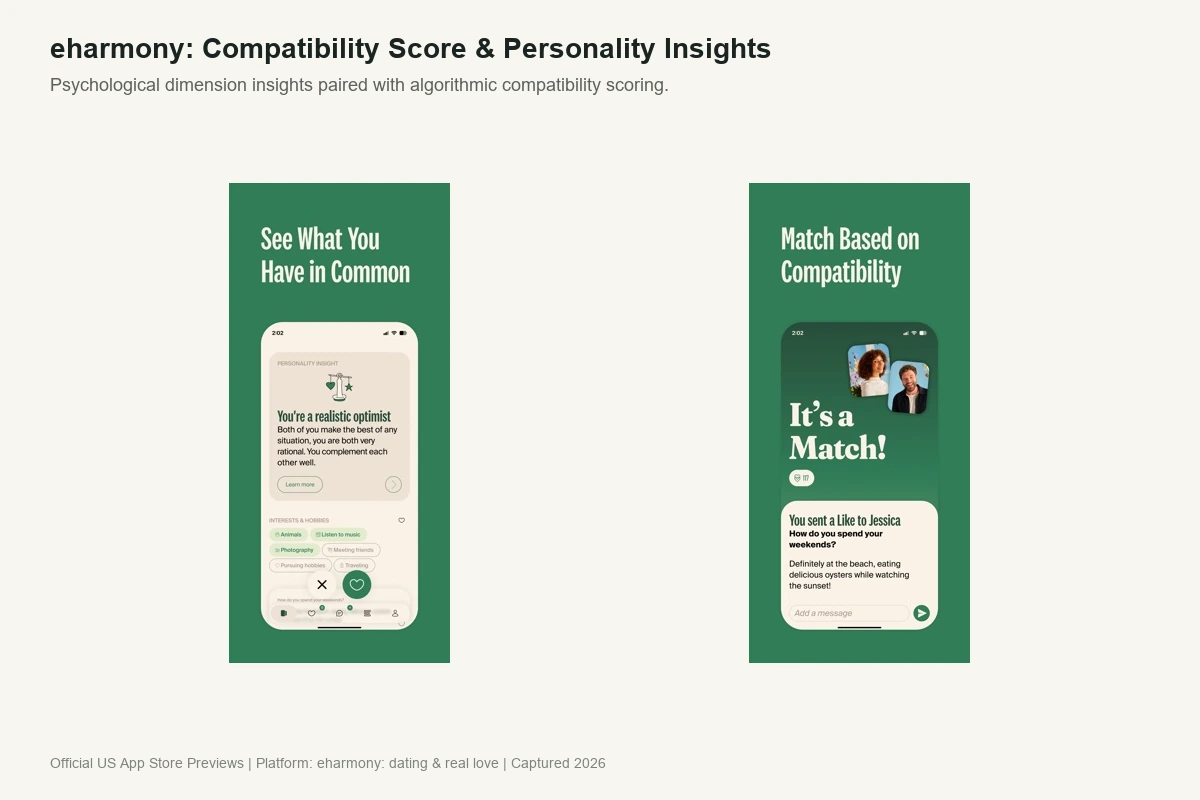
Operating since 2000, eharmony still takes itself very seriously. While mainstream apps take thirty seconds to join, eharmony requires an exhaustive 20-minute psychological assessment before you can even browse your match pool.
The test evaluates your 32 Dimensions of Compatibility, scoring emotional temperament, family values, and communication styles to produce a Compatibility Score (60 to 140). The upside is clear: nobody pays $40 to $65 a month on an annual contract just to mess around. Conversations here are intentional, mature, and focused on marriage.
Best For
Marriage-minded singles aged 30–60+ who want clinical vetting and zero casual hookup culture.
Main Tradeoff
Premium plans require committed contracts ($35.90–$65.90/mo for 6–24 months). Unpaid accounts cannot see unblurred photos or exchange open messages.
Before You Pay on eharmony: Complete the free assessment and inspect your initial match pool. Only upgrade once you verify active, appealing matches in your immediate area.
Transparent Pricing (2026): Basic membership is free (quiz results & limited icebreakers). Premium plans run ~$65.90/mo (6 months), ~$45.90/mo (12 months), or ~$35.90/mo (24 months).
3. EliteSingles — Best for Academic Big Five Science & Professionals
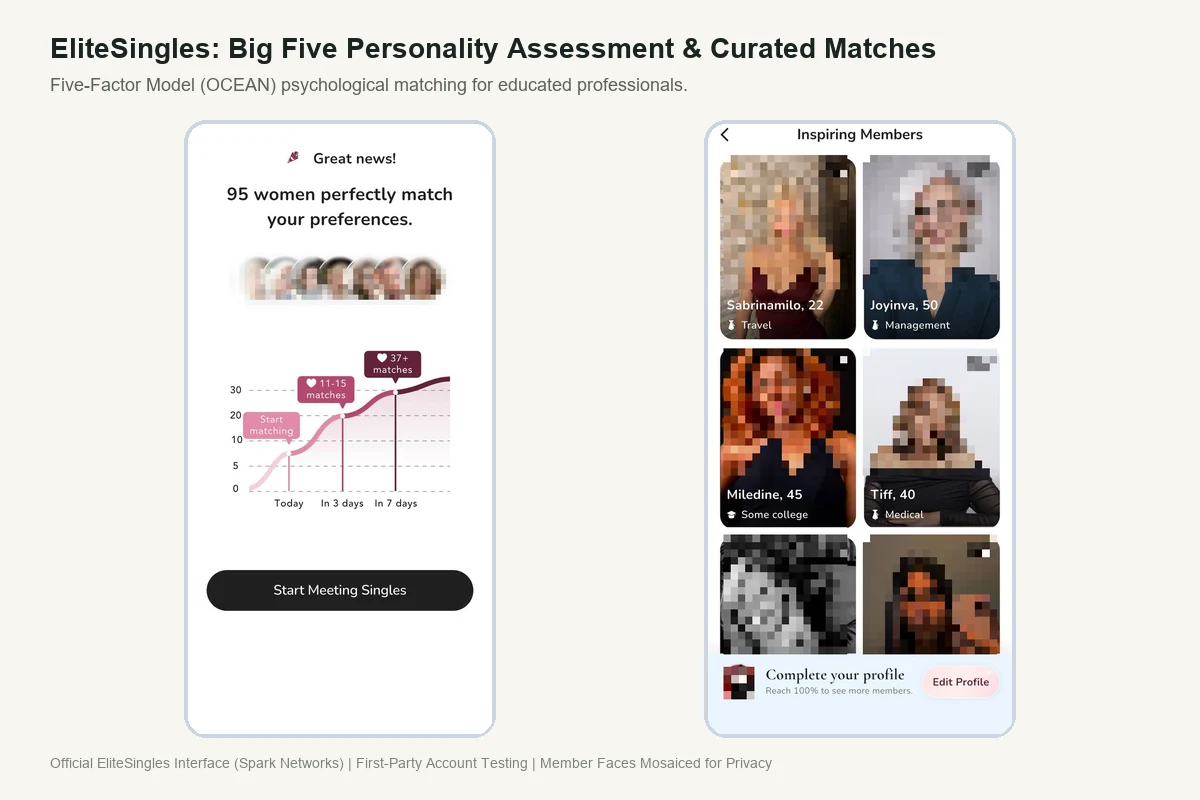
If Myers-Briggs feels too much like a modern horoscope to you, EliteSingles takes an academic route. Its assessment is grounded in the Five-Factor Model (OCEAN)—the personality framework university psychologists actually take seriously.
During setup, you answer 29 trait questions measuring Openness, Conscientiousness, Extraversion, Agreeableness, and Neuroticism. The algorithm pairs you based on mutual trait harmony combined with career and education filters. Around 85% of active members hold a college degree, making it a natural fit for doctors, lawyers, consultants, and executives who want an intellectual peer.
Best For
Educated professionals, executives, and academics aged 32–58 seeking peers with equal drive and emotional maturity.
Main Tradeoff
Subscriptions run $31.95–$59.95/mo. Match volume is noticeably thinner for singles under 30 or those outside major metropolitan areas.
Transparent Pricing (2026): Free trial includes personality assessment and profile previews. Premium plans cost ~$59.95/mo (3 months), ~$44.95/mo (6 months), or ~$31.95/mo (12 months) to unlock messaging and clear photos.
4. Ur My Type — Best for Pure 16-Type Typology & Introverted Singles
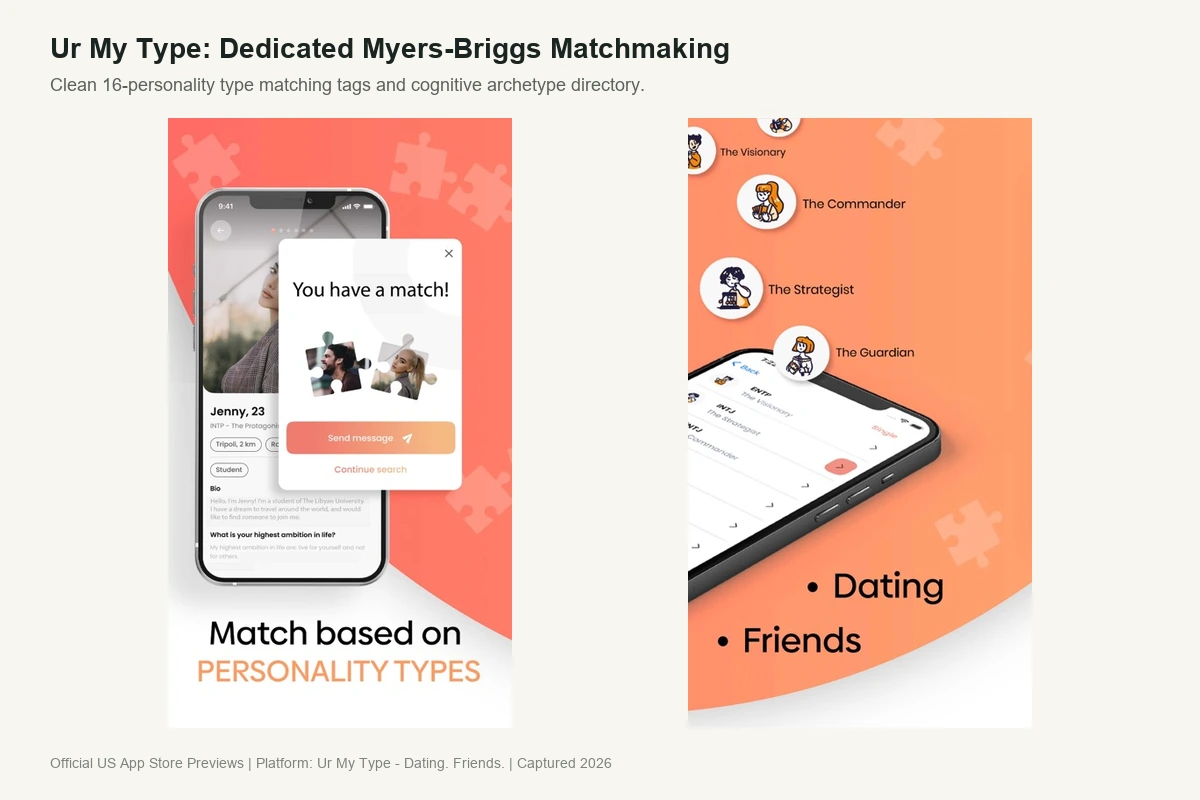
As a dedicated dating app based on personality type, Ur My Type is probably the quietest platform on this list. Built exclusively around 16 Myers-Briggs archetypes, it feels less like a crowded marketplace and more like a relaxed gathering for introverts, writers, and psychology fans.
The app matches you by cognitive function harmony (pairing INTJs with ENFPs, for instance). What we appreciate is the low-pressure vibe: profiles highlight voice bios and archetype tags rather than flashy lifestyle reels. Better yet, the free ad-supported tier lets you message matches without hitting an immediate coin wall.
Best For
Introverts, programmers, artists, and typology fans who prefer low-pressure, text-friendly chats.
Main Tradeoff
Dual positioning for dating and platonic friends creates occasional intent confusion. Modest user density outside Tier-1 cities.
Transparent Pricing (2026): Free tier includes matching and messaging supported by ads. Turbo VIP runs ~$9.99/mo (or ~$59.99 lifetime) to remove ads and view profile visitors.
5. OkCupid — Best for Value-Weighted Questionnaires & Open Filtering
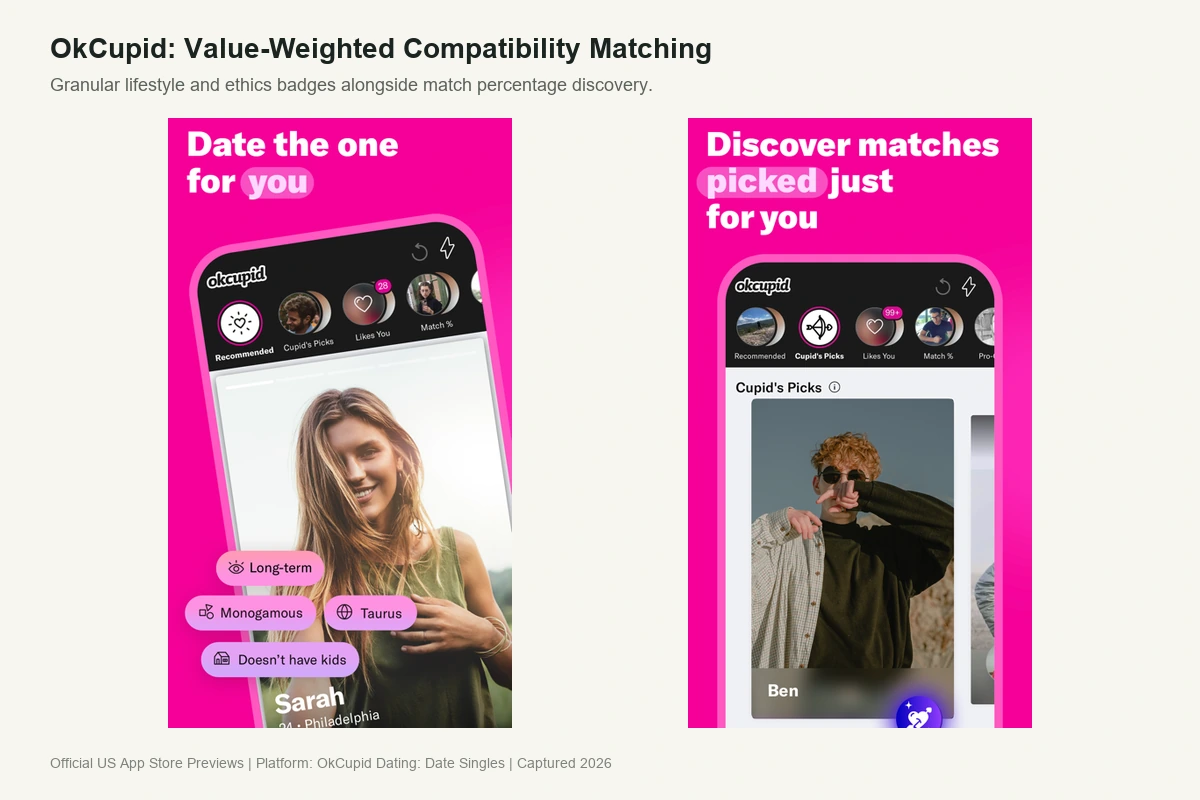
OkCupid is the veteran of question-driven dating. Rather than assigning you a four-letter type, it lets you answer hundreds of specific questions about ethics, lifestyle habits, politics, and relationship expectations.
The real secret sauce is importance weighting: you answer a question, pick what you want your ideal partner to answer, and mark how much it matters (a little, somewhat, or very). This builds a composite Match Percentage (0% to 99%). Because it is backed by Match Group’s scale, you get deep value alignment without sacrificing local user density.
Best For
Singles with strong moral, lifestyle, or political stances who need high local liquidity in almost every zip code.
Main Tradeoff
Match Group paywalls have gotten aggressive with blurred likes and upsells. Accuracy requires answering at least 40+ questions.
Transparent Pricing (2026): Free tier allows mutual-like matching and messaging. OkCupid Basic costs ~$24.99/mo (unlimited likes, ad-free); Premium costs ~$39.99/mo (see likes & unanswered question replies).
6. Hinge — Best for Behavioral Personality & Prompt-Driven Humor
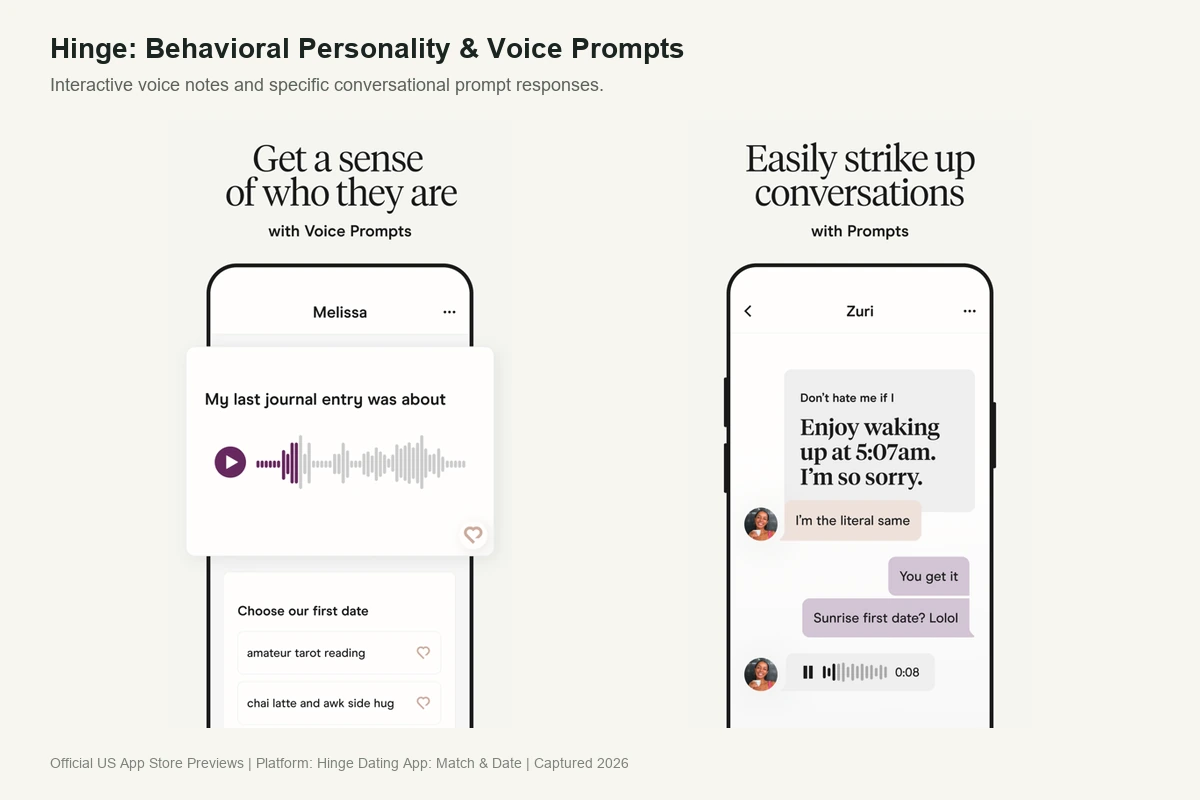
Positioned as “Designed to be Deleted,” Hinge skips the 20-minute multiple-choice tests entirely. Instead, it captures personality through behavior and real conversation.
Every profile features three written Prompts and optional Voice Prompts. You can’t just send a generic like—you have to comment on a specific photo, joke, or audio snippet. Behind the scenes, Hinge’s Nobel Prize-inspired Gale-Shapley algorithm tracks who you actually converse with and date, serving a daily “Most Compatible” pairing based on real chemistry.
Best For
Singles aged 24–42 who want conversational banter, voice chemistry, and high local liquidity without taking long tests.
Main Tradeoff
Photos remain prominent. If you want a blind or purely quiz-driven match feed, Hinge will still feel visual.
Transparent Pricing (2026): Free tier includes 8 daily likes and full messaging. Hinge+ runs ~$14.99/mo (unlimited likes & advanced filters); HingeX runs ~$29.99/mo (priority likes & enhanced discovery).
The 3 Critical Pitfalls of Dating Apps Based on Personality
While choosing among the top dating apps based on personality helps you escape mindless swiping, watch out for these three common traps:
1. The Niche Liquidity Paradox
Here is what happens on niche typology apps: if you live in New York or Chicago, Boo and Ur My Type have plenty of active users. But if you live in suburban Ohio or a smaller regional town, you might swipe through fifteen local profiles before the app starts showing you matches in Toronto or London. Strategy: Pair a niche app with a high-liquidity app (like Hinge or OkCupid) so you don’t run out of people to actually meet for coffee.
2. The Aspirational Self & Horoscope Trap
People almost always take personality quizzes as their ideal self—who they want to be on a calm Sunday morning—rather than who they actually are after a stressful 10-hour workday. And honestly, treating four-letter MBTI codes as rigid rules causes daters to write off great partners just because a pop-psychology chart labeled them “incompatible.” Use typology to understand your own tendencies, not as a checklist to reject people.
3. Vulnerability to Romance Scammers
When singles look for deep emotional connection, they tend to let their guard down faster. Romance scammers understand this perfectly. They build articulate, sensitive profiles designed to make you feel “finally understood” within forty-eight hours.
Essential Safety Rules:
- Never move chats off-app to WhatsApp or Telegram within the first 48 hours.
- Insist on an in-app video call or meet in a busy public cafe before investing weeks into texting.
- Anyone who brings up crypto trading, emergency loans, or overseas business hardships is a scammer. No exceptions. Read our forensic guide on how to tell if a dating profile is fake.
How to Showcase Your Authentic Personality on Any Dating App
When using dating apps based on personality, your personal profile setup drives 90% of actual match quality, whether the app relies on an 80-question test or short prompts. Keep these three rules in mind:
Rule 1: Replace Generic Adjectives With Concrete Evidence
A bio that says “funny, adventurous, and loyal” could belong to anyone on the internet. Instead of claiming a trait, show what your actual life looks like:
- Instead of: “I love the outdoors.” → Write: “Saturday mornings mean 5-mile trail runs, followed by overly ambitious sourdough baking experiments.”
- Instead of: “I have a quirky sense of humor.” → Write: “I will vigorously defend the thesis that Ratatouille is the greatest cinematic achievement of our time.”
Rule 2: Show What Life Feels Like Alongside You
Long lists of demands (“Must be emotionally mature, career-driven, and text back fast”) read as guarded and defensive. Reframe your profile around shared experiences: “Looking for someone to trade favorite essays with, browse neighborhood bookstores, and team up on pub trivia nights.”
Rule 3: Have a Distinct, Playful Point of View
Having a specific, playful opinion gives compatible minds an immediate hook to start a conversation. Whether sharing your take on cold brew coffee or airport travel habits, a clear point of view invites memorable openers.
Frequently Asked Questions About Dating Apps Based on Personality
Can a personality test really predict if a relationship will last?
Honestly? No. Decades of relationship research show that pre-meeting personality tests have almost no correlation with marital longevity. How a relationship turns out depends on how you handle conflict, mutual respect, and emotional attunement. A quiz is a great conversation starter, but never a cosmic guarantee.
Are paid personality platforms like eharmony worth the investment?
If you are looking for marriage and tired of casual swipers wasting your time, yes—the steep subscription fee filters out 90% of low-intent users. But if you are in your early twenties or just dating casually, you will likely find the contracts too rigid. See our full breakdown on are paid dating sites worth it.
Which personality dating app is best for introverts?
For younger daters and typology fans, Ur My Type and Boo offer pressure-free spaces. For professionals seeking marriage, eharmony works well because it replaces frantic swiping with deliberate introductions. For more quiet-friendly platforms, read our guide to the best dating apps for introverts.
Can I use personality dating apps for free?
Yes. OkCupid, Hinge, and Ur My Type offer functional free tiers allowing you to match and message without paying. Platforms like eharmony and EliteSingles let you complete assessments and preview matches for free, but reserve two-way messaging for paid subscribers.
Continue Exploring Compatibility & Safe Dating