

Published under the pen name Julian Hayes.
Dating in your 40s is rarely about your biological age; it is about the established infrastructure of your life.
By 40, your circumstances often include an earlier marriage, co-parenting schedules, a demanding career, independent financial assets, and an acute awareness of how little free time you have to waste. You cannot afford to spend hours swiping on platforms that obscure essential life boundaries.
Crucially, turning 40 does not mean you automatically belong on a senior dating site. A 42-year-old professional managing elementary school logistics has completely different relationship priorities than a 58-year-old planning semi-retirement.
Instead of relying on arbitrary age brackets, this guide evaluates dating platforms across five practical criteria:
- Search autonomy: The degree of direct control you have over non-negotiable filters like marital history, children, and lifestyle.
- Onboarding structure: Whether matching systems evaluate communication and personality or simply leave you in an open catalog.
- Interaction pace: How well the interface accommodates executive workdays and parenting responsibilities.
- Demographic relevance: Whether the active pool reflects mid-career singles or mature empty nesters.
- Pre-paywall transparency: What you can verify about the active local pool before entering credit card details.
The six core recommendations below represent distinct operational approaches. Match provides user-directed database filtering; eharmony offers a structured values-first reset; EliteSingles targets career-focused professionals; Hinge delivers a modern mobile experience for the younger side of 40; OurTime serves daters transitioning toward a 50-plus environment; and Tawkify provides a private, human-led matchmaking alternative. MillionaireMatch and SeniorMatch are included as specialized secondary options.
Table of Contents
The 40+ Dating Decision: Three Clear Paths
Before comparing individual platforms, determine which operational model fits your schedule and non-negotiables:
- Path 1: Self-Directed Control & Modern Interaction (Match / Hinge)
Designed for daters who want hands-on control over marital and family filters, or those in their early-to-mid-40s who prefer an interactive, mobile-first experience. - Path 2: Structured Compatibility & Professional Alignment (eharmony / EliteSingles)
Designed for singles dealing with app fatigue who want guided onboarding that deters casual users, or professionals seeking intellectual and lifestyle parity. - Path 3: Later-Life Transitions & Outsourced Vetting (OurTime / Tawkify)
Designed for singles approaching 50 whose children are independent, or time-poor executives who prefer delegating candidate sourcing to an agency.
Quick Comparison: Best Dating Sites for Over 40
| Platform | Best For | Platform Style | Main Tradeoff |
|---|---|---|---|
| Match | Complex backgrounds & rigid deal-breakers | Self-directed database search | Requires extensive manual profile vetting |
| eharmony | Values-first reset post-divorce | Algorithm-guided compatibility | Lengthy intake; minimal open search autonomy |
| EliteSingles | Career- & education-conscious professionals | Curated daily match batches | Narrow active member pools outside major metros |
| Hinge | Early-to-mid-40s mobile experience | Prompt-driven mobile profiles | Crucial family filters require paid subscriptions |
| OurTime | Transitioning toward a 50+ peer pool | Age-focused mature community | Unsuitable demographic pace for early 40s with kids |
| Tawkify | Busy professionals delegating the search | Private, human-led matchmaking | Bespoke packages cost thousands, not monthly app fees |
| MillionaireMatch (Also Consider) | Socioeconomic parity & financial baselines | Affluent niche with self-submitted vetting | Self-reported badges; no background or debt check |
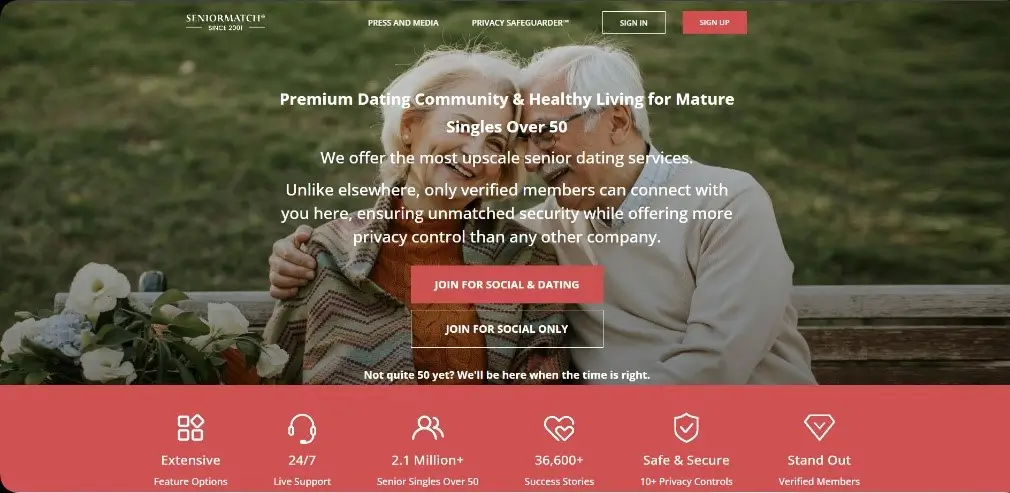
| SeniorMatch (Also Consider) | Dedicated 50+ alternative to OurTime | Strict 50-plus network | Enforces waiting restrictions on daters under 50 |
1. Match — Best for Self-Directed Screening
Imagine you are 43, divorced, sharing 50/50 custody of two middle-schoolers, and firmly done having biological children. Leaving your dating life to a generic algorithmic feed almost guarantees a steady stream of mismatched expectations.
A divorce, the loss of a spouse, or a complex parenting schedule does not dictate which platform you should join, but it fundamentally alters what you need to filter for right away. (If you are re-entering dating after spousal loss, explore our guide to the Best Dating Sites for Widows and Widowers). Match makes sense when you already know your boundaries and insist on controlling the search parameters yourself.
Match’s search console allows you to cross-reference multiple granular criteria:
- Marital history (divorced, widowed, never married).
- Current parenting status versus desire for additional children.
- Religious background and observance levels.
- Professional background and daily lifestyle habits.

The Mechanism Caveats
While Match gives you hands-on filtering, two operational realities require attention:
- Top Picks Criteria Relaxation: According to Match’s official help documentation, the daily “Top Picks” feed intentionally relaxes parameters like age, distance, and height to expand recommendations. If you rely passively on automated feeds, you will encounter profiles that breach your core deal-breakers. Rely instead on custom saved searches executed manually.
- Search Paywall Restrictions: Match promotes basic discovery as open, but technical terms show that unlimited search sorting and advanced criteria tools are tied to specific paid subscription tiers.
Before subscribing, register a free account to verify how many active, relevant profiles actually exist within your commuting radius.
2. eharmony — Best for a Structured Reset
After a long marriage or a difficult breakup, jumping directly into an open, high-speed dating pool can trigger immediate app fatigue. If browsing thousands of superficial bios feels overwhelming, eharmony provides a deliberate, guided pace.
The platform requires all members to complete an 80-plus question Compatibility Quiz during onboarding. This friction serves a clear functional purpose: it weeds out low-effort users looking for casual, immediate gratification.
The resulting Compatibility Breakdown evaluates communication styles, conflict resolution habits, and long-term values. For daters out of practice with modern courtship, this structure provides substantive conversational material on day one, bypassing awkward small talk.

The Functional Tradeoff
The tradeoff is total loss of search autonomy. eharmony functions as an algorithmic delivery pipeline, not a searchable directory. You cannot run keyword queries or manually browse the broader database.
If the system’s recommendations in your zip code are thin, you cannot take the wheel and look for candidates yourself. Treat its compatibility scoring as useful conversational context, not a scientific forecast of relationship success.
3. EliteSingles — Best for Career- and Education-Conscious Professionals
On the current EliteSingles homepage, the service explicitly positions itself around “educated and ambitious singles”. For mid-career executives, physicians, attorneys, and business owners in their 40s, intellectual parity and compatible work rhythms are often central to relationship longevity.

Instead of an unconstrained catalog, EliteSingles delivers 3 to 7 curated daily matches based on a Five Factor Model personality assessment combined with stated career preferences. This setup appeals to professionals working 60-hour weeks who have zero interest in spending their evenings scrolling through open feeds.
The Claim Boundary
EliteSingles states that 85% of its members are highly educated. Keep in mind that this is a corporate marketing claim, not an independently audited metric.
Furthermore, professional standing should never be conflated with emotional maturity. An advanced degree or a corporate title indicates ambition, but it reveals nothing about how a partner manages conflict, expresses empathy, or shares parenting duties. Treat professional filters as a lifestyle baseline rather than an indicator of character.

Geographic Density Limits
EliteSingles maintains active pools in major metropolitan areas, but member density drops sharply in secondary and rural markets. Evaluate your initial match batches under a basic account before committing to a paid membership.
4. Hinge — Best Modern App Option for the Younger Side of 40+
Being 42 does not mean you are obligated to move to a senior-specific dating site. If you are in your early-to-mid-40s and still prefer an app-first dating experience, Hinge provides an engaging format without the superficiality of Tinder.
Its defining feature is Profile Prompts, which interleave photos with short personal statements. For daters aged 40 to 46, prompts provide an effective canvas to showcase humor, parenting perspectives, and life priorities. Users initiate contact by responding directly to a specific prompt or photo, creating natural conversation starters.

Critical Technical Caveats
Three operational details require attention before relying on Hinge:
- The “Flexible” Preference Trap: Hinge’s settings include a “Flexible” option by default. If you do not explicitly toggle a preference to “Dealbreaker,” the algorithm will surface candidates outside your stated boundaries.
- The Family Plans Paywall: Basic demographic filters (age, distance) are free. However, filtering specifically for “Children” and “Family Plans” (whether someone wants biological children) is restricted behind the paid Hinge+ and HingeX tiers. On the free version, you must manually inspect profiles to avoid matching with younger users looking to start brand-new families.
- Manual Location Overrides: Hinge allows users to set their primary location manually, and it does not automatically update when they travel. A match who appears “nearby” may actually reside in another state, making verbal verification of their current physical residence necessary early on.
5. OurTime — Best for Readers Moving Toward a 50+ Environment
When does an age-focused dating platform actually make sense?
Consider a 48-year-old whose children have left for college, whose career is settled, and whose social circle is naturally shifting toward later-life priorities. That dater will likely feel far more comfortable in an age-curated environment than a 41-year-old managing daycare drop-offs.
OurTime caters to mature singles, eliminating the multi-generational noise and demographic mismatch of general dating apps. The service offers an uncluttered interface suited to those re-entering the market after bereavement, divorce, or an extended hiatus.

The Demographic Reality
Being in your late 40s or 50s does not automatically imply an interest in legal remarriage.
A frequent source of friction occurs when one partner seeks a formal wedding, while the other—frequently to protect pensions, estates, or adult children’s inheritances—insists on a permanent Living Apart Together (LAT) arrangement. OurTime provides a relevant demographic pool, but you must clarify expectations around cohabitation and legal marriage early.
If you are in your early 40s with dependent children, OurTime’s overall pace will likely feel disconnected from your daily life.
6. Tawkify — Premium Pick for Delegating the Search
How much is your free time actually worth?
If you are an executive or business owner working 60-hour weeks while managing shared custody, spending ten hours a week swiping, messaging, and vetting profiles may simply be unrealistic. Tawkify addresses this by replacing self-serve software with private, human-led matchmaking.
Clients are assigned a dedicated matchmaker who conducts video consultations, sources prospective matches, conducts initial screenings, and coordinates in-person dates. The value proposition is not that a matchmaker holds a secret formula for chemistry, but that they handle the administrative overhead of sourcing and scheduling on your behalf.

Scrutinize the Service Contract
Matchmaking involves bespoke packages priced in the thousands of dollars, not a $30 monthly subscription. Before signing an engagement agreement, verify these operational terms in writing:
- The exact number of guaranteed introductions included in your package.
- Policies regarding pause requests, candidate replacements, and refund parameters.
- Candidate sourcing pipelines: Are introductions drawn from paying Clients, or selected from the broader, free Member database?
Candidates sourced from the free member database have not made the same financial commitment to the process. Understand this dynamic before hiring an agency.
Specialized Considerations: MillionaireMatch & SeniorMatch
MillionaireMatch: For Socioeconomic Alignment
Also consider MillionaireMatch if you want financial and lifestyle expectations to enter the dating conversation earlier. The platform focuses on professionals and high earners, with strict rules prohibiting sugar-dating or transactional arrangements.

Its signature feature is the Certified Millionaire program. According to the service terms, this badge is voluntary and based on member-submitted documents like tax returns or asset statements.
Crucially, the company disclaims independent audits of these records, and the badge does not constitute a criminal background check or character reference. A financial badge tells you nothing about whether someone is honest, emotionally stable, or compatible with you. Use wealth strictly as an economic lifestyle preference, never as a proxy for trust.
SeniorMatch: A Dedicated 50+ Alternative
If you want an alternative to OurTime that strictly excludes younger demographics, SeniorMatch is worth comparing. Note that its registration system places waiting restrictions on accounts under 50, making it unsuitable for daters in their early 40s.
Four Reality Checks Before Paying for a Dating Site After 40
Run these practical diagnostics before entering payment details on any dating service.
1. The Parenting & Children Matrix
General dating apps frequently collapse family preferences into a generic “Has Kids” tag. In your 40s, family dynamics require evaluating five distinct variables:
- Current Custody: Are dependent children in the home full-time, or is custody shared on an alternating schedule (e.g., 50/50 split)?
- Biological Future: For daters aged 40 to 45, are biological children desired, firmly off the table, or open to discussion? Mismatched timelines here cause sudden breakups.
- Stepparenting Boundaries: Does the parent expect a prospective partner to step into an active co-parenting role, or maintain separate parental boundaries?
- Dating Windows: Do non-custodial weekends align, or does limited childcare create scheduling gridlock?
- Co-Parenting Dynamics: Is there a stable, business-like communication boundary with the former spouse?
If you are actively navigating custody rotations, childcare budgeting, and solo parenting logistics, consult our dedicated guide to the best dating apps for single parents.
If you are actively navigating custody rotations, childcare budgeting, and solo parenting logistics, consult our dedicated guide to the best dating apps for single parents.
2. Testing Filter Strictness & Recommendation Leaks
Many platforms quietly override your selected preferences to keep recommendations flowing:
- On Hinge, verify that critical preferences are set to “Dealbreaker,” not left on “Flexible”.
- On Match, bypass the daily “Top Picks” feed—which routinely relaxes age and distance—and execute saved custom searches manually.
- Confirm whether deal-breaker filters (such as family plans or smoking) are functional on the free tier or restricted behind a paywall.
3. The 72-Hour Local Pool Reality Check
Never commit to a six- or twelve-month membership based on an initial welcome screen:
- Register for a basic account without entering billing info.
- Set your actual location and an acceptable commuting radius (25–35 miles).
- Apply your core non-negotiable filters.
- Track new profiles across three consecutive days.
If the directory runs out of profiles within 72 hours, purchasing a premium tier will not fix the underlying local supply deficit.
4. Badges Are Not Background Checks
Recognize the technical boundaries of app verification badges:
- Photo Verification: Confirms that a selfie matches profile photos; it does not verify identity, criminal history, or marital status.
- ID Badges: Confirm that an uploaded driver’s license matches the account name; they do not screen for active domestic legal proceedings.
- Wealth Badges: Acknowledge submitted tax forms without providing an independent financial audit.
Financial Red Lines
Bad actors frequently target mid-career daters who are perceived to have accumulated retirement assets or home equity. Terminate communication immediately if a match:
- Discusses cryptocurrency trading, foreign exchange platforms, or investment opportunities.
- Requests money for emergency business crises, medical bills, or travel logistics before meeting in person.
- Refuses to participate in a standard video call or in-person public date within two to three weeks.
Related guides: Dating Profile Verification · Online Dating Safety Checklist · How to Tell If a Dating Profile Is Fake · Are Paid Dating Sites Worth It?
Frequently Asked Questions
What is the best dating site for someone over 40?
The answer depends on how you want to manage discovery. Match is the best starting point if you have specific family deal-breakers and want direct search control. eharmony suits singles seeking structured matching that eliminates superficial swiping. Hinge is the strongest choice for singles in their early 40s wanting an interactive mobile app, while OurTime serves those approaching 50 who prefer an age-curated peer community.
Is Hinge good for people over 40?
Yes, particularly if you are between 40 and 46. Its prompt-driven format highlights humor, personality, and family life effectively. However, locking down family planning filters requires upgrading to Hinge+, and critical preferences must be marked as "Dealbreaker" to prevent recommendation leaks.
Is Match or eharmony better after 40?
Choose Match if you want to inspect local directories directly, filter by specific marital or parenting statuses, and manage your own vetting. Choose eharmony if you experience dating burnout and want guided match delivery that emphasizes emotional compatibility and communication.
Should I use a 50+ dating site in my 40s?
Generally, no. Unless you specifically want to date someone older, platforms like OurTime and SeniorMatch focus on later-life transitions, retirement, and grandparenthood. Singles in their early 40s managing young families or active careers will find better demographic alignment on Match, eharmony, or Hinge.
What is the best dating site for women over 40?
Women over 40 often prioritize privacy and control over inbound communication. eharmony reduces unsolicited messages through guided matching, while Match provides granular blocking and visibility toggles. For women balancing demanding executive careers, Tawkify eliminates public profile exposure entirely.
What is the best dating site for men over 40?
Men over 40 often face divergent family planning goals—either dating women who are firmly childfree or seeking partners interested in starting a family. Match offers the most direct utility here, as its advanced preference filters allow men to screen specifically for future parental intentions without guessing.
Are paid dating sites worth it after 40?
A paid subscription is worth it only when it unlocks features essential to your vetting process, such as direct messaging or advanced family filters. Paying confirms financial capability, not emotional maturity or relationship readiness. A paid plan provides better administrative tools, but you must still verify the character of the person behind the profile.
Dating successfully after 40 requires treating platforms as specialized tools rather than general solutions. Use Match for granular control over complex family boundaries, eharmony for guided compatibility, EliteSingles for professional alignment, Hinge for an interactive mobile experience, OurTime for mature empty-nest dating, and Tawkify when your calendar makes delegating the search worthwhile. Platforms narrow the search field, but direct communication regarding custody, finances, and relationship timelines ultimately determines long-term success.

Related Reviews & Guides
Explore our independent audits, pricing breakdowns, and relationship guides: