
Updated : Revised pricing language and removed specific price figures.

The 1-Minute Verdict: Modern Dating’s Best Anti-Swipe App, Held Back by Paywall Aggression
The Bottom Line: For singles aged 24 to 38 looking for an intentional, monogamous relationship, Hinge is currently the most practical mobile dating app in North America. By replacing the rapid left-or-right swipe with vertical profiles, mandatory written Prompts, and element-specific commenting, Hinge removes much of the thoughtless browsing that makes Tinder and Bumble exhausting.
The trade-off is parent company Match Group’s tightening monetization. What was once an open freemium experience now comes with clear operational ceilings: unpaid users are capped at 8 likes per day, standout profiles are routed into a separate tab requiring paid Roses, and subscriptions are split into two steep tiers: Hinge+ and HingeX.
Julian’s Personal Take: Hinge remains the most effective mobile app for young professionals who want to date with genuine intent without paying for a legacy desktop site. If you write specific, conversational prompt responses and use clear, unposed photos, the 100% free tier is genuinely usable—mutual matching and two-way messaging cost nothing. The 8-like daily cap can feel tight in dense cities, but it also discourages low-effort spam. Upgrade to Hinge+ only if your incoming queue becomes unmanageable. Skip HingeX entirely—paying extra for priority queue placement will not fix a bland profile. If you are over 38 or looking for marriage with zero tolerance for ghosting, step away from mobile apps entirely and consider a structured compatibility platform like eHarmony.
Table of Contents: Hinge Dating App Review
Hinge Decision Matrix: Who It Fits vs. Who Should Skip It
Before creating a profile or spending money on subscriptions, evaluate your age demographic, dating intentions, and geographic location against our editorial benchmarks:
| Your Dating Situation & Goals | Editorial Verdict | The Bottom Line (Why) | Recommended Strategy |
|---|---|---|---|
| Singles aged 24–38 looking for serious monogamy in an urban or suburban metro. | Best Fit | Profile prompts and comment-first messaging attract young professionals with authentic relationship intent. | Stay on the Free tier; use your 8 daily likes deliberately with specific comments on prompts. |
| Daters suffering from Tinder or Bumble swiping fatigue wanting deliberate pacing. | Best Fit | No rapid swiping mechanics; each profile must be reviewed individually from top to bottom. | Treat each like as a mini-conversation starter rather than a numbers game. |
| Budget daters unwilling to pay monthly fees who still want two-way messaging. | Great Value | Unlike legacy platforms (Match, eHarmony), Hinge allows 100% free mutual matching and unlimited chat. | Never pay for subscriptions unless your incoming queue exceeds 15 likes per week. |
| Mature singles aged 40+ or divorcees looking for marriage-minded peers. | Moderate Fit | Member density skews under 35. While older members exist, conversation drop-off rates are noticeable. | Explore platforms with established 40+ liquidity like Best Dating Sites for Over 40 or eHarmony. |
| Rural or small-town singles outside major commuter corridors. | Hard Skip | Hinge’s user base is heavily clustered in urban zones. Beyond a 35-mile radius, discovery pools dry up quickly. | Opt for larger legacy networks with broad rural reach like Match.com. |
| Daters looking for fast casual hookups, NSA encounters, or same-day dates. | Hard Skip | Mandatory profile prompts, anti-ghosting nudges, and relationship tags deter casual swipers. | Use purpose-built casual apps like Tinder, Pure, or Feeld. |
| Singles looking for certified background checks or validated marital status. | Reality Check | Hinge uses optional selfie photo verification, but does NOT perform criminal background or income screening. | Read our dating profile verification guide and maintain prudent offline safety rules. |
The Pros and Cons: What Works and What Stumbles
Here is an unvarnished summary of where Hinge excels as an intentional dating platform, and where its commercial mechanics create friction:
The Pros
- Prompt-Driven Conversations: Commenting on specific answers sparks natural dialogue before matching, bypassing generic opening lines.
- Fully Functional Free Tier: Free members can browse profiles, send 8 daily likes, match, and exchange unlimited text messages without paying.
- Mutual Preference Algorithm: The “Most Compatible” feature delivers one reciprocal match recommendation every 24 hours based on shared preference data.
- Mandatory Profile Depth: Users must upload 6 photos/videos and answer 3 prompts; low-effort single-photo blank bios are rejected by onboarding.
- “We Met” Feedback Loop: Follow-up surveys track whether first dates occurred, helping tune future recommendations based on real-world chemistry.
The Cons
- Strict 8 Daily Likes Limit: For active daters in competitive urban markets, 8 likes per day can feel severely restrictive.
- Aggressive “Roses” Monetization: Highly active profiles are frequently placed in the “Standouts” feed, demanding a $3.99 paid Rose to initiate contact.
- Expensive Tier Split ($29.99 vs $49.99): Splitting features between Hinge+ and HingeX creates steep pricing barriers with diminishing returns.
- Ghosting Remains Common: Despite anti-swipe features, the casual nature of mobile apps means unreturned messages and conversation drop-offs still occur.
- Urban Demographic Bias: Member density drops substantially in rural counties and secondary towns compared to major metropolitan centers.
1. Hinge Dating App Review: The “Designed to be Deleted” Philosophy
When Justin McLeod founded Hinge in 2012, it originated as a Facebook-connected friend-of-friends platform. In 2016, following extensive user feedback revealing dissatisfaction with the superficial culture of swipe apps, Hinge completely scrapped the horizontal swipe gesture and relaunched with its signature slogan: “The dating app designed to be deleted.”
In practice, anti-swipe design fundamentally alters user psychology in three distinct ways:
- Vertical Scrolling: Instead of rapidly flicking profile cards left or right within seconds based purely on a primary photo, Hinge displays profiles as an editorial, multi-page layout. You must scroll down past prompts, photos, voice notes, and lifestyle indicators.
- Element-Specific Interaction: You cannot simply “like” a person as an abstract profile. You must select a specific photo, a specific prompt response, or a specific voice memo and tap the heart icon attached directly to that item.
- Mandatory Friction as a Quality Filter: By allowing users to type a comment alongside their like for free, Hinge incentivizes context-rich openers. According to Hinge’s public engineering data, sending a comment alongside a like substantially increases initial response likelihood compared to sending a blank like.
This structural friction acts as a natural filter against bot networks, social-media self-promoters, and mindless rapid swipers. However, Match Group’s corporate ownership has gradually surrounded this core design with prominent monetization paywalls.
2. Profile Architecture: Prompts, Voice Notes & Lifestyle Badges
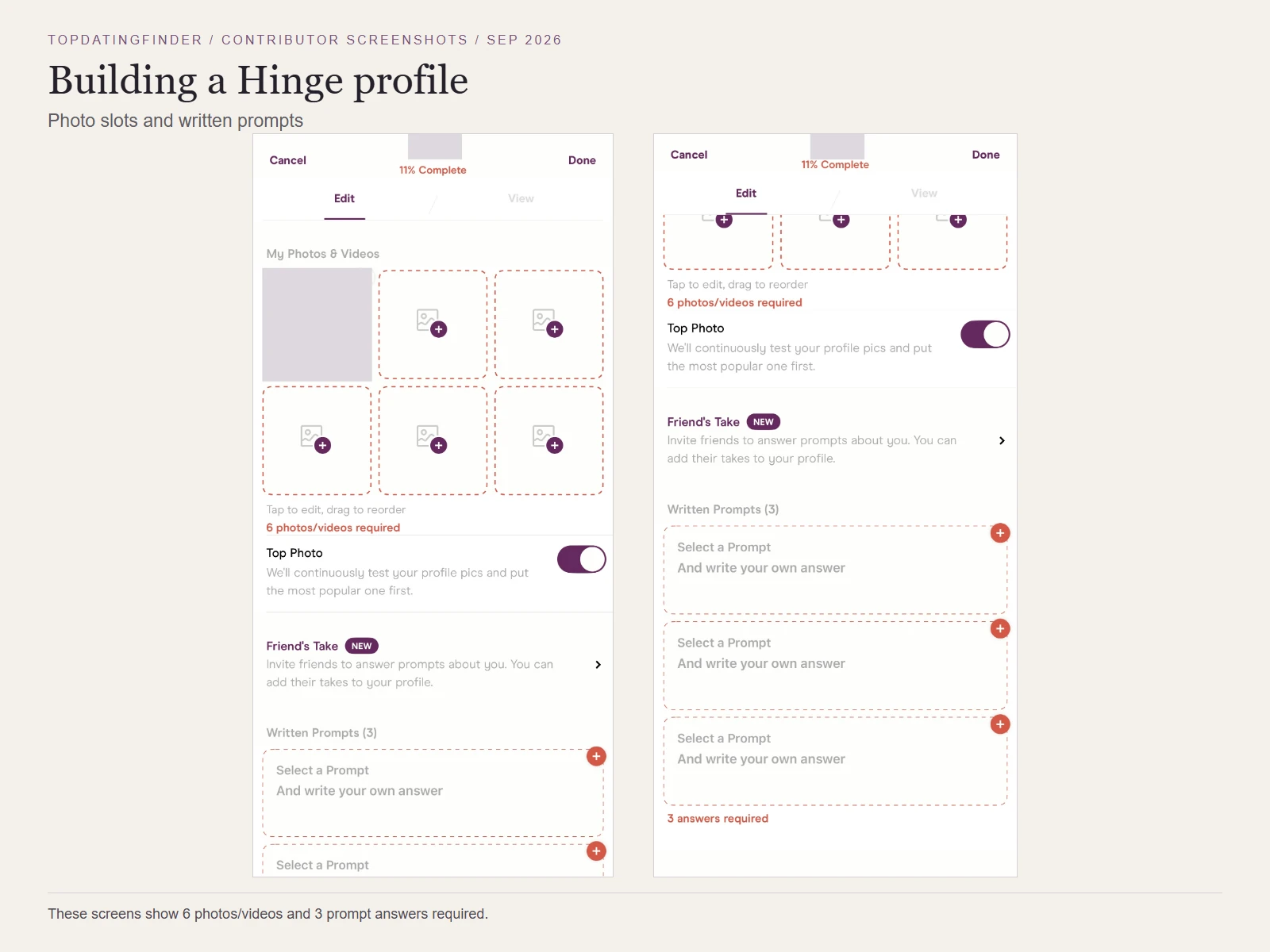
A Hinge profile consists of a strictly mandated framework: exactly six photos or video loops, exactly three written Prompts selected from a rotating library of over 100 choices, and optional Voice Prompts.
A. The Three Profile Prompts
Hinge Prompts are conversational prompts designed to reveal humor, lifestyle habits, and dating priorities. Common examples include:
- “Together, we could…”
- “I’m looking for someone who…”
- “The most spontaneous thing I’ve ever done…”
- “Two truths and a lie…”
Editorial Testing Insight: The most common mistake new users make is writing generic prompt answers—such as claiming to love travel, tacos, or “someone who doesn’t take themselves too seriously.” Prompts work best when they provide concrete conversational hooks. Mentioning a specific niche hobby, an opinion on local architecture, or a funny childhood memory gives potential matches an effortless reason to reach out.
B. Voice Prompts and Video Prompts
Hinge allows members to record a 30-second audio clip answering a prompt (e.g., “Saying the word ‘caramel’ in my native accent” or “My best impression of a movie trailer”). Hearing someone’s vocal cadence, laugh, and tone helps gauge personality early and reduces photo-only misrepresentation before meeting.
C. Vitals, Virtues & Dealbreaker Filters
Hinge allows users to display key demographic badges, including:
- Vitals: Age, Height, Location, Hometown, Ethnicity, Work, School.
- Virtues: Religious beliefs, Political leaning, Dating intentions, Relationship type (monogamy vs. non-monogamy).
- Vices: Drinking, Smoking, Cannabis, Other drugs.
Crucially, Hinge allows you to mark standard fields as a “Dealbreaker.” If you select “Non-smoker” as a dealbreaker, Hinge will strictly hide any member who smokes, regardless of other compatibility factors. Standard dealbreaker enforcement is completely free, making Hinge notably more practical than apps that gate basic lifestyle filtering behind subscriptions.
3. The 8 Daily Likes Limit & The Incoming “Likes You” Feed
Perhaps the most polarizing operational constraint on Hinge is its daily likes ceiling. Unpaid members receive exactly 8 likes every 24 hours, resetting at 4:00 AM local time.
Intentional Scarcity vs. Paywall Coercion
The 8-like limit creates a distinct trade-off between user intentionality and platform monetization:
- The Positive Impact: On swipe-based apps, many users swipe right indiscriminately, generating empty matches that never message. By capping likes at 8, Hinge forces users to consider whether a profile is genuinely worth a portion of their daily allocation. This intentionality directly benefits popular daters, who receive fewer spam likes and more thoughtful openers.
- The Frustration Point: In dense metropolitan areas where match rates can be modest, sending 8 likes per day means building connections slowly. This scarcity is calculated to encourage purchases of Hinge+ (from $29.99/mo), which removes the daily limit entirely.
The Incoming “Likes You” Queue Mechanism
Unlike Tinder Gold or Bumble Premium, where unpaid users see their inbound likes blurred out into unrecognizable shapes, Hinge displays incoming likes completely unblurred for free. However, there is a structural restriction: free users can only view one incoming like at a time.
You must either match with that individual or tap the “X” to dismiss them before the app reveals the next person waiting in your queue. This 1-by-1 mechanism prevents users from casually comparing dozens of admirers without taking action. To see your entire incoming likes queue in a clean, multi-column grid simultaneously, you must subscribe to Hinge+.
4. The Algorithm Decoded: Gale-Shapley & “Most Compatible”
Unlike Tinder’s legacy Elo score—which ranked users on an absolute hierarchy of physical attractiveness—Hinge’s recommendation engine is grounded in cooperative game theory. Specifically, Hinge’s engineering team adapted the Gale-Shapley Stable Marriage Algorithm, a Nobel Prize-winning economic model designed to pair two distinct groups based on mutual, ranked preferences.
Traditional dating apps ask: “Who is the most attractive person nearby?” Hinge’s algorithm asks: “Who is Person A most likely to like, AND who among those candidates is most likely to like Person A back?” It optimizes for mutual reciprocation rather than one-sided browsing.
The Daily “Most Compatible” Pairing
Once every 24 hours, Hinge spotlights a single profile labeled “Most Compatible.” According to product disclosures from Match Group, users are substantially more likely to go on an actual in-person date with their “Most Compatible” pairing than with a random profile from the standard discovery feed.
The algorithm refines these daily suggestions over time by analyzing your historical liking patterns, pass behavior, and dealbreaker boundaries, looking for subtle commonalities in lifestyle, education, and conversational interests.
The “We Met” Real-World Date Feedback
Hinge’s primary method for training its machine learning models is the “We Met” feature. A few days after exchanging phone numbers or initiating active messaging in the app, Hinge privately prompts both parties with a simple questionnaire: “Did you meet in person?” and “Are they the type of person you’d like to see again?”
If both users confirm that they met and enjoyed the date, the algorithm reinforces the attributes of that pairing across future discovery feeds. If a date was unsatisfactory, Hinge recalibrates recommendations accordingly. This closed-loop offline feedback helps align the recommendation engine with real chemistry rather than just in-app screen time.
5. The Standouts & Roses Economy: Ethical Dating or Virtual Cash Grab?
While Hinge’s core discovery feed remains an effective space for intentional dating, its secondary “Standouts” tab represents the platform’s most controversial monetization mechanism.
What Is the Standouts Feed?
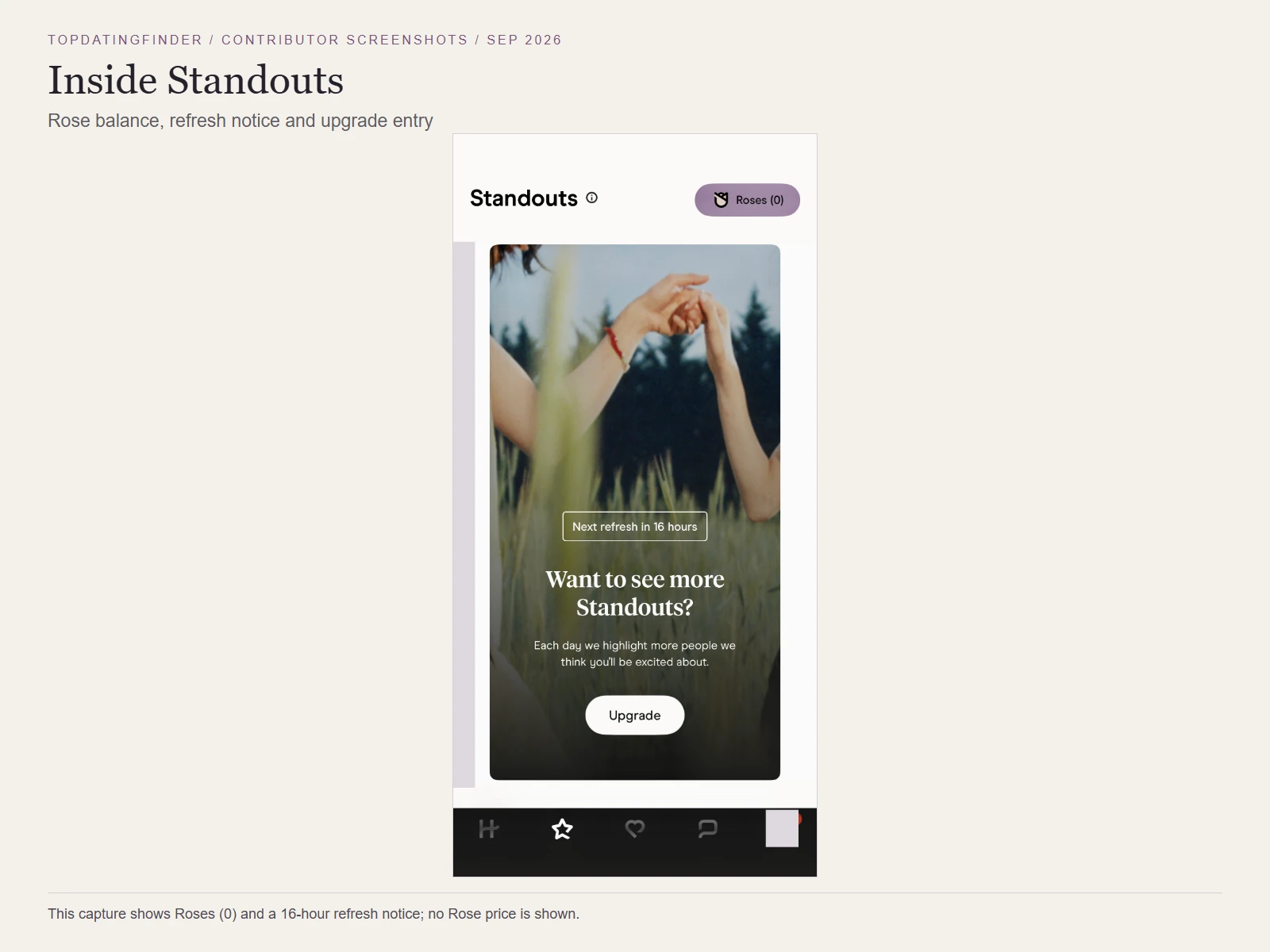
Located behind a star icon on the bottom navigation bar, Standouts displays a daily curated collection of profiles. These are users who have received an exceptionally high volume of incoming likes and comments in your local area. In effect, Hinge isolates high-activity, popular daters into a dedicated showcase.
The “Rose” Paywall Friction
You cannot use one of your 8 free daily likes on a Standouts profile. To send a like to someone in Standouts, you must send a “Rose.”
- Hinge grants every member one free Rose per week, deposited into accounts every Sunday at noon.
- Once your weekly Rose is exhausted, additional Roses must be purchased as in-app microtransactions:
- 1 Rose: $3.99
- 3 Roses: $10.49 ($3.50 each)
- 12 Roses: $29.99 ($2.50 each)
- 50 Roses: $99.99 ($2.00 each)
In our editorial view, buying paid Roses represents poor value for money. Highly sought-after users in the Standouts feed already receive substantial inbound attention. A virtual rose does not compel someone to reply; in practice, high-demand members often find unsolicited roses overly forward compared to receiving a charming, unforced comment on their standard profile. We advise readers to rely on the free weekly Rose and avoid purchasing standalone microtransactions.
6. Hinge Dating App Review: Paywall Audit (Free vs. Hinge+ vs. HingeX)
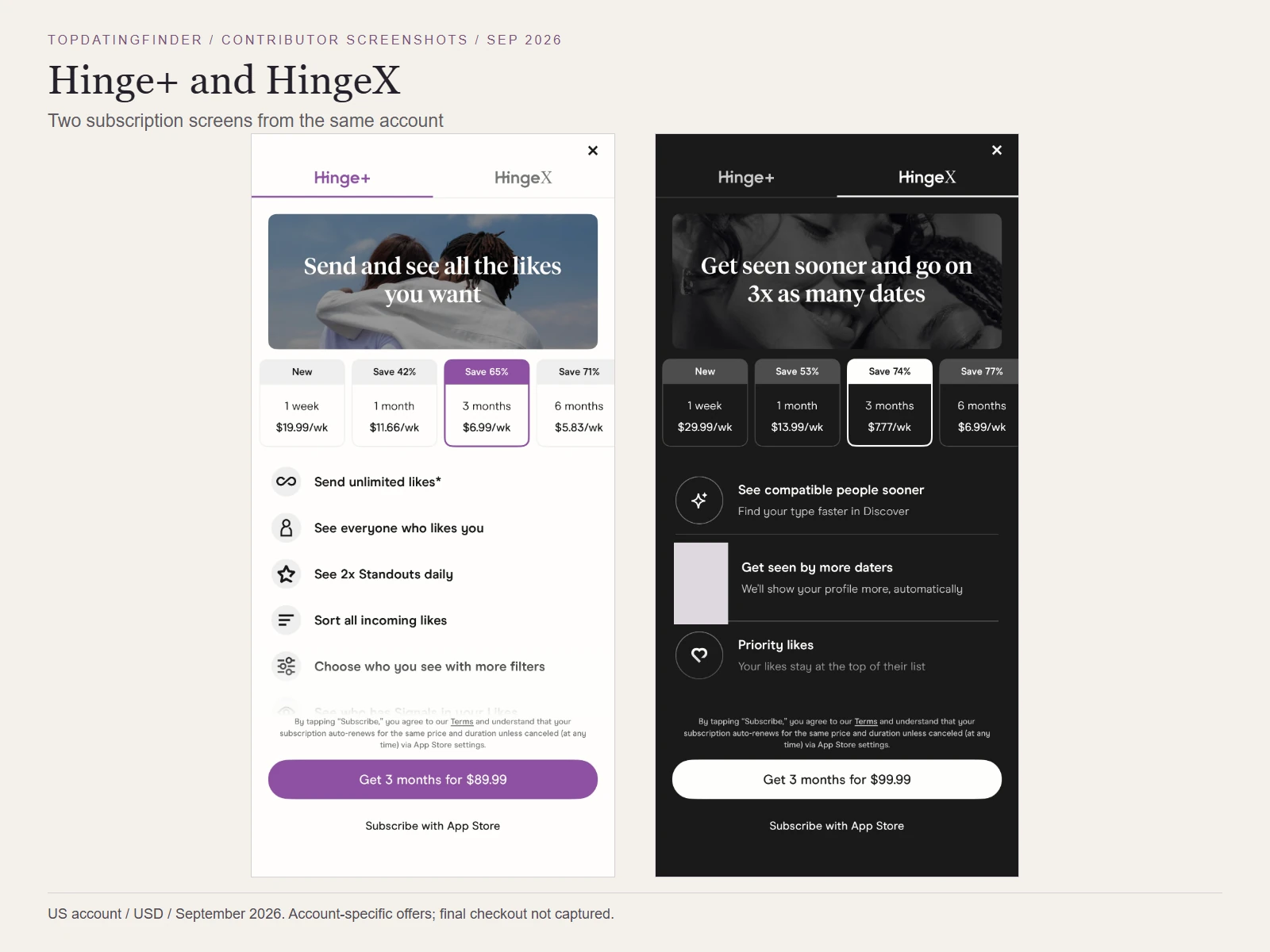
A central evaluation in this Hinge dating app review is paywall fairness. In 2023, Hinge replaced its legacy “Preferred” membership by splitting paid access into two distinct tiers: Hinge+ and HingeX. Before committing funds, daters should understand how Hinge structures its pricing and where marketing claims diverge from practical value.
Pricing Transparency & Dynamic Tiering
Like many Match Group applications, Hinge utilizes dynamic, localized pricing. Published rates and in-app offers vary depending on your age demographic, geographic market density, and active promotional test buckets. Readers should always check their local in-app checkout screen before purchasing.
In our verified US contributor account walkthrough (September 2026, captured above):
- Hinge+ 3-Month Plan: Quoted at $89.99 total (displayed as $6.92/wk).
- HingeX 3-Month Plan: Quoted at $99.99 total (displayed as $7.69/wk).
The Weekly Breakdown Presentation Tactic: Underneath each commitment button, Hinge prominently displays a weekly breakdown rate (`/wk`). While this makes plans appear relatively inexpensive on screen, the App Store charges the full 3-month contract amount as a single upfront lump sum. Across standard US App Store baseline tiers, 1-month subscriptions typically range from $29.99 to $34.99 for Hinge+ and $49.99 for HingeX.
| Feature / Capability | Hinge Free | Hinge+ (from $29.99/mo) | HingeX (from $49.99/mo) |
|---|---|---|---|
| Monthly Plan Cost (1-Mo) | $0.00 | ~$29.99 – $34.99 / month | ~$49.99 / month |
| 3-Month Contract Range | $0.00 | $59.99 – $89.99 total (dynamic) | $99.99 total (dynamic) |
| Daily Likes Allocation | 8 likes / 24 hours | Unlimited Daily Likes | Unlimited Daily Likes |
| View Incoming “Likes You” | 1 profile at a time | Full Grid View (All Likes) | Full Grid View (All Likes) |
| Advanced Preference Filters | Basic dealbreakers only | Education, Family Plans, Politics | Education, Family Plans, Politics |
| Priority Likes (Top of Queue) | No | No | Yes (Likes stay elevated) |
| Enhanced Recommendations | No | No | Yes (Real-time feed tuning) |
| Two-Way Text Messaging | Included (100% Free) | Included | Included |
Is Hinge+ Worth the Cost?
Verdict: Yes, but primarily as a time-saver. If you live in a dense metropolitan area and receive a regular stream of incoming likes, Hinge+ eliminates the friction of reviewing admirers one by one. Being able to browse your admirer queue in a clean multi-column grid streamlines your routine. Furthermore, if you prefer to batch your dating outreach on weekends rather than opening the app daily, unlimited likes provide practical flexibility.
Is HingeX Worth $49.99/Month?
Verdict: Firmly No for most users. At approximately $50 per month (or $600 annually), HingeX is priced higher than standard memberships on Match or Bumble. The headline feature is “Priority Likes”—ensuring your comment remains elevated near the top of the recipient’s incoming queue. Match Group’s marketing copy in the app claims this leads to “3x as many dates,” but this is an internal promotional claim rather than an independently verified outcome.
In practice, if someone is not attracted to your photos or prompt responses, priority queue placement simply ensures they decline your profile faster. Paying $50 a month cannot substitute for strong photos and authentic conversational skills. That money is far better spent on professional photography or actual first-date experiences.
7. Account Walkthrough, Verification & Messaging Reality
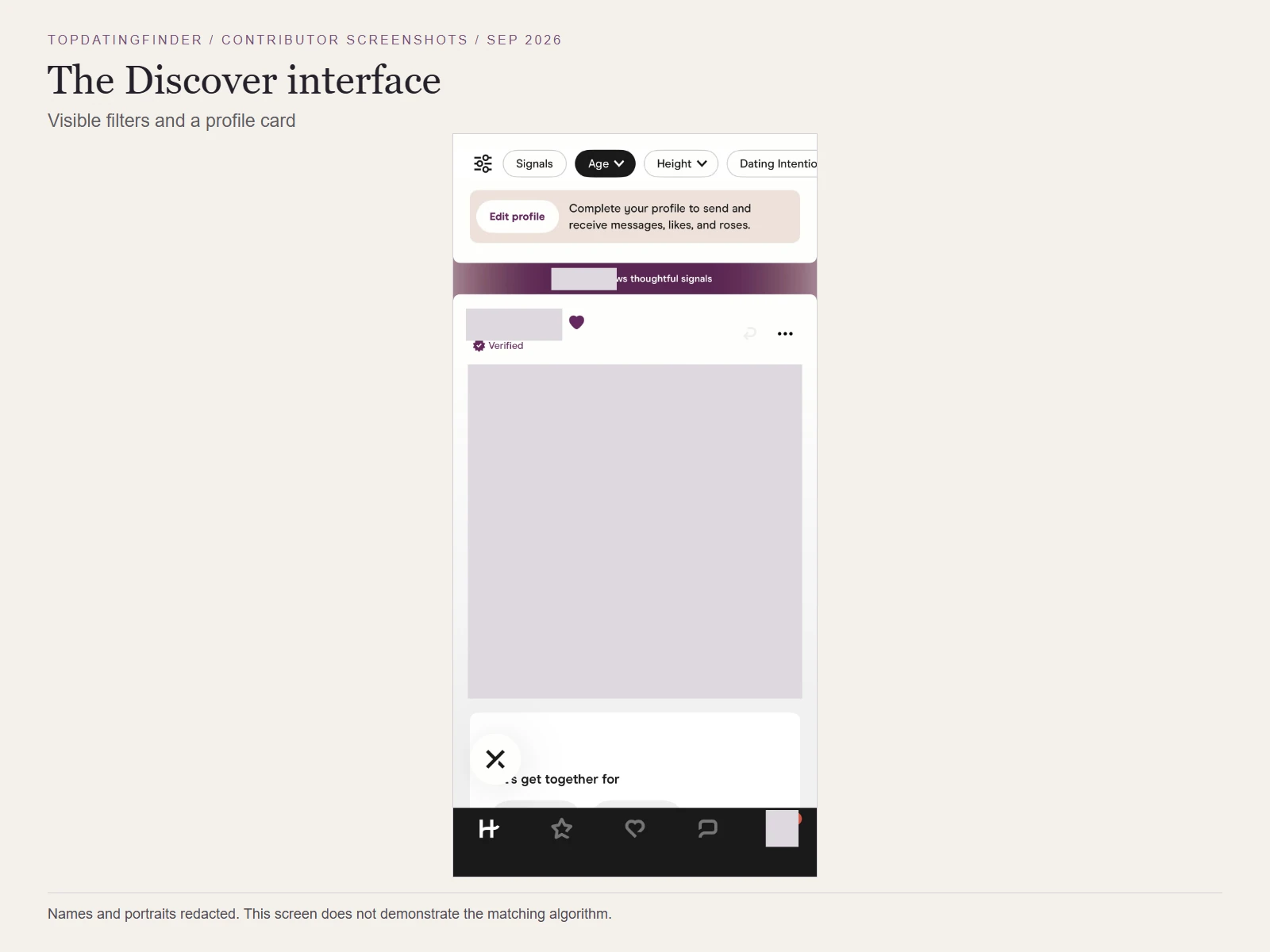
In conducting our Hinge dating app review walkthrough, we evaluated its onboarding sequence, verification tools, and conversation dynamics against real-world user expectations.
A. Onboarding & Account Verification
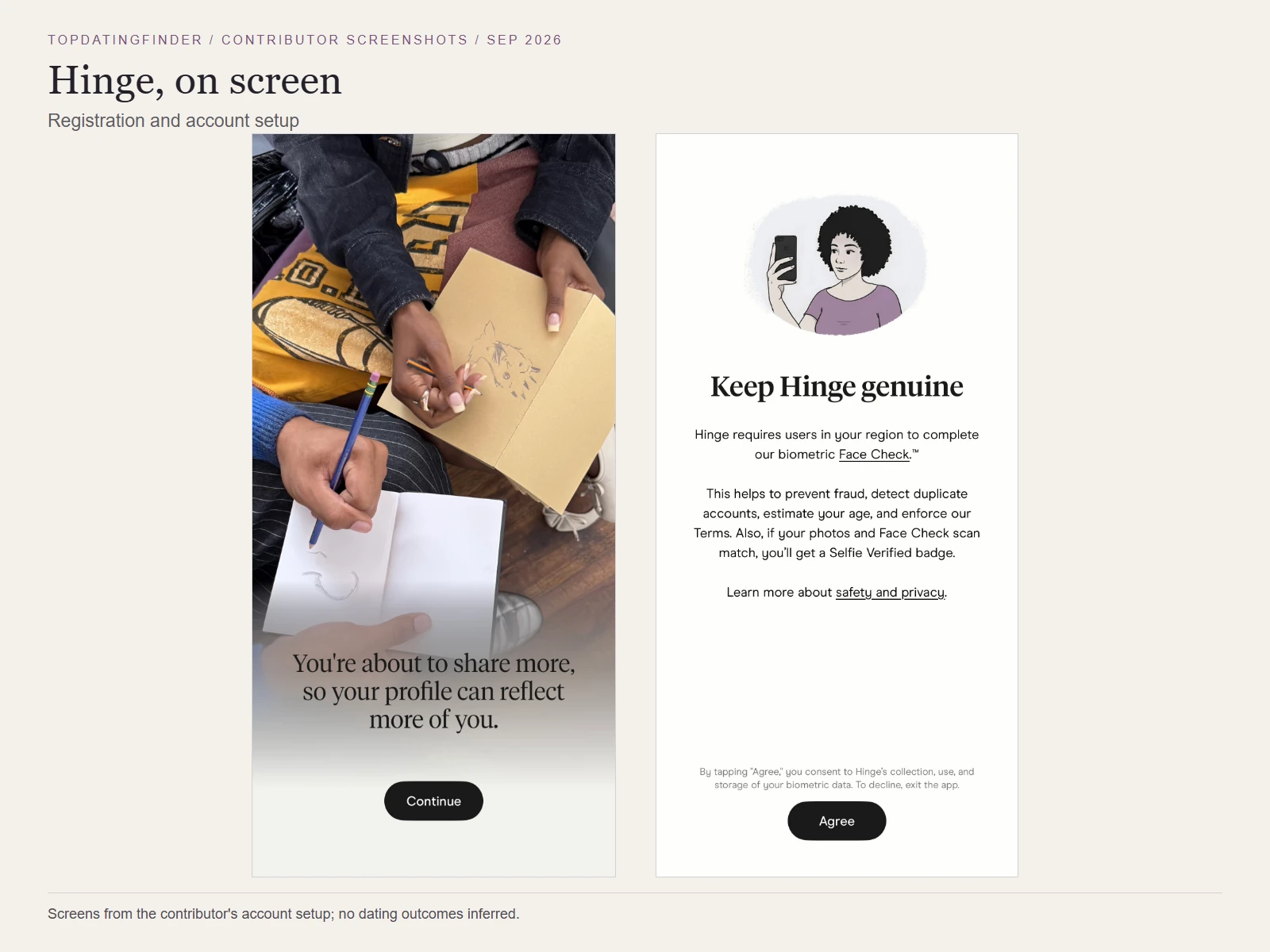
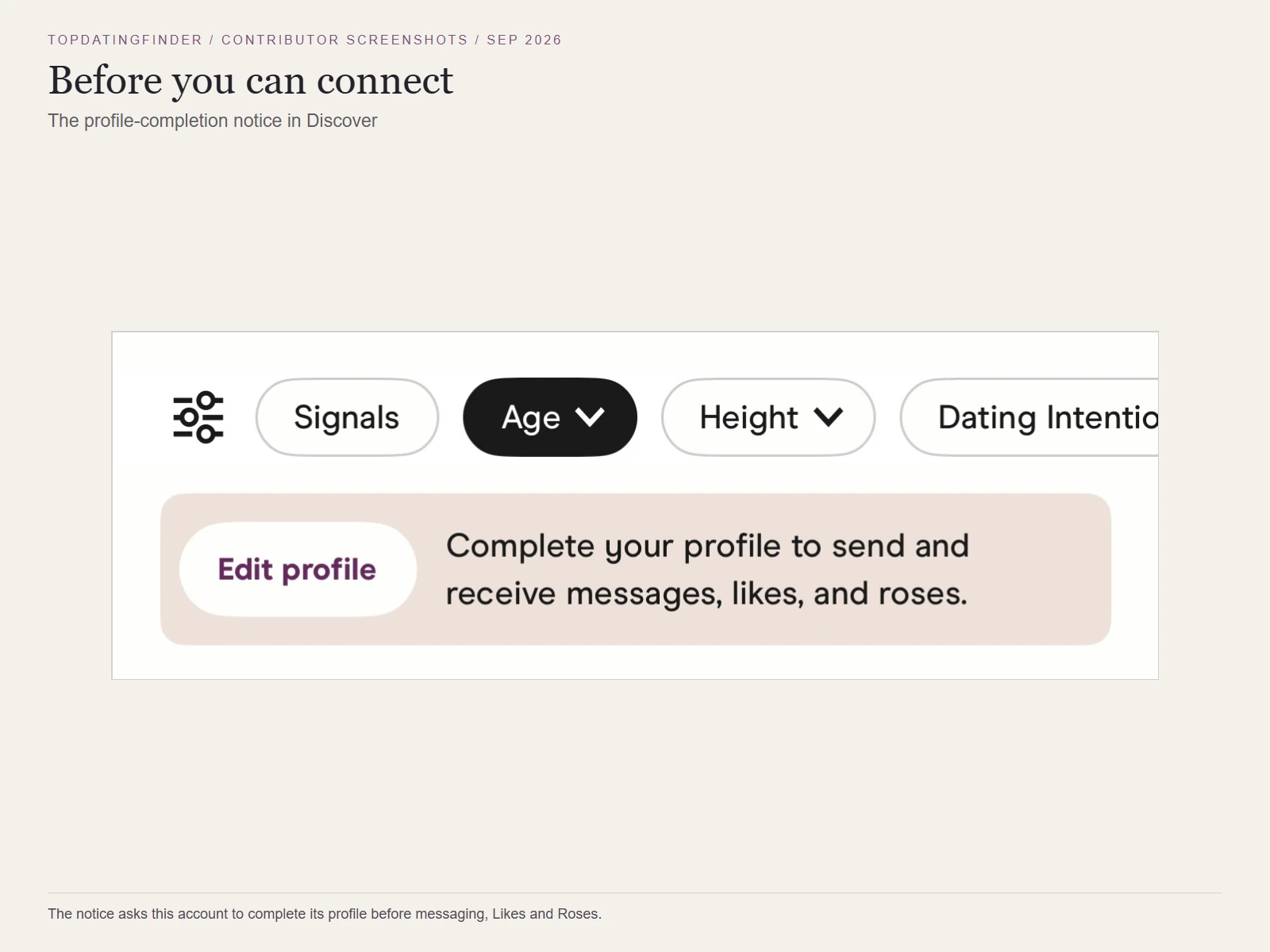
Account creation takes approximately 10 to 15 minutes. Hinge enforces a strict completion gate: you cannot enter the discovery feed or send likes until all six photo or video slots are filled and all three prompts have written responses.
During setup, Hinge presents a regional Face Check / Selfie Verification prompt (shown in our contributor walkthrough above). This feature scans facial geometry via a brief video selfie to confirm that your photos depict a real person, awarding a blue verified checkmark. While this helps deter catfishing and bots, daters should understand its legal limits: Hinge does NOT conduct criminal background checks, sex offender registry screenings, or income verification.
B. The Contextual Messaging Flow
When you match with someone on Hinge, the conversation does not open to an empty text box. The specific photo or prompt response that triggered the like is pinned directly to the top of the chat window alongside the initial comment. This contextual anchor eliminates awkward openers like “Hey, how’s your week going?” and provides an immediate topic for discussion.
C. The Ghosting Reality & Modern App Fatigue
While Hinge’s prompt system fosters more substantive opening conversations than swipe apps, it cannot eliminate modern app fatigue. Daters should anticipate realistic communication hurdles:
- Conversation Drop-offs: Matches frequently stop responding after three or four messages if neither party moves toward a voice call or an in-person meeting.
- Ghosting: Sudden mid-conversation silence remains a regular aspect of mobile app culture.
- Intent Misalignment: While Hinge skews heavily toward relationship-minded daters, some users still use the app casually or passively without genuine availability to meet.
Nevertheless, because free users cannot spray hundreds of likes across an entire city in a single evening, daters on Hinge tend to be noticeably more responsive than those on open-swipe networks.
8. The Serious Dating Bridge: When to Graduate from Hinge to eHarmony
While Hinge is an effective mobile app for singles in their twenties and early thirties, many daters reach a point where mobile messaging feels repetitive. If you find yourself repeatedly matching with people who are hesitant to commit or overwhelmed by options, it is helpful to recognize Hinge’s demographic boundaries.
| Dimension / Metric | Hinge (Mobile Anti-Swipe) | eHarmony (Psychological Compatibility) |
|---|---|---|
| Primary Age Cohort | 22 to 36 years old | 30 to 55+ years old |
| Dating Intention | Serious relationships & intentional dating | Exclusively marriage & lifelong partnership |
| Matching Mechanism | Prompt banter & mutual physical attraction | 32-Dimension Psychological Compatibility Quiz |
| Free Communication | Yes (Unlimited two-way chat) | No (Mandatory subscription paywall) |
| Ghosting & Flake Rate | Moderate (Casual drop-offs still common) | Very Low (Financial commitment filters out casual daters) |
| Typical Pricing Tier | Free to $29.99/mo (Hinge+) | $35.90 to $65.90/mo (Annual commitment) |
For daters over 30 whose explicit objective is marriage, the paywall on eHarmony serves as an effective quality filter. Because active members have invested financially in a multi-month commitment, members share an urgency to find a compatible partner rather than passively chatting. For a complete financial breakdown of plans, check out our guide on how much eHarmony costs in 2026.

eHarmony: The Definitive Choice for Serious Commitment
If you have experienced app fatigue on Hinge and want structured psychological compatibility matching over gamified swiping, eHarmony remains our highest-rated relationship platform.
- 32-Dimension Assessment
- Verified Intent Profiles
- High Marital Success Rate
Read our complete 2026 eHarmony cost & subscription breakdown →
9. Frequently Asked Questions: Hinge Dating App Review (2026)
Can you actually get dates on Hinge without paying anything?
Yes, absolutely. Unlike eHarmony or Match where private messaging is locked behind a subscription paywall, Hinge allows free members to send 8 likes per day, match with mutual admirers, and exchange unlimited text messages for free. If you optimize your three prompts with engaging conversational hooks and use clear photos, you can consistently arrange dates without spending money.
What is the difference between Hinge+ and HingeX?
Hinge+ (from $29.99/mo) gives you unlimited daily likes, the ability to view your entire incoming likes queue in a multi-column grid, and advanced preference filters. HingeX (from $49.99/mo) includes everything in Hinge+ plus “Priority Likes” (your likes stay elevated near the top of recipients’ feeds) and “Enhanced Recommendations.” For most users, HingeX provides diminishing returns; Hinge+ is the more rational choice if you need extra tools.
What happens when you send someone a Rose on Hinge?
A Rose acts as an enhanced like that highlights your profile at the top of the recipient’s incoming “Likes You” feed with a rose icon. Roses are mandatory to contact profiles displayed in the curated “Standouts” feed. Every member receives one free Rose on Sunday, while additional Roses cost between $2.00 and $3.99 each. In our editorial view, buying Roses rarely changes whether someone finds your profile appealing.
How does Hinge’s “Most Compatible” feature work?
Every 24 hours, Hinge pairs you with a single profile using an adapted version of the Nobel Prize-winning Gale-Shapley Stable Marriage Algorithm. The system evaluates mutual preference indicators—including your past like and pass behavior, dealbreakers, and post-date “We Met” survey feedback—to suggest someone you are likely to appreciate and who is likely to appreciate you in return.
Does Hinge perform criminal background checks on members?
No. Hinge offers optional “Selfie Verification” to confirm that profile photos match a live video scan of your face, but it does NOT conduct criminal history screening, income verification, or sex offender registry checks. Daters should always practice prudent real-world safety: meet in public spaces, arrange personal transportation, and let friends know your plans.
How do I cancel my Hinge subscription to avoid auto-renewal?
Deleting the Hinge app from your phone does NOT cancel your subscription. If you subscribed on an iPhone, open iOS Settings > tap your Apple ID > Subscriptions > Hinge > Cancel Subscription at least 24 hours before your billing cycle ends. Android users must cancel through Google Play Subscriptions. Cancellations take effect at the end of the current pre-paid billing period.
Is Hinge better than Bumble for serious relationships?
For daters looking for intentional monogamy, Hinge generally outperforms Bumble. (See our full Bumble review). Bumble’s 24-hour message expiration timer creates conversational pressure, and opening lines frequently default to simple greetings (“Hey”, “👋”). Hinge’s prompt-first commenting sparks contextual dialogue from message one, leading to more natural conversations. For our in-depth evaluation of Bumble’s new 72-hour window and pricing, read our dedicated Bumble review.