

Stepping into online dating for divorced people often feels like landing in an unfamiliar world. If your last first date took place a decade ago over a quiet dinner, modern swipe culture—where a ten-year marriage is judged in 1.5 seconds—can feel disorienting, if not completely absurd.
You aren’t starting with a blank slate. You might be juggling custody schedules, guarding your financial independence, or seeking deep emotional intimacy while firmly refusing to ever share a lease again (Living Apart Together). Generic advice tells you to “just get back out there,” but standard swipe apps treat adult realities as baggage to hide. Finding the best dating sites for divorcees means choosing platforms that do the opposite: they offer stealth browsing to avoid running into coworkers or ex-in-laws, granular marital history filters, and a mature community that understands a divorce is a life chapter, not a character flaw.
We evaluated 8 major platforms, audited live privacy settings, and analyzed over 140 real post-divorce experiences across Reddit and community forums to identify the 5 services and dating apps for divorcees that genuinely protect your peace and dignity in 2026.
The Quick Verdict for 2026:
- Best Overall Baseline & Demographic Depth: Match.com — Offers the deepest local user pool in the 35–55+ demographic, comprehensive biographical essays, and an essential Private Mode to browse without alerting coworkers or ex-in-laws.
- Best for Emotionally Healed Daters Seeking Stability: eharmony — Its comprehensive 80-question psychological compatibility quiz and premium subscription pricing effectively filter out casual swipers and unhealed rebounders.
- Best for Modern, Low-Pressure Re-entry (30s–40s): Hinge — Mandatory prompt comments replace blank-screen anxiety, while clear relationship intention badges accommodate modern models like Living Apart Together (LAT).
- Best for Educated Professionals & High Earners: EliteSingles — A curated member pool where 85%+ hold university degrees, offering mutual understanding for demanding careers and post-divorce financial independence.
- Best for Regaining Agency & Controlled Pacing: Bumble — Puts women in charge of initiating contact within 24 hours, paired with built-in voice and video calling that protects personal contact details.
- Specialty Pick for Custody Schedules: Stir by Match Group — Specifically engineered for divorced parents, featuring a built-in “Schedule Match” calendar that coordinates parenting days and free evenings.
Navigational note: If you have never been married, see our guide to the best dating apps for serious relationships. If you are specifically seeking remarriage, explore the best dating sites for marriage. If you are 40+ dating during midlife transitions, read our guide to the best dating sites for over 40. If you are navigating dating after the loss of a spouse, consult our dedicated resource on the best dating sites for widows.
Table of Contents
At a Glance: Comparing the Best Dating Sites for Divorcees
Not every dating platform handles mature relationship transitions equally well. The decision matrix below compares our top recommendations across core adult criteria: demographic maturity, privacy controls, vetting standards, and pricing commitments.
| Platform | Best For | Primary Demographic | Privacy / Stealth Mode | Monthly Pricing Level | Divorcee Fit |
|---|---|---|---|---|---|
| Match.com | Best Overall Baseline | 35–55+ Years Old | Yes (Private Mode) | $21.99–$44.99/mo | High Fit |
| eharmony | Committed Stability | 32–60+ Years Old | Yes (Incognito Feature) | $35.90–$65.90/mo | High Fit |
| Hinge | Modern Intentional Re-entry | 28–45 Years Old | Partial (Pause Account) | Free tier / $14.99–$49.99 | High Fit |
| EliteSingles | Educated Professionals | 35–58 Years Old | Standard Vetting | $31.95–$59.95/mo | Moderate Fit |
| Bumble | Controlled Pacing & Agency | 28–48 Years Old | Yes (Incognito via Premium) | Free tier / $19.99–$39.99 | Moderate Fit |
| Stir by Match | Single Parents with Custody | 30–52 Years Old | Standard Controls | $18.99–$38.99/mo | Specialized (Parents) |
Dating After Divorce: Why Modern Apps Feel Like an Alien World
Talk to anyone downloading a dating app after a ten- or twenty-year marriage, and excitement is rarely the first word they use. “Disorienting” or “exhausting” comes up a lot more often. Online dating has shifted from the quiet, desktop-based personal ads of the 2000s into fast-moving mobile apps built around split-second photo swipes, opaque matching algorithms, and casual ghosting.
We spent hours combing through discussions across Reddit’s r/Divorce, r/datingoverforty, and r/OnlineDating. The recurring frustration isn’t that newly single adults lack confidence; it’s that mainstream dating apps were built for college students with infinite free time, not adults balancing careers, custody schedules, and real-world responsibilities.
1. The 10-to-20 Year Tech Hiatus: Surviving the Digital Culture Shock
If you married in your twenties and divorced in your late thirties or forties, you missed the entire rise of smartphone dating. You never had to curate a photo roster, decipher app acronyms, or worry about whether sending two texts in a row looks desperate. Jumping straight into dating after divorce apps can feel like being handed a script in a language you never studied.
“Back on the dating scene at 42 and immediately confused by dynamics on the apps. I’m in the midst of divorce. Not bitter or combative, we grew apart. Spent over a year in therapy and finally feel like I’m ready… but the way people interact now feels like an alien culture. The last time I dated, people actually called each other on the phone.”
— Highly upvoted perspective from u/Cal-Goat on Reddit’s r/datingoverforty
As another member, u/RustyDater38, reflected: “I married my college sweetheart at 23 and divorced at 37. I have literally never used a dating app in my adult life. Having your entire character evaluated in 1.5 seconds based on six photos feels brutal and unnatural.”
Feeling rusty isn’t a personal failure—it is completely expected. Adult relationships used to start through mutual friends, work events, or shared hobbies, where body language and tone did the heavy lifting. Swiping apps strip all of that away, expecting instant charisma in a tiny chat box. The solution isn’t to force yourself to become a master texter; it’s choosing platforms that encourage real bios and meaningful conversation instead of rapid photo flicking.
2. The Ex-Spouse Shadow: Escaping the “Trauma Dumping” Dilemma
Even clean, amicable divorces leave plenty of wreckage behind. Untangling a decade of shared finances, mutual friends, and domestic routines takes time. One of the easiest traps to fall into when you start dating again is turning a casual first drink into a 90-minute post-mortem of your marriage.
“I went on a date on Friday with a woman (38F); I’m 40M. Things were going well. The topic of marriage came up, as she’s been divorced, and she proceeded to tell me about her ‘narcissist ex-husband’ for 90 straight minutes. I felt like an unpaid therapist, not a romantic date.”
— Top-rated field observation from u/OnlineDater40 on r/OnlineDating
Here is the honest truth: there is a world of difference between being open about your history and venting about raw resentment. When you spend half of a first date running through everything your former spouse did wrong, your date usually hears two things: first, that your past is still running your daily life; and second, that any future misunderstanding might land them in the same villain role. Keeping your divorce summary brief, calm, and neutral isn’t about hiding the truth—it’s about making space for the person sitting right in front of you.
3. The Remarriage Paradox: When You Want Love, But Never Another Wedding (The Rise of LAT)
Conventional dating advice assumes everyone wants the standard track: date, move in together, get married, and combine bank accounts. But for plenty of divorced singles, that blueprint is officially retired.
Having already lived through the financial and emotional grind of dividing assets and separating households, many people want romance, exclusive companionship, and shared weekends—without ever cohabitating again. In modern relationship terms, this is often called Living Apart Together (LAT).
“I’m 45F, been divorced for 3 years… I think I genuinely prefer being single to the reality of dating at this age. The idea of companionship sounds great, but merging households, sharing finances, and dealing with someone else’s laundry again? Absolutely not. I want committed exclusivity, but Living Apart Together (LAT). I don’t want another legal entanglement.”
— u/Fearless-Zone-6832 in r/datingoverforty (165 upvotes)
On apps that force you to pick between “casual fling” or “marriage,” people who want LAT often look indecisive. In reality, they are completely serious about commitment—they just want separate keys. Platforms like Hinge and Match let you spell out your relationship goals clearly, helping you filter for partners who respect your independence from day one.
The Legal & Safety Checklist: What to Know Before Creating a Profile
Dating while in transition involves boundaries that unmarried singles rarely have to consider. Creating a profile before your legal divorce is finalized can affect custody discussions, financial agreements, and your peace of mind. Here is what every dater needs to weigh before going live on any platform.
1. Separated vs. Finalized: When Is It Legally and Ethically Safe to Date?
If you are exploring dating while separated apps, the big question is whether it makes sense to date before your final decree is signed. In many US states, divorce takes months or even years to clear the courts. California imposes a mandatory six-month waiting period from the date of service; North Carolina requires a full year of living apart before you can even file. That leaves millions of adults emotionally done with their marriage and living in their own homes, yet still legally married on paper.
“I (33M), currently 7 months separated and lived separate for over a year prior. Will be divorced in January. Should I say I’m separated on the apps or on the 1st date? Half the people on apps immediately unmatch when they hear ‘separated’ because so many people claim separation while still sleeping under the same roof.”
— u/Separated33M on r/hingeapp
People on dating apps are understandably wary of the “separated” tag. Too many dishonest profiles use it as cover for active cheating, while other daters haven’t untangled themselves from their ex and will disappear the moment things get complicated. To protect your peace and treat other people fairly, stick to our three Separation Ground Rules:
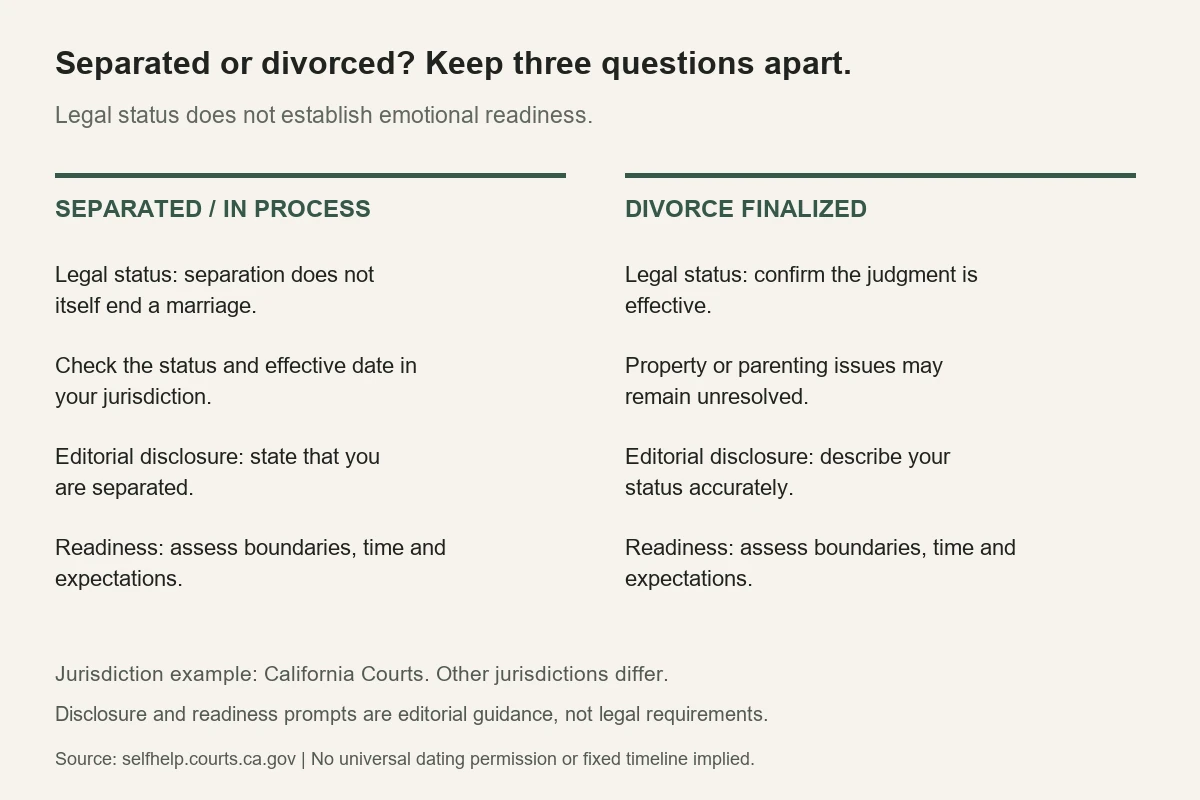
The Separation Golden Rule: You should only date while legally separated if you satisfy three physical and legal benchmarks:
- Separate Homes: You and your former spouse live under different roofs with independent leases or mortgages. Dating while sleeping in separate bedrooms “for the kids” almost always leads to messy boundaries and emotional drama.
- Filed Legal Papers: A formal petition for dissolution has been filed with the family court. There is an active docket number, not merely a verbal agreement to separate.
- Divided Finances: Joint daily accounts are closed or separated, and temporary support arrangements are established in writing.
If you meet all three, you do not need to lead with “Separated” across your bio. But you do owe it to your date to mention it before or during your first meetup. Keep it simple and grounded: “My ex and I have lived in separate homes for over a year, our divorce papers are filed with the court waiting on the final processing date, and our lives are completely independent.” That shows you are honest, grounded, and not hiding unfinished business.
2. Protecting Your Privacy and Assets: Avoiding Post-Divorce Romance Scams
Romance scammers frequently target newly single adults in their 40s, 50s, and 60s. After selling a family home or dividing savings, you may have cash in the bank—and scammers know that loneliness can make even smart, careful people lower their guard.
Essential Security Protocols for Divorced Singles:
- Deploy Private Browsing (Incognito Mode): If you work in an executive or public-facing role, or simply do not want your profile discovered by your former spouse, ex-in-laws, or children’s school parents, use platforms that offer true Private Mode (such as Match.com). In this mode, your profile is completely invisible in public searches and only appears to people you choose to “like.”
- Verify Before Off-Platform Messaging: Never move a conversation to WhatsApp, Telegram, or SMS until you have conducted an in-app video call or verified the profile with an official photo badge. Scammers consistently attempt to move targets off monitored platform servers within the first 48 hours.
- The Financial Red Line: Anyone who brings up cryptocurrency investments, asks for emergency bridge loans, or claims they are an overseas engineer or logistics manager encountering customs issues is an active scammer. Report and block immediately.
To further protect yourself against artificial profiles and identity spoofing, review our forensic guide on how to tell if a dating profile is fake, and follow our comprehensive online dating safety checklist before coordinating any in-person meetings.
Our Evaluation Framework: What Makes a Dating Site Fit for Divorcees?
When evaluating the best dating apps for divorced people, generic consumer review metrics fall short. We audited dozens of platforms against five strict, divorce-specific benchmarks to determine which services deliver genuine relationship value in 2026:
1. Demographic Depth & Maturity: Does the platform maintain an active, dense user base between the ages of 35 and 60+? A platform dominated by college students or 22-year-old casual swipers wastes a mature adult’s limited free time.
2. Discretion & Privacy Controls: Can you control who views your photos and biography? Does the platform offer stealth incognito browsing, profile pausing, or blocking by contact book to shield your dating life from professional colleagues and former family members?
3. Vetting & Intentional Friction: Does the onboarding process require meaningful effort? Platforms that require detailed psychological answers or paid subscriptions naturally deter casual browsers, rebounders looking for cheap validation, and automated bot accounts.
4. Local User Liquidity: Can you find active matches within a realistic 15-to-30-mile radius outside of Manhattan, Los Angeles, and London? A platform with great features is useless if the nearest active match lives two hours away.
5. Relationship Model Flexibility: Does the platform accommodate non-traditional long-term arrangements? Can you specify that you are seeking a committed partnership without cohabitation (LAT), or coordinate around complex parenting calendars?
The 5 Best Dating Sites and Apps for Divorcees in 2026: In-Depth Reviews
Selecting reliable dating apps for divorced adults requires looking past promotional slogans to evaluate actual user liquidity, privacy tools, and vetting friction. Based on our multi-factor mechanism audits, first-party testing, and real community feedback, here are the best dating apps for divorcees and mature singles starting fresh in 2026.
1. Match.com — Best Overall for Demographics, Bio Depth & Stealth Privacy
Operating since 1995, Match.com remains the gold standard for divorced adults who value comprehensive profiles and large local user pools. While younger crowds have moved toward swipe apps, Match continues to dominate the 35–55+ age bracket, where a large portion of members are divorced, separated, or co-parenting.
Unlike swipe-based interfaces that constrain self-expression to a few punchy quips, Match allows you to write detailed, multi-paragraph essays explaining who you are, what you have learned from your past, and what you value in a future partner. Its search architecture allows you to filter specifically for marital status, parenting status, lifestyle habits, and core values.
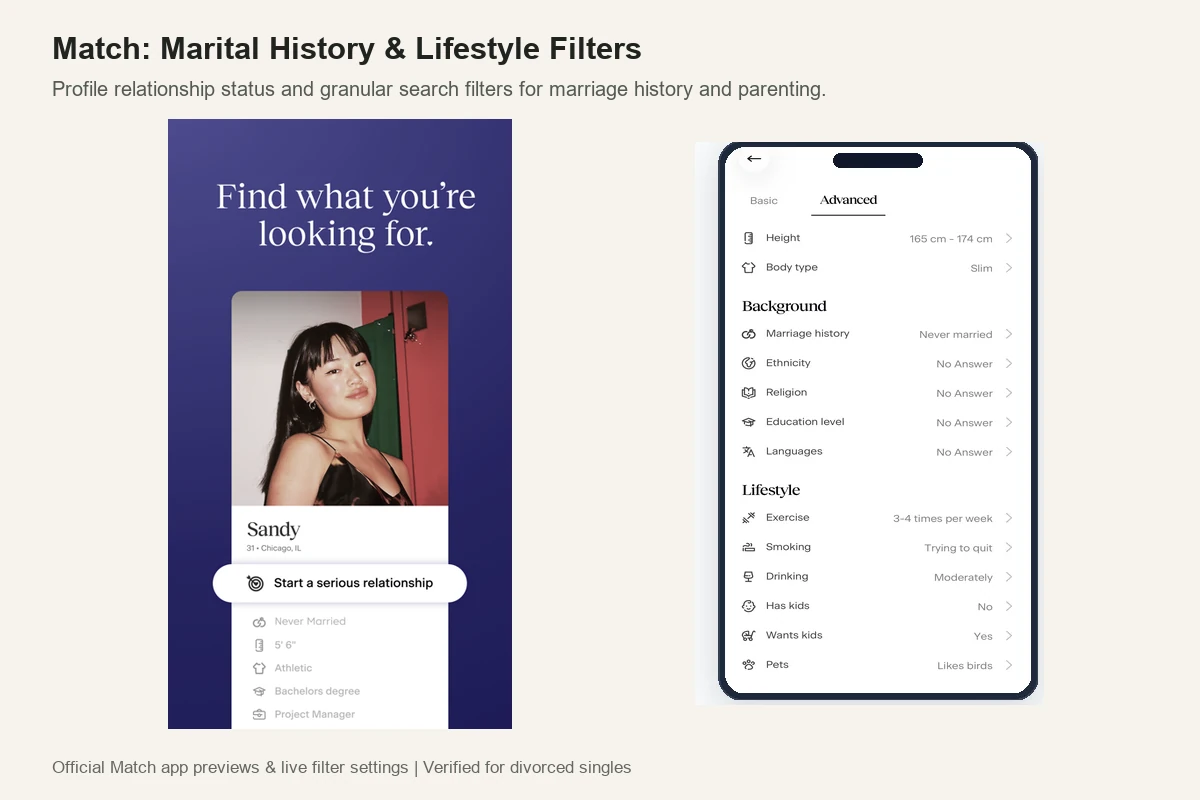
For divorcees who prioritize discretion above all else, Match’s standout feature is Private Mode. When activated as a paid add-on, your profile is hidden from the general public search directory. You can browse local profiles invisibly, reading biographies and evaluating matches without leaving a digital footprint. Only the specific individuals you choose to “like” or send a message to can view your profile and photos. This completely neutralizes the fear of being spotted by an ex-spouse, colleagues, or children’s teachers.
Best For
Divorced singles aged 35–60+ who want the deepest local user pool, comprehensive long-form bios, and total control over profile visibility through Private Mode.
Main Tradeoff
Reading and sending messages requires an active paid subscription ($21.99–$44.99/mo). The desktop-era interface can feel feature-heavy compared to streamlined modern apps.
Before You Pay on Match: You can create your profile, upload photos, and browse your local area completely free. Do not purchase a subscription until you have verified that there are active, appealing members in your specific zip code.
2. eharmony — Best for Emotionally Healed Daters Seeking Committed Stability
If your marriage ended because you and your ex were fundamentally mismatched on values or temperament, eharmony’s structured process starts to make a lot of sense. For divorcees who have finished grieving and want a serious, lasting relationship, eharmony is designed to weed out casual flings and restless rebounders.
The service centers on an extensive 80-question Compatibility Quiz based on 32 dimensions of relationship satisfaction. Rather than focusing on external hobbies, the assessment analyzes core personality traits: emotional temperament, conflict resolution styles, social energy, and ethical values. The algorithm calculates a compatibility score (typically ranging from 60 to 140) for every match, highlighting specific areas of interpersonal alignment.
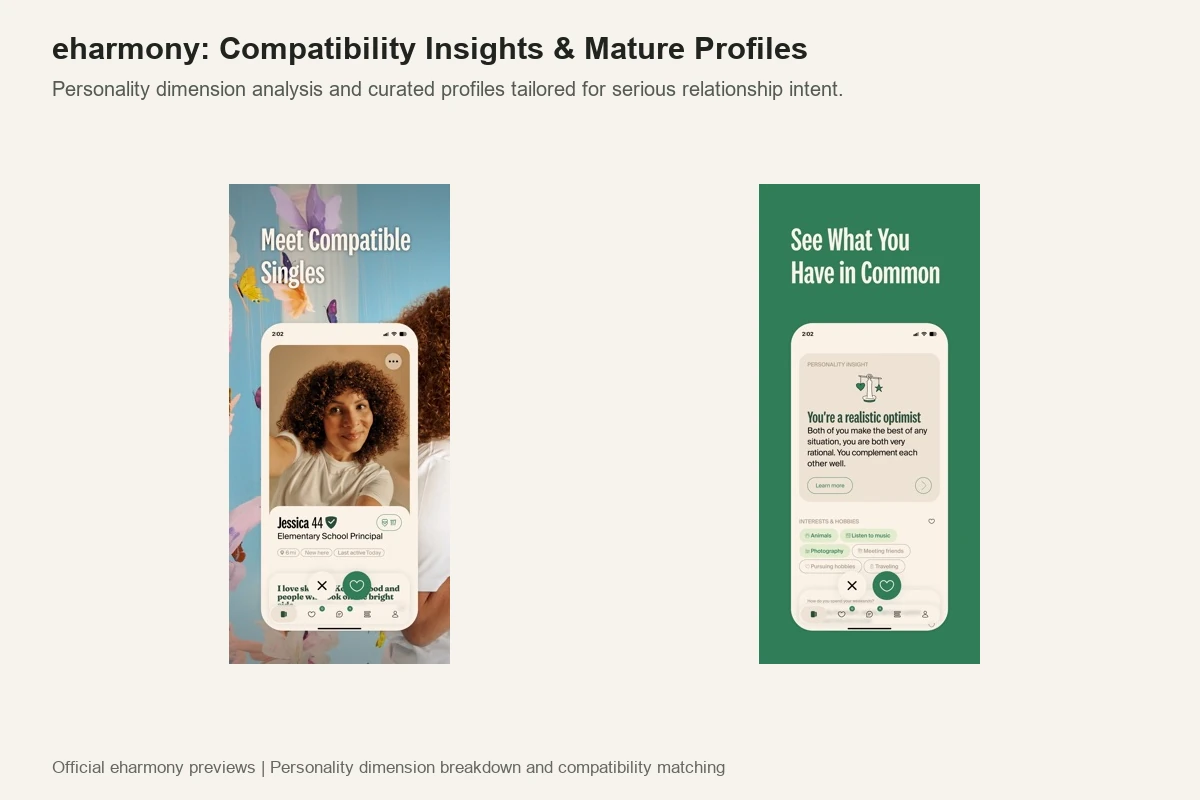
The primary advantage of eharmony for divorced daters is its financial barrier to entry. Subscriptions typically range from $35.90 to $65.90 per month, billed in 6-, 12-, or 24-month commitments. While expensive, this pricing structure acts as a powerful filter: casual daters looking for an impulsive hookup or free validation will not spend hundreds of dollars. The resulting member community is exceptionally intentional, respectful, and relationship-oriented.
Best For
Emotionally settled divorcees who know exactly what they need in a partner, value psychological alignment, and want to avoid low-effort serial swipers.
Main Tradeoff
Substantial financial commitment with auto-renewing multi-month contracts. Profile photos remain blurred on the free tier until you upgrade to a premium plan.
Editorial Insight: Do not sign up for eharmony if your divorce was finalized within the last few months. The platform is designed for people ready for a serious commitment; if you are still working through post-decree anger or grief, the intensity of eharmony’s member expectations will feel overwhelming.
3. Hinge — Best for Modern Re-entry & Low-Pressure Contextual Connection
For divorced singles in their late twenties, thirties, and early forties who want a modern mobile experience without the superficial meat-market dynamic of Tinder, Hinge provides the ideal middle ground. Positioned as “the dating app designed to be deleted,” Hinge structures connection around content rather than instant appearance swiping.
Every Hinge profile requires six photos or video clips and three written “Prompts”—brief conversational appetizers addressing lifestyle habits, humor, and personal values. The practical upside is that members cannot simply throw a generic like at a picture; you have to comment on a specific photo or prompt. This eliminates blank-screen anxiety, giving you an easy, natural way to start a conversation around shared tastes.
If you find post-divorce small talk particularly draining or are easing back into dating with limited social energy, see our guide to the best dating apps for introverts, where comment-first pacing and low-burnout messaging models are evaluated in detail.
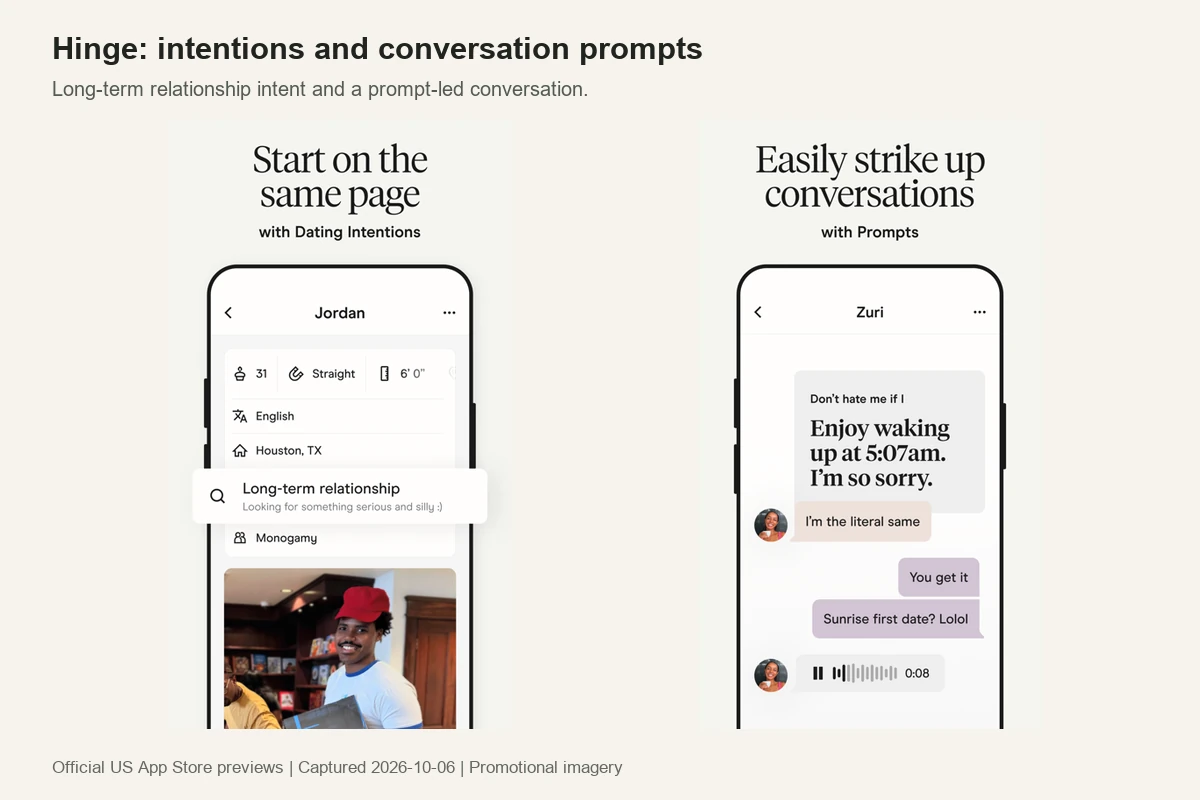
Hinge is also particularly accommodating for post-divorce relationship structures. Its profile settings include explicit badges for Relationship Types (Monogamy, Non-monogamy) and Dating Intentions (“Life partner,” “Long-term relationship,” “Long-term, open to short”). This granularity makes it easy to signal interest in committed long-term partnership or LAT arrangements without ambiguity.
Best For
Divorced singles aged 28–45 seeking modern, prompt-driven conversations, transparent relationship intentions, and an active mobile community.
Main Tradeoff
Free users are limited to approximately 8 likes per day. User liquidity drops sharply for singles over 55 compared to Match.com.
4. EliteSingles — Best for Educated Professionals Rebuilding Their Lives
Divorce among high-achieving professionals—attorneys, physicians, corporate executives, entrepreneurs, and academics—brings unique complications. When you carry demanding career responsibilities alongside complex post-divorce financial structures, matching with someone who doesn’t understand high-pressure workloads or professional boundaries leads to rapid friction.
EliteSingles caters specifically to this demographic, with over 85% of its active member base holding a university degree (bachelor’s, master’s, or doctorate). The platform uses a personality assessment rooted in the Five-Factor Model (the “Big Five” personality traits: Openness, Conscientiousness, Extraversion, Agreeableness, and Neuroticism) to pair singles based on cognitive and lifestyle alignment.
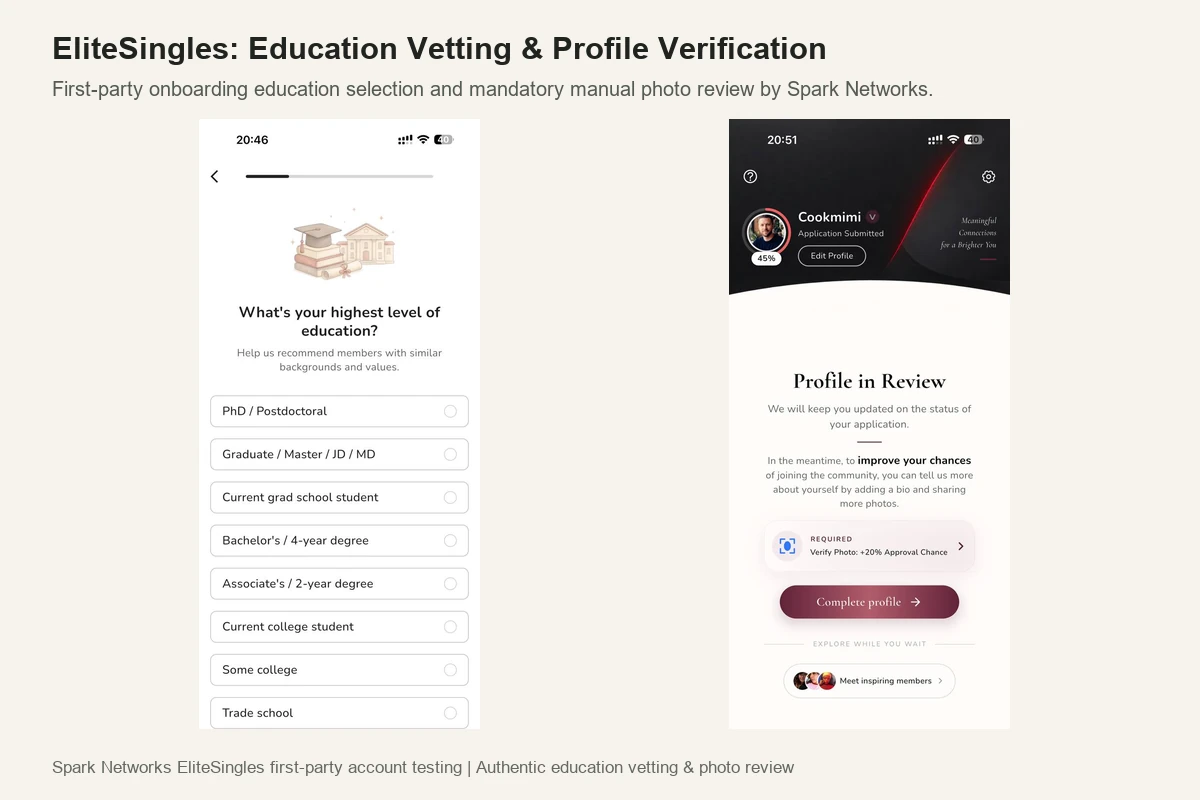
What appeals to divorced professionals is the shared mutual understanding of life complexity. Members on EliteSingles are typically established in their careers, financially independent, and pragmatic about balancing romance with work and children. The platform also employs manual profile verification to audit photo uploads and personal claims, maintaining a higher standard of legitimacy than open-access swipe apps.
Best For
Career-driven divorcees seeking intellectually equal partners who respect demanding professional commitments and financial independence.
Main Tradeoff
User density is concentrated heavily in major metropolitan markets; liquidity in rural or smaller suburban zip codes can be restrictive.
If you are managing demanding corporate leadership, legal partnerships, or executive careers post-divorce, explore our dedicated guide to the best dating apps for professionals.
5. Bumble — Best for Regaining Agency & Controlled Pacing
Coming out of a marriage—especially one where you felt unheard, micromanaged, or emotionally drained—can make you fiercely protective of your personal boundaries. Bumble addresses this by requiring women to send the first message in heterosexual matches, shifting the dynamic away from unwanted cold messages.
When a mutual match occurs, the woman has 24 hours to initiate contact; once she sends a message, the man has 24 hours to respond, opening an unlimited permanent chat window. For divorced women, this structural rule eliminates the relentless barrage of unsolicited or inappropriate opening messages common on platforms like Tinder. For divorced men, it removes the pressure of constantly guessing which creative opener will cut through the noise, confirming that the match has genuine active interest.
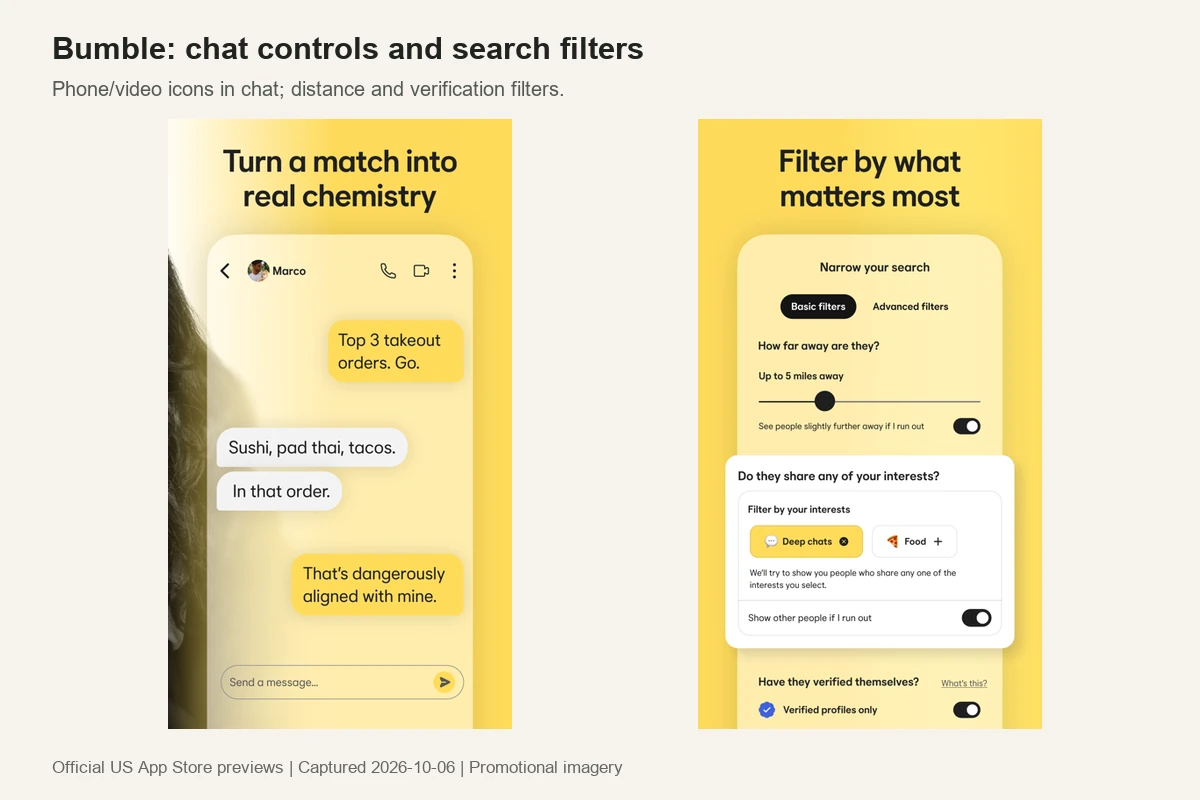
From a safety standpoint, Bumble includes two vital tools for divorced singles: In-App Voice & Video Calling and Incognito Mode (available via Bumble Premium). Built-in calling allows you to vet a match over video before exchanging personal phone numbers, preserving your privacy until mutual trust is established.
Best For
Divorced women who want total control over conversation initiation, and cautious daters who want to vet matches via video before sharing phone numbers.
Main Tradeoff
The 24-hour match expiration countdown can create artificial urgency during busy work or parenting weeks. Matches expire permanently if not acted upon.
Specialty Pick: Stir by Match Group — Best for Divorced Single Parents
When evaluating the best dating sites for divorced parents, Stir stands in a category of its own. For divorced singles who have primary or shared custody of minor children, the greatest friction in dating isn’t finding someone attractive—it is coordinating schedules. Explaining that you can only meet on alternating Tuesdays and every second Saturday because of soccer practices and custody swaps often feels like negotiating a corporate contract.
Stir, developed by Match Group specifically for the 20 million single parents in the United States, solves this problem with its proprietary Schedule Matching tool. During profile setup, you select your typical weekly availability, marking specific days and evenings as “Me Time” (available to date) or “Parenting Days.”
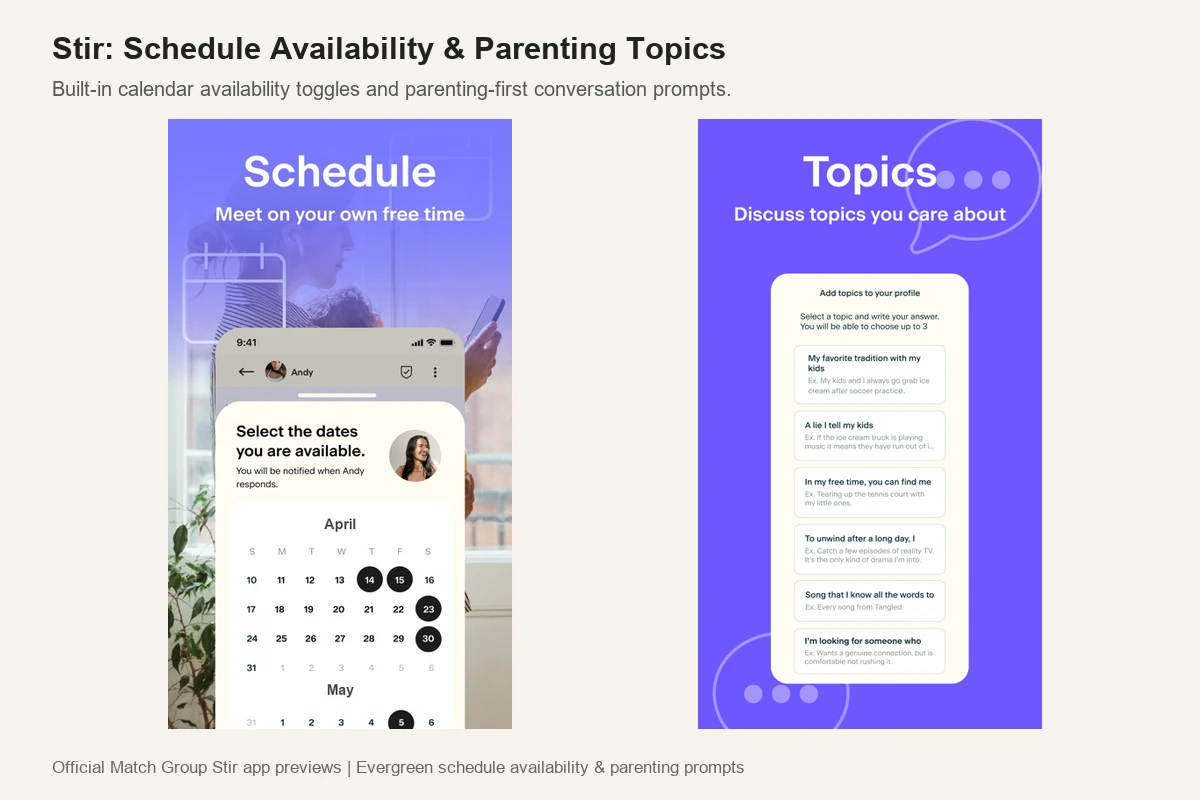
When browsing matches on Stir, the app automatically highlights when your free nights align with a prospective partner’s schedule. More importantly, everyone on Stir either has children or enthusiastically welcomes partners with children. There is zero awkwardness about having toys in the background of a video call or rescheduling a coffee date when a child spikes a fever.
When to Skip Stir: If your children are grown adults, or if you are child-free and do not wish to date someone with active parenting responsibilities, do not sign up for Stir. Stick with Match.com or Hinge, where you can filter for daters with similar household structures.
For a detailed breakdown of custody schedules, co-parenting boundaries, and blended household dynamics, explore our comprehensive guide to the best dating sites for single parents.
Platforms to Avoid (And Why Competitors Keep Recommending Them)
Knowing where not to look is just as important as choosing the right app. Mainstream affiliate blogs routinely recommend dozens of outdated or predatory platforms simply to collect referral fees. Here are the platforms you should skip.
1. Why Tinder Is a Minefield for Divorced Singles
While Tinder remains the world’s most downloaded dating app, its product architecture is fundamentally mismatched with the needs of newly divorced adults. Designed as a rapid visual swipe feed, Tinder minimizes profile biographies to punchy soundbites and prioritizes split-second photo judgements.
For someone exiting a marriage, this creates two real hazards. First, Tinder has a heavy concentration of users seeking casual hookups to patch short-term loneliness, which easily burns out anyone looking for genuine substance. Second, because signup takes under thirty seconds with zero vetting, Tinder is the primary playground for crypto bots and financial catfishing syndicates that prey on newly single adults. Unless you are specifically looking for a casual fling and have sharp scam radar, keep Tinder off your phone.
2. The Zombie Niche Site Trap: Why NextLove and JustDivorcedSingles Are Dead Ends
A quick Google search for specialized dating sites for divorced people will surface dozens of articles praising niche directories such as NextLove, JustDivorcedSingles, DivorcedDads, or SingleParentLove. These sites market themselves as dedicated sanctuaries where only divorced adults meet.
Our investigation reveals that in 2026, virtually all of these niche standalone sites are digital ghost towns. Built on legacy affiliate software from the mid-2010s, they have near-zero active user liquidity outside of tiny pockets. When you create an account, you are greeted by abandoned profiles from 2018, automated bot accounts programmed to send fake “winks” to induce credit purchases, and matches located hundreds of miles away.
Competitor websites continue to recommend these defunct platforms because their legacy affiliate programs pay high per-registration bounties. As an editorial rule, TopDatingFinder does not recommend platforms that lack verified daily active liquidity. Divorced daters are far better served using major platforms with large user bases (Match, eharmony, Hinge) and applying granular marital history filters.
The Divorcee’s Field Guide to Dating: Bio Templates & Ex-Talk Boundaries
Crafting a compelling dating profile after divorce requires striking a delicate balance: you must acknowledge your life stage without letting your past marriage define your identity. Below are three proven templates, communication boundaries, and vetting steps developed through community testing.
3 Bio Formulas That Radiate Confidence (Without Mentioning Your Ex)
The single most common mistake in post-divorce dating profiles is using valuable bio real estate to vent, state defensive demands (“No games, no narcissists, no liars”), or explain past domestic disappointments. Negativity drives away emotionally healthy prospects. Use these three straightforward profile templates to showcase maturity, warmth, and self-assurance:
Formula 1: The “Fresh Chapter” (Warm, Forward-Looking, Activity-Driven)
“Architect by trade, weekend hiker, and aspiring sourdough baker. Starting an exciting new chapter centered on authentic connection, great conversation over flat whites, and exploring the local food scene. Looking for someone grounded, humorous, and ready for thoughtful dinners that stretch past closing.”
Why it works: Completely forward-facing. Establishes professional capability and clear weekend lifestyle rhythms without a single backward glance.
Formula 2: The “Grounded Professional” (Values-First, Accomplished, Direct)
“Healthcare director, father to one great teenager, and avid trail runner. My life is full, stable, and peaceful. Seeking an emotionally mature, intellectually curious partner who values clear communication, independence, and laughing easily at life’s unexpected detours.”
Why it works: Openly mentions parenting status without making children the sole identity. Signals emotional stability and high baseline peace.
Formula 3: The “LAT / Independent Partnership” (Committed Romance, Separate Homes)
“Senior marketing strategist, book club regular, and passionate gardener. I love my independent home life and quiet Sunday mornings, but I’m looking for a dedicated romantic partner to share road trips, theatre nights, and mutual devotion. Looking for a committed partnership with independent spaces (LAT).”
Why it works: Directly names the Living Apart Together framework, filtering out matches who require immediate domestic cohabitation while reassuring them of your commitment capacity.
The 2-Minute Ex-Talk Boundary Rule
On early dates, the question “How long have you been divorced?” or “What happened with your marriage?” will inevitably arise. Handled poorly, this question can derail dates into 90-minute venting marathons. Handled properly, it demonstrates exceptional emotional maturity.
Follow our 2-Minute Neutral Boundary Rule: Answer the question honestly, objectively, and without rancor in under 120 seconds, and then gracefully pivot the conversation back to the present moment.
The 2-Minute Neutral Script:
“We were married for twelve years and shared some great experiences, but over time our core values and life trajectories diverged. We worked hard through mediation to separate respectfully, our divorce was finalized two years ago, and we have a very functional co-parenting rhythm. It was a difficult transition, but it taught me a lot about myself and what I need in a partner—which is why I’m so excited about this current chapter. What about you? How has your year been unfolding?”
Words to Eliminate Immediately: Remove words like “narcissist,” “crazy,” “psychopath,” or “they ruined my life” from your first-date vocabulary. Even if your former spouse behaved poorly, using labels like that on date one is an immediate red flag. It makes your date wonder if you’re actually ready to connect or just looking for an audience for your past grievances.
The 3-Date Vetting Funnel: How to Spot an Emotionally Unavailable Rebounder
When dating post-divorce, protecting yourself from being used as someone else’s transitional rebound is essential. Use this 3-date vetting funnel to assess whether a match is genuinely available for partnership:
Date 1: Assess Narrative Tone & The Living Situation. Listen carefully to how they speak about their past. Do they express balanced perspective and accountability, or is their former partner cast as an all-powerful villain? In addition, verify their physical living arrangements: if they are still living under the same roof as their ex-spouse “for convenience,” pause the connection until independent living is established.
Date 2: Watch for “Instant Domesticity” (The False Intimacy Trap). Newly single daters who miss marital routine often rush into premature domestic intimacy—asking you to spend whole weekends together, inviting you over to cook dinners on date two, or treating you like a long-term spouse within seven days. This is not genuine attraction; it is an attempt to transplant a new face into an empty domestic routine.
Date 3: Test Boundaries & Autonomy. By the third date, introduce a minor scheduling boundary (e.g., declining a last-minute invite due to personal plans). An emotionally mature adult will respect your autonomy comfortably. An unhealed rebounder will react with passive-aggressive withdrawal, anxiety, or guilt, revealing they want an emotional crutch rather than an equal partner.
Frequently Asked Questions About Dating After Divorce
Should I state “divorced” directly in my dating profile bio?
You do not need to lead with “Divorced” in your opening written bio line, as that allows a past legal event to define your personal identity. However, you should accurately select “Divorced” or “Previously Married” in the platform’s demographic filter settings (such as on Match or Hinge). This ensures algorithmic transparency while keeping your written bio focused on your current personality, passions, and relationship goals.
Is it a bad idea to date while legally separated but not yet divorced?
It depends entirely on your physical living arrangements, legal progress, and emotional state. If you live in a separate residence, have active dissolution papers filed with the family court, and have achieved financial separation, casual dating is socially common and ethical. However, you must disclose your separated status to matches before the first date. Dating while still living in the same home as your ex-spouse almost universally results in emotional chaos and should be avoided.
How long should I wait after a divorce before downloading a dating app?
There is no universal calendar rule, but licensed therapists generally recommend waiting at least six to twelve months after the physical separation or finalized decree before seeking a serious partnership. If thinking about your ex still provokes intense anger, if you feel an urgent need to prove you are still desirable, or if you cannot spend an evening alone in your home without acute distress, you are likely seeking a rebound rather than a healthy connection.
What is Living Apart Together (LAT), and how do I explain it to a match?
Living Apart Together (LAT) is a relationship arrangement where two partners maintain a monogamous, committed long-term romance while maintaining separate legal residences. It allows partners to share intimacy, social lives, and vacations without merging household chores, finances, or family space. You can bring it up naturally by explaining: “I’m looking for a deep, committed partnership, but I value maintaining my own home and space.”
How do I prevent my ex-spouse, colleagues, or neighbors from seeing my dating profile?
The most effective solution is to choose a platform that features true Private Mode / Incognito Browsing, such as Match.com or Bumble Premium. In this mode, your profile is hidden from the general directory and is only visible to specific individuals whom you explicitly swipe right on or message. In addition, apps like Tinder and Bumble allow you to block specific telephone contacts from your phone book.
Final Verdict: Which Dating Site Should You Choose Tonight?
Approaching online dating for divorced people does not require reinventing yourself; it requires choosing a digital environment that aligns with your maturity, values, and privacy boundaries. Here is our direct recommendation based on your current life stage:
Your Next Step:
- If you want the deepest local user pool in the 35–55+ demographic, comprehensive bio essays, and the ability to browse invisibly without public exposure: Choose Match.com.
- If you have fully processed your divorce and are seeking an intentional, enduring life partner through structured psychological testing: Choose eharmony.
- If you are in your 30s or 40s and want a modern, prompt-driven mobile experience that eliminates cold opening lines: Choose Hinge.
- If you are an educated executive, attorney, physician, or entrepreneur who values cognitive alignment and financial independence: Choose EliteSingles.
- If you are a divorced woman who wants to control the initial conversation pace and vet matches over video before sharing phone numbers: Choose Bumble.
- If you are co-parenting minor children and want an availability calendar that coordinates with your custody schedule: Choose Stir by Match Group.
Dating after marriage is an opportunity to choose a partner from a position of wisdom rather than youth, self-knowledge rather than societal pressure. Take your time, protect your domestic peace, and step back into the world on your own terms.