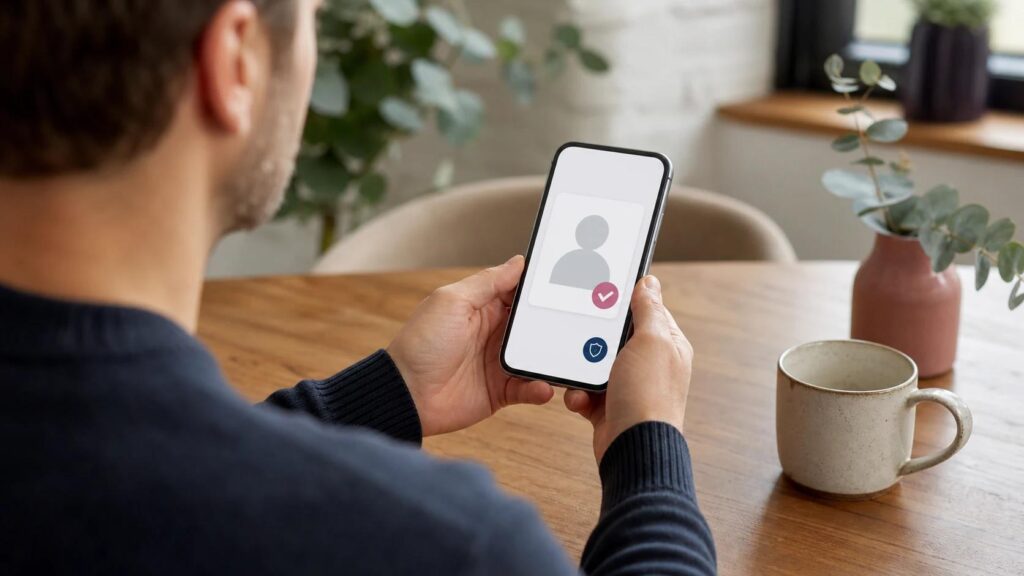
A tiny blue checkmark next to an attractive stranger’s name carries an enormous psychological payload. In the fragmented, ambiguous world of online dating, that badge whispers reassurance: This person is real. You are safe. You can let your guard down.
That psychological shortcut is precisely why dating profile verification is both one of the industry’s most valuable anti-spam tools and one of its most dangerous sources of false security. Over the past five years, major dating platforms—including Tinder, Bumble, Hinge, and Match—have invested millions of dollars in automated facial geometry algorithms, video liveness detection, and third-party biometric pipelines to purge millions of automated bots. Yet federal consumer reports, cybersecurity audits, and victim registries reveal an uncomfortable reality: thousands of verified profiles across these exact apps are actively operated by romance scammers, identity thieves, and sophisticated transnational fraud rings.
The problem is not necessarily that the algorithms fail to recognize a face. The problem is a fundamental breakdown in consumer understanding: readers routinely confuse biometric verification with character, honesty, and identity verification.
The Core Rule of Verification: The word “verified” has zero practical meaning until you ask: Verified how? A badge confirming that a live smartphone camera matched an uploaded photograph does not prove legal identity, marital status, criminal history, or moral intent. It proves a face was present at a single moment in time—nothing more.
This independent investigation is based on platform technical documentation, official terms of service, biometric privacy disclosures, cybersecurity case studies, and account-flow testing conducted by TopDatingFinder in 2026. Platform verification requirements vary significantly by operating system, geographic market, account age, and background risk scoring.
Before evaluating any profile, swipe, or conversation, you must understand the technological tier behind the badge. Dating platforms employ four distinct tiers of verification architecture. While marketing departments group them all under the banner of “verification,” their investigative value varies from essentially useless to moderately protective.
| Verification Tier | Underlying Technology | What It Actually Proves | Critical Vulnerabilities & Limitations |
|---|---|---|---|
| Tier 1: Contact Point (SMS / Email Code) | One-time passcode (OTP) delivered via cellular SMS or email inbox. | The account operator had temporary access to an email or telephone number. | Zero identity verification. Easily bypassed using burner VoIP numbers (Google Voice, TextNow) and disposable email domains. |
| Tier 2: Biometric Liveness (Standard Blue Check) | Live video selfie, head turn, or pose mimicry matched against uploaded photos via automated facial geometry. | The live human holding the device closely matches the face in at least one profile photo. | Does not prove legal name, age, background, or honesty. Vulnerable to single-photo matching flaws, post-verification photo swaps, and account hijacking. |
| Tier 3: Government ID (Elevated ID Badge) | Driver’s license or passport scan processed via OCR + biometric live facial cross-check (Jumio, Veriff). | The person holding the phone matches a valid, unexpired government identification document. | High barrier against synthetic personas. However, it still does not include a criminal background check or guarantee ethical behavior. |
| Tier 4: Background Screening (Public Records Check) | Cross-referencing civil, criminal, and sex-offender registries (e.g., historical Garbo pilots). | No disqualifying violent or sexual offenses appear in indexed public records under that legal name. | Extremely rare on mainstream apps. Limited by jurisdictional reporting gaps, name aliases, and high operational costs. Largely discontinued as a built-in feature. |
Table 1: The Four Tiers of Dating Profile Verification Architecture. Most consumer dating apps only operate within Tier 1 and Tier 2.
The 4 Tiers of Dating Profile Verification Architecture
To assess risk accurately in dating profile verification, let us dissect how each verification tier operates under the hood, what computational checks take place on the server, and where the perimeter breaks down.
Tier 1: Contact-Point Verification (Access to an Inbox or SIM)
Almost every dating app requires email confirmation or an SMS verification code during registration. When a platform advertises that “100% of our members are verified,” they are frequently referring strictly to this Tier 1 threshold.
From a fraud-prevention perspective, Tier 1 is minimal hygiene. While cellular verification stops naive script bots from spinning up tens of thousands of automated accounts on a single residential IP address, organized romance scam syndicates treat phone verification as a negligible operating expense. Virtual SIM services, overseas SMS-receive farms, and bulk VoIP numbers allow bad actors to generate verified accounts for less than thirty cents each. A profile verified solely by phone or email provides zero guarantee that you are speaking to a real person in your geographic region.
Tier 2: Biometric Facial Geometry & Liveness Video Selfies
Tier 2 represents the iconic “Blue Checkmark” featured on Tinder, Bumble, and Hinge. When you initiate this flow, the app asks you to grant front-camera permissions and complete a series of physical challenges. On Bumble, you might be asked to replicate a specific hand gesture (such as touching your temple or making a peace sign). On Tinder and Hinge, you are instructed to position your face within an oval frame, nod, or slowly turn your head from left to right.
During this process, client-side and server-side machine vision models execute two separate mathematical calculations:
- Liveness Detection (Passive & Active): The software analyzes subtle micro-reflections, skin texture, depth variation, and motion parallax to verify that the camera is filming a living, three-dimensional human head rather than a printed photograph, an iPad screen displaying a YouTube video, or a silicone mask.
- Facial Vector Mapping (Facial Geometry): The algorithm measures spatial distances between key landmark nodes—the distance between the pupils, the width of the nasal bridge, the contour of the jawline, and the depth of the cheekbones. It converts these measurements into a compact mathematical array (a biometric template) and computes the cosine similarity between the video template and the photographs uploaded to the profile gallery.
If the similarity score exceeds the platform’s internal threshold, the system issues an authentication token, and the blue badge illuminates. This is an impressive technological achievement that effectively eliminates traditional “Google image search” catfishing. However, it only confirms that someone whose face matches the pictures is holding the phone. It does not establish who that person is.
Tier 3: Government ID Plus Facial Cross-Matching
Tier 3 is the emerging gold standard for high-trust mobile verification. Rather than relying solely on social photos, the app redirects the user to an encrypted verification session hosted by an accredited identity vendor such as Jumio, Veriff, or Persona.
The user scans the physical front and back of a government-issued credential (a state driver’s license, national identity card, or passport). High-resolution computer vision inspects the document’s microprint, holographic watermarks, font consistency, and Machine-Readable Zone (MRZ) checksums to rule out digital tampering or counterfeit templates. The system then requires an immediate live 3D video selfie to cross-match the applicant’s face against the photo etched into the government plastic.
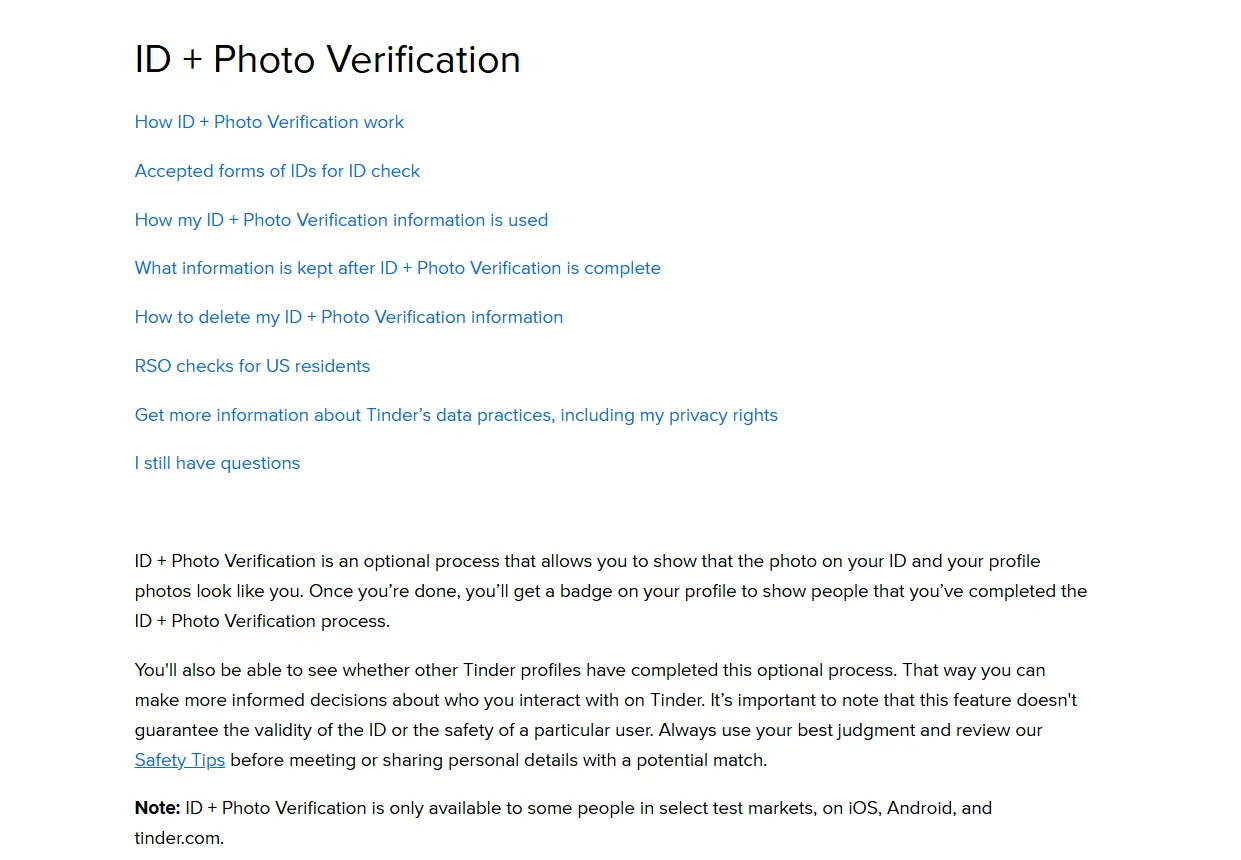
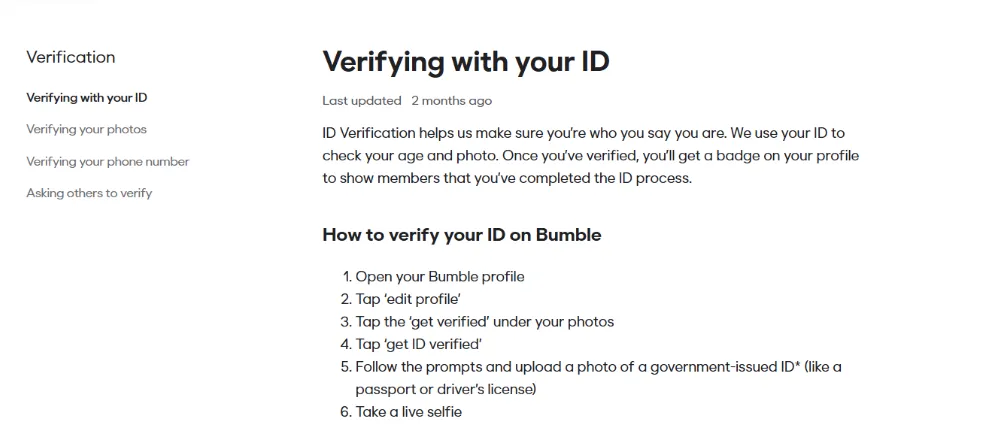
Bumble has deployed ID Verification globally as an elevated badge option, and Tinder has progressively rolled out optional or market-specific ID checks. Tier 3 makes systemic impersonation exponentially more expensive for scammers, as creating fraudulent accounts requires either synthetic identity theft or physical document forgery. Nevertheless, an ID check remains a snapshot in time: it confirms identity, but it cannot evaluate personal intentions.
Tier 4: Independent Background Screening (The Rarest Tier)
A persistent myth among casual dating app users is that platforms run background checks on their members. With very few exceptions, they do not.
In 2021, Match Group announced an equity investment in and partnership with Garbo, a non-profit background check platform designed to allow Tinder and Match users to check matches for histories of violent crime, orders of protection, and sex offenses. However, by 2023, Garbo suspended its consumer background check operations, citing cost barriers, legislative hurdles, and disputes over public-record accessibility. Today, no mainstream free-to-use dating app conducts automated, mandatory criminal background screenings on its general user base. To understand how dedicated matchmaking platforms handle vetting compared to algorithmic apps, examine our detailed eHarmony Review, where profile screening is supplemented by psychological onboarding and strict subscription paywalls.
Platform Breakdown: How the Major Apps Verify Profiles in 2026
Each major application has engineered its own verification workflow, user experience, and risk thresholds. Understanding these differences allows you to accurately weigh the badge you see on your screen.
Tinder: Video Selfie Liveness and Optional ID Checks
Tinder pioneered mobile dating verification and currently utilizes a two-part video selfie flow. Users must center their face within an on-screen oval and turn their head toward dynamic prompts to satisfy liveness detection. The system then compares this biometric capture against all photos currently active in the user’s six-to-nine-slot photo grid.
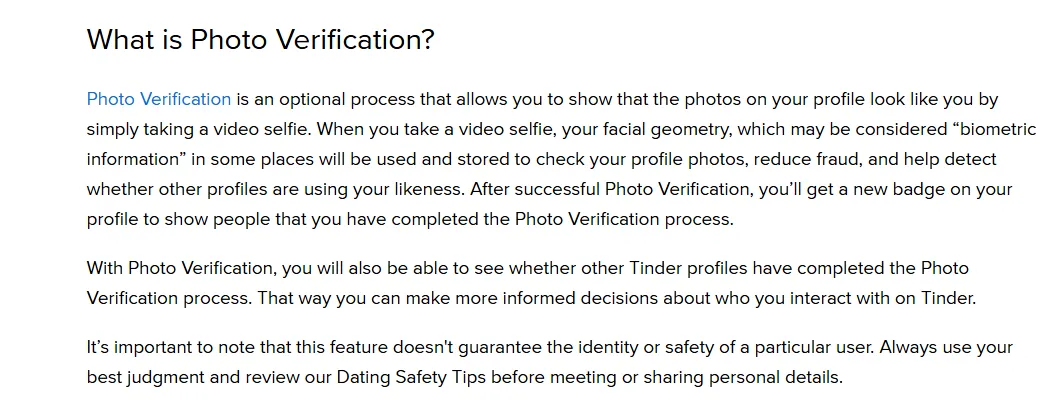
From a legal and technical standpoint, Tinder’s official terms and support documentation contain explicit liability boundaries. Tinder states directly: “Photo Verification does not guarantee a user’s identity, safety, or that the user has not committed any criminal acts. It does not verify the authenticity of all information on the profile.” In select international markets and test states, Tinder also offers an enhanced badge reflecting an uploaded government ID alongside the video selfie.
Bumble: Pose-Prompt Selfies and Government ID Badging
Bumble relies heavily on human-in-the-loop and automated gesture verification (see our hands-on Bumble review). Rather than head turns, Bumble displays an illustration of a model performing an uncommon gesture (such as three fingers raised or an angled hand tilt). The applicant must mimic the exact posture within a brief window.
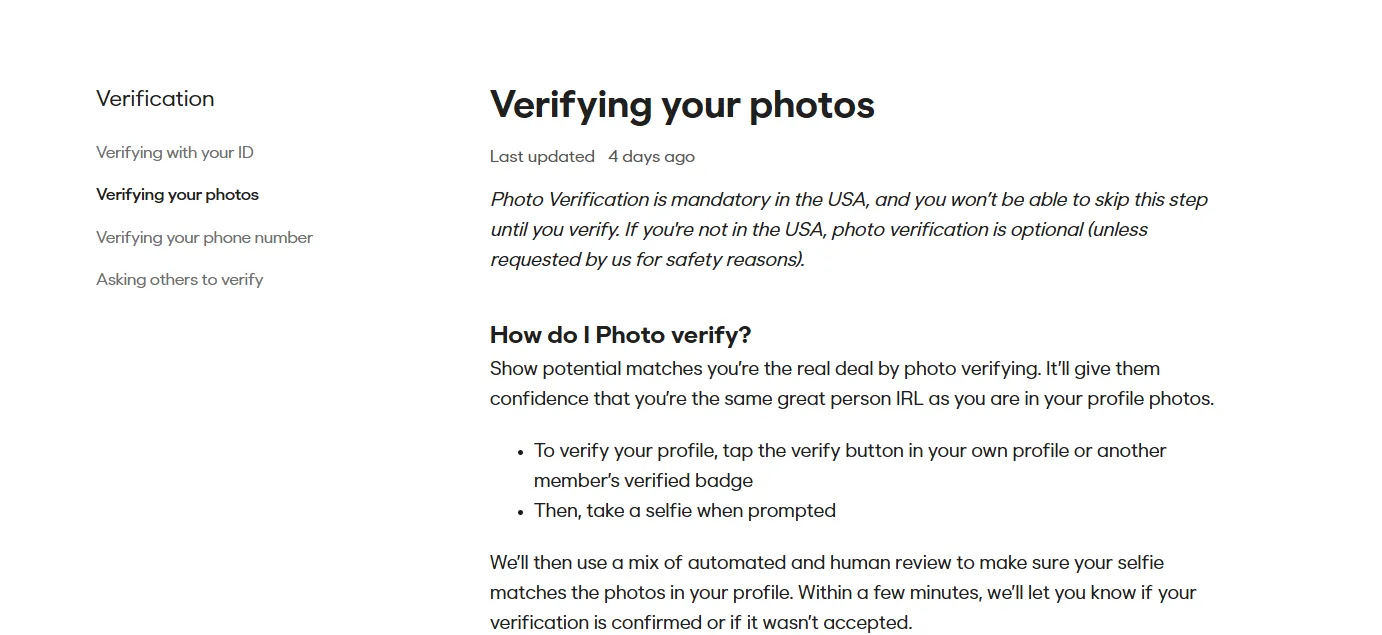
In the United States, Bumble has moved aggressively toward mandatory photo verification for new registrations in high-fraud zip codes or accounts that trigger device-level risk flags. Users who pass receive Bumble’s blue shield checkmark. For members looking for maximum trust, Bumble provides a secondary “ID Verified” flow incorporating government documents.
Hinge: 3D Face Check and Auto-Revocation Safeguards
Hinge (also owned by Match Group) implements a proprietary 3D Face Check protocol. The app captures video frames to map facial depth and calculates mathematical vectors that are compared against prompt photos. Where Hinge stands out architecturally is its automated badge revocation policy: if a verified user modifies, deletes, or significantly updates their core photos, the system automatically revokes the blue checkmark until a new selfie verification is completed. This stops one of the most common post-verification exploits dead in its tracks.
| Platform | Verification Method | Enforcement Level | Official Platform Disclaimer & Limitations |
|---|---|---|---|
| Tinder | Video Selfie (oval alignment & head turns) + Optional ID Check | Optional for most users; mandatory upon risk trigger | “Does not guarantee a user’s identity, safety, or that the user has not committed any criminal acts.” (Terms Sec. 8) |
| Bumble | Pose-Prompt Gesture Mimicry + Tier 3 Government ID Check | Mandatory in select US regions; optional globally | “Confirms facial match against photos only. Does not conduct criminal history background checks or verify moral intent.” |
| Hinge | 3D Face Check video scan with automated photo-swap locks | Voluntary for standard profiles; prompted on report | “Selfie Verification is not a background check and does not guarantee that a user will not act dishonestly or unlawfully.” |
| Match.com | Email/Phone verification + Optional third-party ID validation | Optional across baseline matching tier | “Match does not routinely screen members or inquire into the backgrounds of its members.” (Match Terms of Use) |
Table 2: Comparison of Major Dating App Profile Verification Policies, Biometric Technologies, and Official Disclaimers.
To see how Face Check fits into Hinge’s mandatory profile completion gate and daily discovery feeds, read our full Hinge dating app review.
The Dark Side: 4 Ways Scammers Bypass Dating Profile Verification
Because consumers have been taught to trust the blue checkmark blindly, professional romance scam syndicates prioritize acquiring verified badges. Understanding how dating profile verification can be circumvented is essential for digital safety. Drawing from cybersecurity research, Federal Trade Commission (FTC) fraud reports, and real-world forum disclosures, here are the four primary attack vectors fraudsters use to bypass dating verification systems in 2026.
Exploit 1: The “Mural Trick” (The Single-Matching-Photo Flaw)
One of the most insidious vulnerabilities documented across algorithmic photo verification systems stems from how platforms balance user experience against false rejection rates. Most dating profiles feature five to nine pictures: some are close-up portraits, while others are distant full-body shots, sunglasses photos, or group pictures where facial recognition struggles.
To avoid frustrating legitimate users whose secondary photos cannot be parsed by AI, verification algorithms were historically designed to pass an account if the live selfie matched at least one photograph in the profile gallery. Scammers exploited this logic with surgical precision:
- The scammer constructs a profile using five pristine, high-resolution photographs stolen from an obscure European model or Instagram influencer (the “catfish” persona).
- In the sixth and final photo slot, the scammer uploads a wide-angle image—such as a street scene with a mural, an art gallery poster, or a crowd shot—where the scammer’s actual face is subtly integrated into the background.
- The scammer initiates the live video selfie check using their own face. The facial recognition engine scans the photo grid, matches the scammer’s live video to the small face in the sixth photo, ignores the five influencer photos, and awards the profile an authentic blue checkmark!
When prospective matches view the profile, they see five photos of an attractive model, a glowing blue checkmark, and assume the person is fully authenticated. While major platforms continuously update their models to detect multiple face vectors in a single account, variants of this vulnerability continue to appear across smaller and legacy apps.
Exploit 2: Post-Verification Bait-and-Switch (Photo Swapping)
On platforms that lack Hinge’s aggressive real-time photo-revocation locks, fraudsters utilize temporary human compliance. A fraud operative (or a paid accomplice in an offshore scam center) registers an account using their own genuine, mundane photographs and immediately completes the pose or video selfie check. Once the account receives its official blue badge, the operative waits a short cooling period and gradually edits the profile, swapping out the original photos for glamorous stolen assets. Unless the platform’s backend enforces instant re-verification, the badge persists, creating a verified imposter account.
Exploit 3: Credential Stuffing and Hijacked Aged Verified Accounts
The most dangerous verified accounts are not created by scammers—they are stolen from legitimate users. Billions of plaintext email-and-password combinations circulate across dark-web marketplaces from past data breaches at e-commerce, gaming, and lifestyle websites. Fraud rings run automated “credential stuffing” attacks against dating app login endpoints, testing millions of combinations to breach dormant dating accounts.
When they compromise an account created by a real user two years ago who completed photo verification, the scammers strike gold. They wipe the biographical text, replace the pictures, adjust the discovery radius, and inherit a verified profile with an established account age that bypasses new-account algorithmic shadowbans. To learn how to identify behavioral inconsistencies on compromised accounts, consult our companion guide: How to Tell If a Dating Profile Is Fake: 7 Critical Signs.
Exploit 4: Virtual Camera Drivers and Deepfake Video Injection
At the apex of cyber sophistication, transnational fraud syndicates bypass physical smartphones entirely. Operating inside rooted Android emulators running on desktop servers, attackers hook the Android Camera2 API using frameworks like LSPosed or Magisk. Instead of capturing real light through a physical optical lens, the virtual driver injects a pre-rendered, high-definition synthetic video stream directly into the operating system’s camera buffer.
Using real-time deepfake rendering tools, the operator maps a stolen target face onto a live digital puppet that nods, blinks, and turns on command. While biometric providers like FaceTec deploy advanced depth-mapping and passive liveness checks to detect software injection, the technological arms race between generative AI video and biometric detection remains ongoing.
The #1 Verification Phishing Trap: The “Safe Date ID” Scam
While scammers exploit legitimate in-app badges, they run an even more widespread racket weaponizing the concept of verification against unsuspecting users. This attack, known across consumer protection agencies as the “Safe Date Verification ID Scam”, is responsible for millions of dollars in fraudulent credit card billings annually.
CRITICAL SCAM WARNING: No legitimate dating app (Tinder, Bumble, Hinge, Match, etc.) will EVER require you to visit an external website, register for a third-party “safe dating passport”, or enter a credit card number to verify your safety before a meetup. Any match who demands that you verify yourself on an external link is 100% a scammer. Block and report them immediately.
The playbook for this scam follows a rigid, highly calculated psychological script:
- The Fast Hook: The match appears attractive, responsive, and enthusiastic. After a brief conversation, they eagerly propose an in-person date at a local restaurant or coffee shop.
- The Safety Pivot: Shortly before finalizing the date, the match sends an urgent, emotional message: “I really want to see you, but I had a terrible experience with a stalker last year. For my peace of mind, can you verify your safety profile on this portal before we meet?” They supply a link to a website with an authoritative-sounding domain (e.g.,
SafeDatingPass-Verify.com,MeetSafeID-Check.org). - The Financial Snare: The external website mimics a law-enforcement or government registry, promising a “free criminal background check” or “anti-violence certification.” However, during the final step, it demands a credit card to process a “$1.00 age-verification transaction” or “refundable authorization hold.”
- The Recurring Trap: In reality, the victim has entered their payment information into an offshore shell merchant. Buried in the site’s unreadable terms of service is a hidden subscription clause that instantly bills $39.99 to $69.99 per month. Within minutes of completing the transaction, the match vanishes, unmatches, or blocks the victim on the dating app.
Never fall into this trap. Legitimate safety verification happens exclusively inside the official application using your phone’s camera—and it is always completely free.
Review our 7-point forensic checklist covering reverse image analysis, scripted dialogue patterns, and off-app redirection traps.
Biometric Privacy: What Happens to Your Face Scan and ID Data?
For privacy-conscious readers, submitting a high-resolution biometric video scan or an unredacted driver’s license to a consumer dating app raises legitimate surveillance concerns. What happens to your face once the blue checkmark turns on?
Under stringent biometric privacy statutes—most notably the Illinois Biometric Information Privacy Act (BIPA) and the California Consumer Privacy Act (CCPA)—dating platforms are subject to strict legal obligations regarding the collection, retention, and destruction of biometric data:
- Third-Party Processors: Major platforms do not build raw biometric engines in-house; they integrate enterprise identity vendors (such as FaceTec or Jumio). These vendors act as data processors under contractual data-protection agreements.
- Mathematical Templates vs. Video Footage: Most platforms do not permanently archive your raw video selfie. Once facial geometry vectors are calculated and compared, the raw video frames are typically scheduled for automated deletion within 24 to 72 hours.
- Vector Retention & Ban Enforcement: Platforms generally retain the compiled mathematical facial template (a cryptographic hash representing your facial geometry). This vector is retained for two primary purposes: confirming that future photo updates match the account owner, and enforcing safety bans. If an account is permanently banned for sexual harassment, hate speech, or financial fraud, the platform hashes the face vector to prevent that banned individual from creating a new profile using a different email address or device.
Our Editorial Recommendation: For average users, completing in-app photo verification provides a substantial boost in match reciprocity and matches while presenting negligible privacy risk. However, if you are an investigative journalist, a corporate executive, or someone with strict digital anonymity requirements, skip voluntary government ID uploads and rely on alternative verification steps.
The 4-Step Verification Self-Defense Protocol: How to Protect Yourself Beyond the Badge
Because badges can be gamed, compromised, or misunderstood, smart daters never treat a blue checkmark as the conclusion of their vetting process. Implement TopDatingFinder’s battle-tested 4-Step Verification Self-Defense Protocol before moving any conversation off-app or agreeing to meet in person.
Step 1: Audit the Full Photo Stack (Spotting the “Odd Last Photo”)
Never stop swiping after the second picture. Scroll through every single photo in the match’s profile. Specifically inspect the final one or two slots:
- Do the first four photos look like professional studio shots of a glamorous model, while the final photo is a low-resolution snapshot of an entirely different person in a dimly lit room?
- Does the last photo feature a bizarre, out-of-place street mural, artistic illustration, or group photo where someone’s face is tucked into a corner?
If the visual continuity fractures abruptly, you may be looking at an account exploiting the single-matching-photo loophole. Unmatch immediately.
Step 2: Demand an Unscripted Live Video Call Before Meeting
This is the single most powerful fraud-detection tool in existence. Both Tinder and Bumble feature built-in, encrypted in-app video chat functions that do not require exchanging phone numbers or moving to external messengers.
Before agreeing to an in-person date, request a casual, two-minute video chat: “I’m really looking forward to drinks on Thursday! Let’s do a quick 60-second video wave tonight just to say hi.”
A genuine match who looks like their profile will gladly accept. A romance scammer, catfish, or fraud ring operative will invariably manufacture excuses: their camera is broken, their front microphone has static, they are traveling in a location with poor cellular data, or their cultural background forbids impromptu video calls. Treat any refusal to hop on a live video call as an absolute red flag.
Step 3: Run a Contextual Image and Digital Continuity Check
If your intuition signals something is amiss, take a screenshot of the profile’s main portrait and run it through Google Lens or TinEye. Check for digital continuity:
- Does the image link directly to an Instagram influencer with 300,000 followers living in Miami, while your match claims to be a quiet freelance accountant in Cleveland?
- Do the localized details match? If their bio states they grew up in Chicago, but they do not recognize basic neighborhood landmarks or local transit references, the account is likely managed by an overseas operator.
Step 4: Enforce the Zero-Financial Rule (The Absolute Firewall)
This rule overrides every badge, selfie, video call, and conversation in the world. Never, under any circumstances, transfer money, purchase gift cards, accept parcels, or invest in cryptocurrency recommended by someone you met on a dating app.
It does not matter if the person possesses an official blue checkmark. It does not matter if you completed a video call with them. Transnational syndicates frequently hire attractive actors to jump on thirty-second video calls simply to build trust before introducing a fraudulent crypto trading platform or a sob story regarding an overseas medical emergency. Keep financial boundaries absolute. Before your first physical meetup, ensure you review our mandatory protocol: Online Dating Safety Checklist: 10 Rules Before You Message, Move Off-App, or Meet.
Follow our complete 15-point online dating safety protocol before scheduling an in-person meeting or exchanging contact details.
Frequently Asked Questions
Can a verified profile on Tinder, Bumble, or Hinge still be a scammer?
Yes, absolutely. A verified blue checkmark only proves that the person operating the smartphone completed a facial biometric match against the photos uploaded to the profile. It does not verify their legal name, marital status, criminal record, or personal honesty. Transnational romance scammers frequently pass verification using their own faces, buy hacked verified accounts from dark-web marketplaces, or exploit single-matching photo loopholes.
Does dating profile verification run a criminal background check?
No. Mainstream free dating apps (including Tinder, Bumble, and Hinge) do not conduct criminal background checks or sex offender registry screenings on their general user base. Previous pilot partnerships (such as Match Group’s integration with Garbo) have been largely suspended or discontinued due to legal, financial, and database limitations.
Can you lose your verified badge on Hinge or Tinder?
Yes. On Hinge, updating or replacing your core profile photos triggers an automatic badge revocation, requiring a fresh selfie verification. On Tinder and Bumble, profiles that receive multiple user reports for impersonation or undergo significant algorithmic risk re-evaluations are automatically placed under review and stripped of their badge until re-verified.
What should I do if a match asks me to verify my profile on an external website?
Block and report them immediately. This is the classic “Safe Date ID” phishing scam. Legitimate dating apps only verify accounts inside their official mobile applications and never charge a fee. Any third-party website demanding a $1.00 credit card transaction for a “dating background check” or “safety passport” is an offshore phishing trap designed to steal your credit card and bill recurring unauthorized monthly fees.
Is it safe to submit my driver’s license or passport to a dating app?
For most users, submitting government documents to major regulated platforms (like Bumble or Tinder) is relatively secure, as data is processed by accredited enterprise vendors like Jumio or FaceTec under strict privacy compliance laws (BIPA, CCPA, GDPR). However, if you have high-security digital footprint requirements, you should decline voluntary government ID checks and rely strictly on in-app pose selfies.
Final Verdict: Treat the Badge as a Filter, Not a Shield
Ultimately, dating profile verification is a valuable piece of modern digital hygiene. It forces automated spam scripts off mainstream networks, raises the financial barrier for low-level imposters, and provides useful baseline confidence that the person holding the phone looks roughly like their pictures. Enabling verification filters on your account will undeniably eliminate the clumsiest bots from your daily swipe stack.
However, a blue checkmark is a preliminary filter, never an impervious shield. The most dangerous predators in the dating ecosystem are not automated bots—they are flesh-and-blood humans with real faces, verified accounts, and malicious intentions. Use the badge to filter out automated noise, but rely on unscripted video calls, digital continuity audits, and immovable financial firewalls to keep yourself genuinely safe.