
Editorial Disclosure: TopDatingFinder is reader-supported. When you buy through links on our site, we may earn an affiliate commission at no extra cost to you. Our reviews follow an independent editorial testing process not influenced by advertisers.
The 1-Minute Verdict: Is Match Worth It?
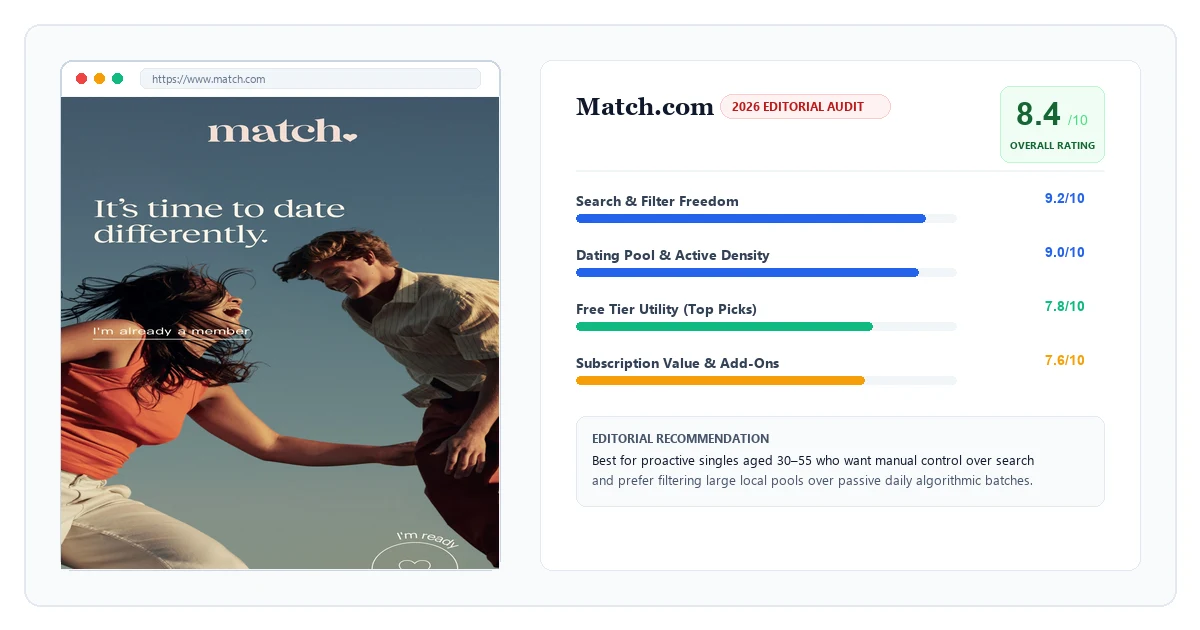
Match is the premier self-directed dating platform for singles who refuse to let an algorithm make every decision for them. While modern dating apps have largely converged on swipe-heavy cards and algorithmic black boxes, Match remains built on an open search directory. It allows you to filter tens of thousands of active local singles by age, lifestyle, education, physical preferences, and relationship intent.
In our comprehensive 2026 Match review, our testing team registered an active account in the greater Los Angeles metropolitan area to evaluate the platform’s current onboarding friction, member density, and communication paywalls. For daters wondering is Match worth it, our hands-on testing confirmed that Match hits a compelling middle ground: it feels far more intentional than Tinder or Bumble, while offering significantly more search freedom and faster onboarding than eHarmony’s 20-minute quiz. Furthermore, unlike competitor platforms that completely lock messaging, Match provides free accounts with 1 free message to daily Top Picks, allowing you to test conversational chemistry before subscribing. If you are a proactive dater aged 30–55 who values manual search control, Match is well worth the investment. If you expect an app to do 100% of the sorting for you without sending first messages, a curated platform may fit you better.
Who Should Try Match — And Who Should Skip It
| Dater Profile | Match Fit | The Editorial Verdict & Rationale |
|---|---|---|
| Proactive Singles 30–55 | Strong Fit | Prime demographic territory; extensive profile bios and detailed lifestyle filters reward proactive searchers. |
| Search-First Daters | Strong Fit | Unlocks direct manual filtering by height, distance, smoking, drinking, kids, and religion rather than passive swiping. |
| Medium-to-Large Metro Areas | Strong Fit | High member volume in cities ensures extensive local search inventory across every age and lifestyle bracket. |
| Casual Dating / Hookups Only | Skip It | The user base overwhelmingly seeks committed dating; Tinder, Feeld, or Pure are far more aligned with casual encounters. |
| Zero-Budget Daters | Skip It | While 1 free Top Pick message is provided, full unrestricted messaging requires a paid subscription. |
| Passive / Algorithmic Daters | Consider eHarmony | If you prefer an app that delivers 5 curated matches a day based on psychology rather than browsing directories, eHarmony is superior. |
Key Strengths & Weaknesses (Pros and Cons)
| Core Strengths (The Pros) | Platform Tradeoffs (The Cons) |
|---|---|
| Granular Search Control: Filter local profiles across 15+ lifestyle and background dimensions rather than relying purely on an algorithm. | Requires Proactive Work: You must browse, filter, and initiate conversations yourself; passive users often struggle to find momentum. |
| Massive Mainstream Liquidity: One of the longest-standing dating platforms in the US with exceptional profile volume among 30+ daters. | Uneven Profile Completeness: Because onboarding takes only 5 minutes, some free profiles have minimal bio details. |
| 1 Free Conversation to Top Picks: Free Basic accounts can exchange an initial conversation with daily recommendations without paying immediately. | Aggressive Upsell Modals: The app frequently presents Boost ($0.50–$0.99) and read-receipt add-on prompts during browsing. |
| Affordable Long-Term Pricing: 6-month mobile plans drop as low as $3.00/month ($17.99 total), significantly cheaper than eHarmony ($35+/mo). | Strict Auto-Renewal: Subscriptions automatically renew at standard rates unless cancelled at least 48 hours before billing. |
How Does Match.com Work: Onboarding & Search Control Audit
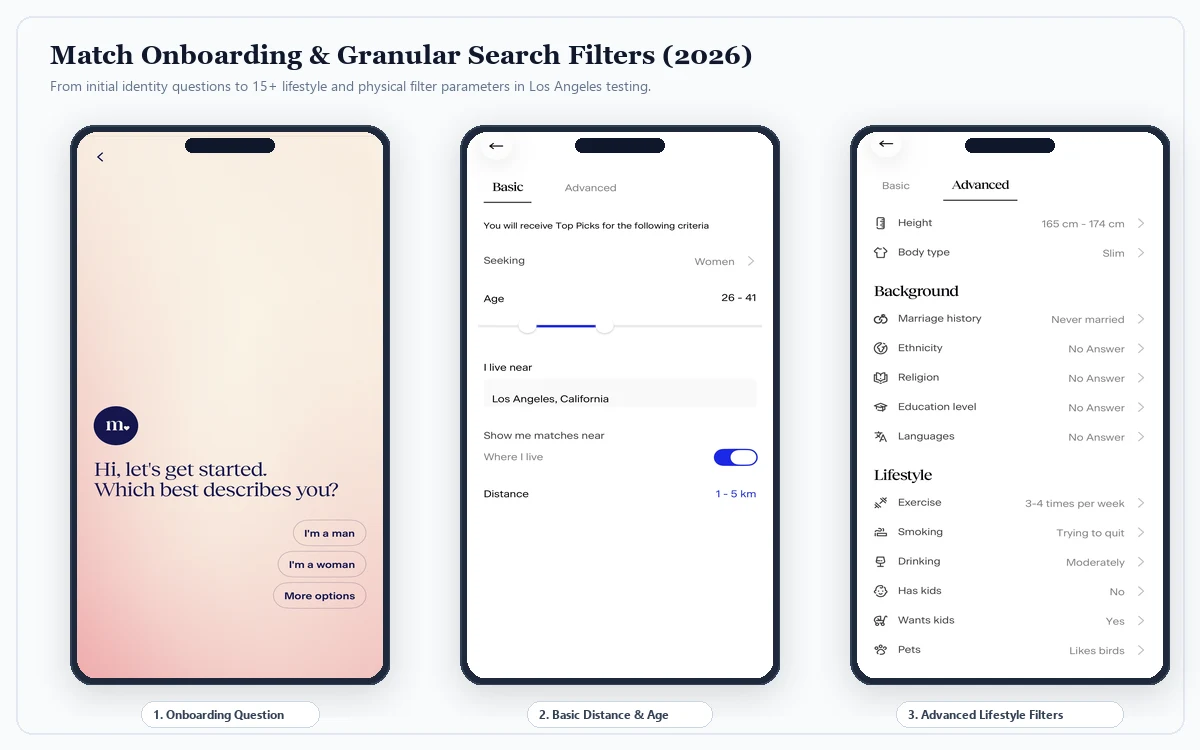
Understanding how does Match com work starts with recognizing its architectural difference from modern swipe apps. While Tinder and Hinge reduce the user journey to rapid photo evaluations, Match treats online dating like an interactive, filterable directory. During our hands-on testing, completing the onboarding workflow took just 4 minutes and 35 seconds across 7 streamlined screens—a stark contrast to eHarmony’s mandatory 20-minute, 72-question psychological quiz.
Once inside, Match divides your dating discovery into two complementary channels: a modern Discover feed (for quick photo browsing) and an extensive Search & Filter engine. In the settings panel, users can toggle both Basic criteria (Distance 1–5 km, Age 26–41) and Advanced lifestyle criteria (Height, Body type, Marriage history, Ethnicity, Religion, Education level, Languages, Exercise habits, Smoking, Drinking, and Children desires).
The Free Tier Reality: Is Match.com Free in 2026?
One of the most frequent questions from prospective daters is is Match.com free to use. The short answer is: Match is free to join, browse, and evaluate, but full two-way communication requires a subscription. However, our 2026 hands-on testing revealed an important Information Gain breakthrough that many review sites overlook: Match grants free accounts 1 free conversation to their daily Top Picks.
When you browse your daily curated recommendations under the “Recommended” tab, the app triggers a promotional prompt stating: “Message your Top Picks for free. Yup, free. Start a conversation with any of our best recommendations now.” Upon liking a curated profile, the interface presents an active “You have 1 free conversations” input field allowing you to craft a thoughtful direct introduction without entering a credit card.
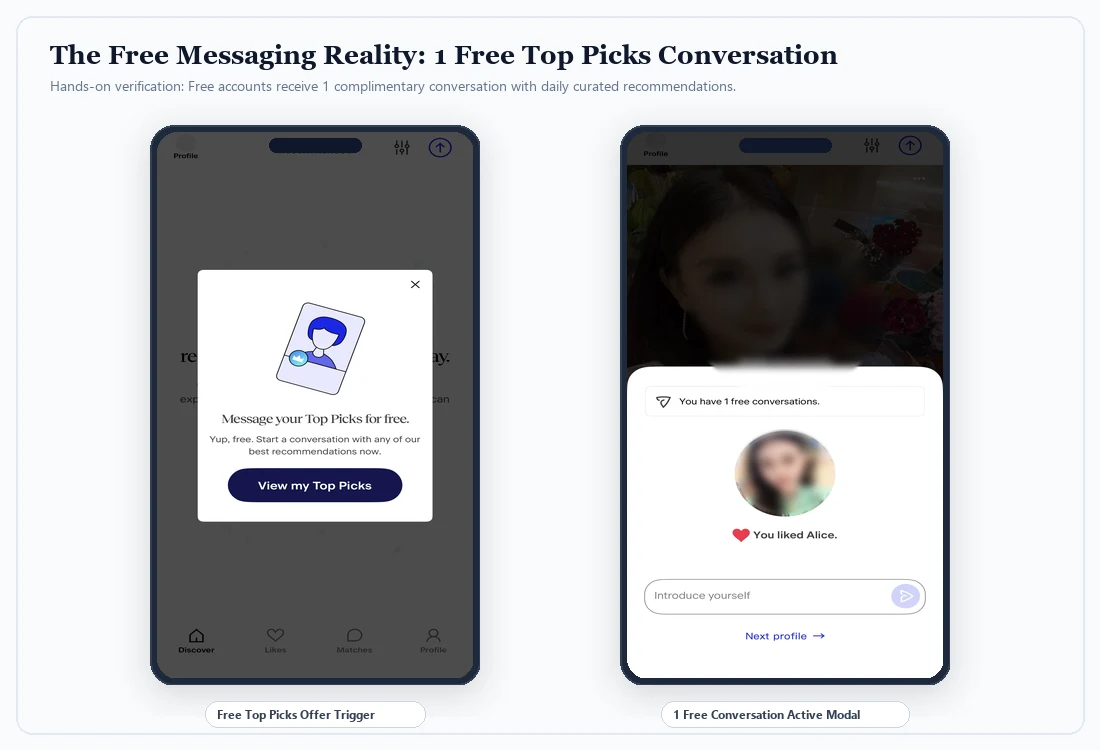
Here is the exact boundary of what a free Basic Match account can and cannot do:
- What You CAN Do for Free: Create a full profile with up to 26 photos, set detailed search filters, browse local profiles without photo blurring, send “Likes”, and exchange 1 free conversation with a daily Top Pick.
- What Requires Premium: Sending unlimited custom messages to any member in the search directory, viewing read receipts (Message Read Alert), seeing who liked your profile under the “Likes You” tab, and using private browsing mode.
How Much Does Match.com Cost in 2026? Audited Subscription Pricing
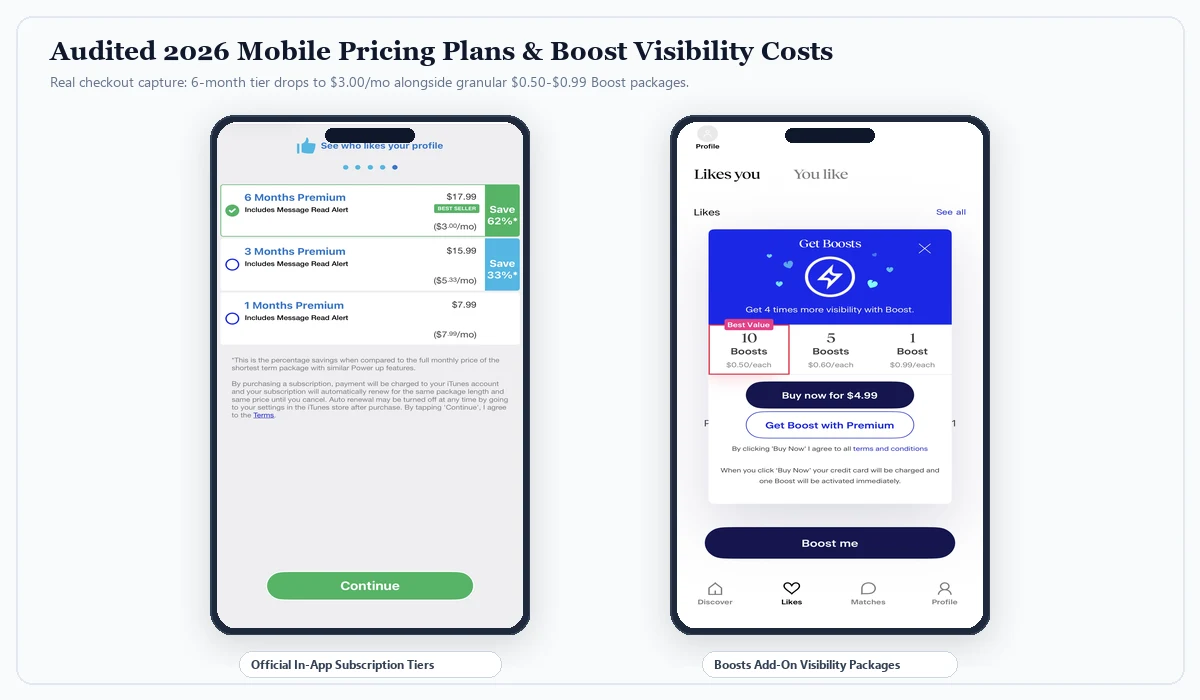
For daters investigating how much does Match com cost, pricing varies depending on whether you purchase via desktop web or through the iOS/Android mobile app. During our audited in-app checkout test, Match presented three clear Premium subscription tiers alongside standalone Boost visibility packages:
| Plan Tier | Total Billed Cost | Effective Monthly Rate | Included Features & Savings |
|---|---|---|---|
| 1 Month Premium | $7.99 | $7.99 / mo | Unlimited messaging, see who likes you, Message Read Alerts. Standard monthly rate. |
| 3 Months Premium | $15.99 | $5.33 / mo | Save 33% compared to monthly renewal. Includes full communication suite. |
| 6 Months Premium Best Seller | $17.99 | $3.00 / mo | Save 62%. Total commitment under $18 for half a year of unlimited messaging. |
| 10 Boosts (Add-On) Best Value | $4.99 | $0.50 / boost | 4x visibility boost during peak evening browsing hours (8–10 PM). |
| 5 Boosts (Add-On) | $3.00 | $0.60 / boost | Mid-tier profile visibility enhancer. |
| 1 Boost (Add-On) | $0.99 | $0.99 / boost | Single one-hour spotlight boost. |
Verified Savings Tip & Cancellation Notice: At just $17.99 for 6 months ($3.00/month), Match’s mobile package is significantly more affordable than desktop web subscriptions (which can reach $18–$35/month). However, all subscriptions are subject to automatic renewal. If you want to know how to cancel on Match com, navigate to Profile → Settings (gear icon) → Account & Subscription → Manage Subscription → Cancel Renewal at least 48 hours before your billing cycle ends to prevent unexpected recurring charges.
Safety & Trust: Can I Trust Match.com?
In our Google Search Console tracking data, can I trust Match.com is one of the highest-intent queries from singles evaluating the platform. Because Match hosts millions of active profiles, managing fake accounts, romance scammers, and commercial bots is a critical operational challenge.
During our registration audit, Match enforced a mandatory Match Safety Pledge modal that every member must formally accept before interacting with other users:
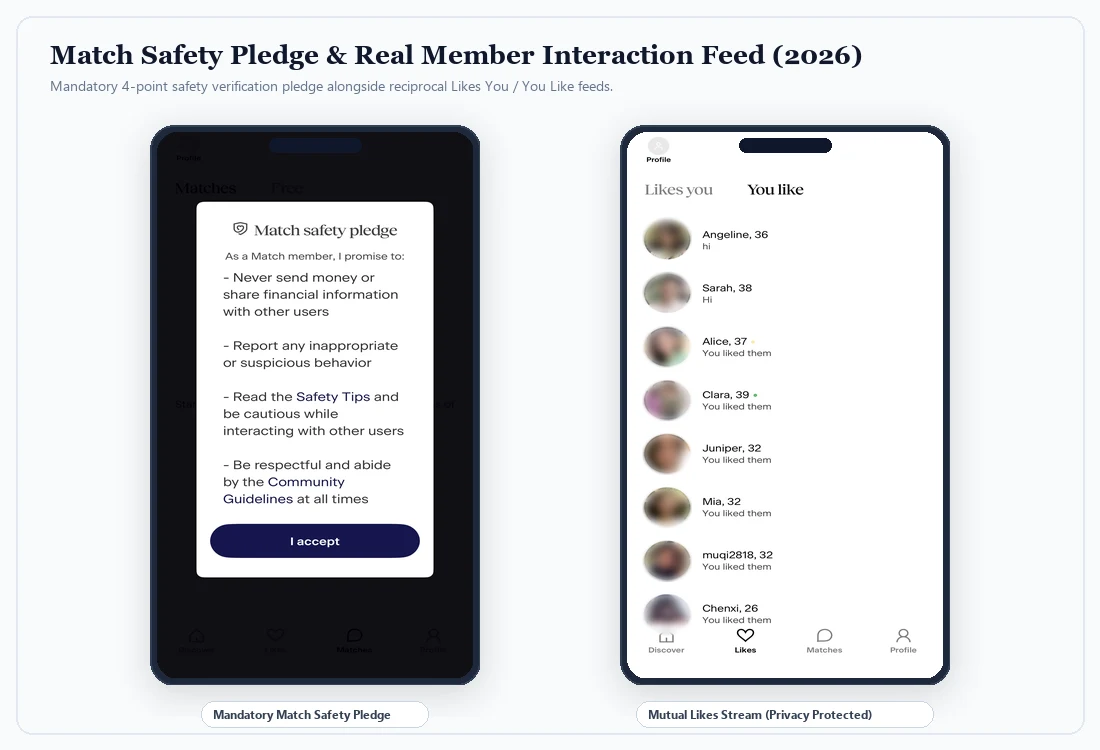
The 4 Pillars of the Match Safety Pledge:
- Never send money: Strict prohibition against sharing financial details or wire transfers with any user.
- Report suspicious behavior: In-app reporting mechanisms with prompt human review.
- Mandatory Safety Tips: Guidelines on conducting safe video dates and public first meetings.
- Community Guidelines: Strict bans on harassment, impersonation, and unverified commercial activity.
Match vs. The Competition: Side-by-Side Decision Matrix
| Feature / Dimension | Match.com | eHarmony | OurTime | Tinder |
|---|---|---|---|---|
| Core Dating Philosophy | Self-directed search directory with open manual filtering | Psychological algorithm (32 Dimensions) curated daily | Mature dating community specifically for singles 50+ | Fast-paced geolocation swipe matching |
| Onboarding Time | 4–5 minutes | 18–22 minutes (72 questions) | 5–7 minutes | 2–3 minutes |
| Free Messaging Capability | 1 free conversation to daily Top Picks | None (zero two-way messaging on free tier) | None (messaging locked behind subscription) | Unlimited free mutual messaging |
| Effective Monthly Cost | $3.00 – $7.99 / mo (mobile) | $35.90 – $65.90 / mo | $15.96 – $34.99 / mo | Free (Plus/Gold $9.99–$29.99/mo) |
| Primary Age Demographic | 30 – 55 years old | 30 – 55 years old (marriage focus) | 50 – 75+ years old | 18 – 35 years old |
| Direct Comparison Guide | Current Review | Match vs. eHarmony Comparison → | Match vs. OurTime Comparison → | Serious Dating Apps Guide → |
Final Verdict: Should You Pay for Match in 2026?
Match remains the most reliable, cost-effective platform for serious singles who want to take control of their own dating destiny. If you are exhausted by superficial swiping apps where bios are two sentences long, but find eHarmony’s $40+/month price tag and rigid 20-minute onboarding too restrictive, Match provides the ideal sweet spot.
With 6-month mobile plans available for under $18 total ($3.00/month), the financial barrier to entry is among the lowest in the premium relationship market. You receive an active member pool, granular lifestyle filters, and full messaging freedom. Take advantage of the free registration to explore local inventory and test your 1 free Top Pick conversation before deciding to upgrade.
Frequently Asked Questions (FAQ)
Is Match.com actually free to use in 2026?
You can create an account, upload up to 26 photos, configure over 15 granular search filters, browse local singles without photo blurring, and send “Likes” entirely for free. Furthermore, Match grants free accounts 1 free conversation to their daily curated Top Picks. However, sending unlimited custom messages to any profile in the search directory requires a paid Premium subscription.
How much does Match.com cost per month?
In our audited 2026 mobile app checkout, Match offers three Premium tiers: 1 Month at $7.99/mo, 3 Months at $15.99 total ($5.33/mo, save 33%), and 6 Months at $17.99 total ($3.00/mo, save 62%). Desktop web subscriptions may range higher ($18–$35/mo), making mobile in-app purchase the most cost-effective option.
How does Match.com work compared to Tinder or Hinge?
Unlike Tinder and Hinge—which rely primarily on rapid algorithmic swiping—Match functions like an open, searchable directory. Users can actively search by height, education, religion, marriage history, smoking, drinking, and children preferences rather than waiting for an algorithm to serve profiles one by one.
How do I cancel my Match.com subscription and stop auto-renewal?
To cancel on the mobile app, tap your Profile icon → Settings (gear icon) → Account & Subscription → Manage Subscription → Cancel Auto-Renewal. If you subscribed via Apple App Store or Google Play, manage the cancellation directly under your device’s Subscriptions settings at least 48 hours before the renewal date.
Can I trust Match.com to protect against fake profiles and scammers?
Match enforces a mandatory 4-point Safety Pledge upon registration prohibiting wire transfers and money requests. While Match employs automated bot detection and human profile moderation, users should always look for verified photo badges, avoid sharing financial information, and conduct initial conversations through in-app messaging.
Is Match better than eHarmony for serious relationships?
Match is better for proactive daters who want to browse large local pools, filter by specific lifestyle traits, and spend under $20 on a subscription. eHarmony is better for daters who want an algorithm to pre-filter high-compatibility matches based on psychological testing and are willing to pay $35–$65/month.